5 Bodyweight Exercises to Totally Reshape Your Body Better Than Weight Training After 50
Bodyweight training earns its place because it makes you control your own body through space. After 50, that skill pays off in strength, balance, coordination, core control, joint stability, and muscular endurance. Done well, these exercises can change how your body looks and how it moves.
Weight training is excellent, but bodyweight exercises have a different advantage: they reward clean positions and consistent effort. You can do them almost anywhere, scale them up or down, and repeat them often without needing a full gym setup. The best bodyweight moves also target large muscle groups, making every rep more productive.
When I’m coaching bodyweight work, I look for exercises that reveal control right away. Can you lower yourself smoothly? Can you stand up without shifting all over the place? Can your core hold position while your arms or legs move? Strong, repeatable, connected reps are what drive better muscle tone and body composition.
These five exercises cover the body from top to bottom: legs, glutes, chest, back, shoulders, arms, and core. Use them as a full-body routine, or plug them into your current workouts when you want a simple, effective training day.
Push-Up
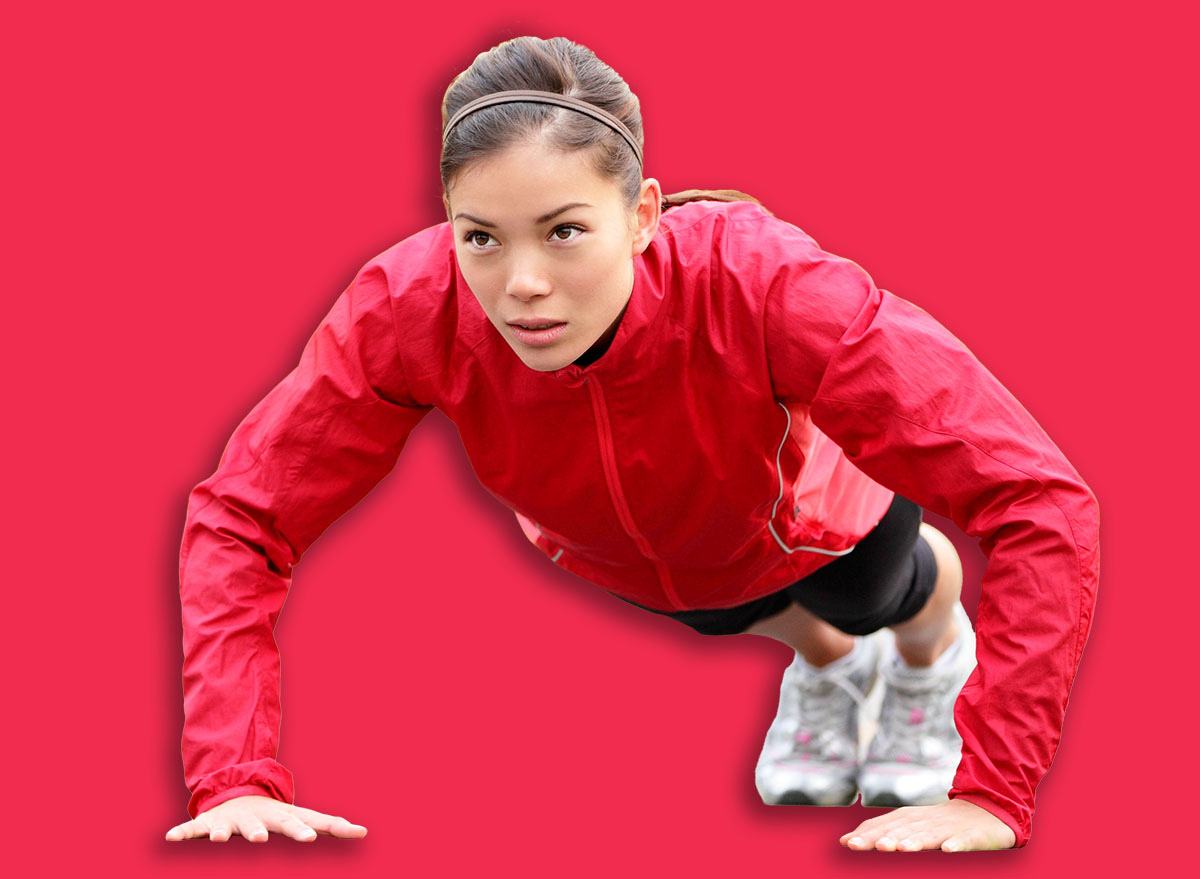
Push-ups train your chest, shoulders, triceps, core, and glutes. They’re one of the best upper-body bodyweight exercises because your arms press, your trunk braces, and your lower body has to stay locked in place. After 50, that combination builds strength you can feel when getting off the floor, pushing yourself up, carrying items, and supporting your body with your hands. Start with an incline if needed and lower the angle as your strength improves.
Muscles Trained: Chest, shoulders, triceps, core, glutes.
How to Do It:
- Place your hands on the floor, a wall, a bench, or a sturdy, elevated surface.
- Step your feet back until your body forms a straight line.
- Brace your core and squeeze your glutes.
- Lower your chest toward your hands with control.
- Bend your elbows to at least 90 degrees if your strength and shoulders allow.
- Press through your hands to return to the starting position.
Recommended Sets and Reps: Perform 3 sets of 6 to 12 reps. Rest for 45 to 60 seconds between each set.
Best Variations: Wall push-ups, incline push-ups, knee push-ups, full push-ups.
Form Tip: Keep your elbows angled slightly back and press through your whole hand.
Squat
Squats train your quads, glutes, hamstrings, hips, and core. They deserve a spot on this list because they build the lower-body strength you use all day: standing up, sitting down, climbing stairs, getting in and out of the car, and moving with more confidence. A good bodyweight squat also teaches balance and control without needing an external load. Keep your feet grounded and move through the deepest range you can own.
Muscles Trained: Quadriceps, glutes, hamstrings, hips, core.
How to Do It:
- Stand with your feet about shoulder-width apart.
- Brace your core and keep your chest lifted.
- Bend your knees and lower your hips.
- Lower until your thighs reach at least parallel, or as low as you can control.
- Press through your feet to stand tall.
- Squeeze your glutes at the top without leaning back.
Recommended Sets and Reps: Perform 3 sets of 10 to 15 reps. Rest for 45 to 60 seconds between each set.
Best Variations: Chair squats, box squats, tempo squats, pause squats.
Form Tip: Keep your knees tracking with your toes and drive through your whole foot.
Reverse Lunge
Reverse lunges train your glutes, quads, hamstrings, hips, calves, and core while giving each leg its own job. The reverse step usually feels smoother than a forward lunge, which makes it a strong choice after 50. You get lower-body strength, balance, coordination, and hip control in one exercise. Use a wall or chair for light support if needed, and focus on making each rep steady.
Muscles Trained: Glutes, quadriceps, hamstrings, hips, calves, core.
How to Do It:
- Stand tall with your feet hip-width apart.
- Brace your core and keep your chest lifted.
- Step one foot back into a lunge.
- Lower your back knee toward the floor with control.
- Press through your front foot to return to standing.
- Complete all reps, then switch sides.
Recommended Sets and Reps: Perform 3 sets of 8 to 10 reps per side. Rest for 45 to 60 seconds between each set.
Best Variations: Assisted reverse lunges, split squats, alternating reverse lunges, walking lunges.
Form Tip: Keep your front foot planted and let your front leg drive you back to standing.
Inverted Row
Inverted rows train your upper back, lats, rear shoulders, biceps, grip, and core. They’re one of the best bodyweight pulling exercises because they balance out push-ups and strengthen the muscles that support posture. A sturdy table, low bar, suspension trainer, or rings can work for this movement. Adjust your body angle to make the exercise easier or harder.
Muscles Trained: Upper back, lats, rear delts, biceps, core, grip.
How to Do It:
- Set up under a sturdy bar or suspension handles.
- Hold the bar or handles with both hands.
- Walk your feet forward until your body forms a straight line.
- Brace your core and squeeze your glutes.
- Pull your chest toward your hands.
- Lower yourself with control.
Recommended Sets and Reps: Perform 3 sets of 6 to 12 reps. Rest for 60 seconds between each set.
Best Variations: Higher-angle inverted rows, bent-knee inverted rows, paused rows, towel rows.
Form Tip: Pull through your elbows and keep your body straight from shoulders to heels.
Plank With Shoulder Taps
Planks with shoulder taps train your abs, obliques, shoulders, chest, glutes, and deep core. The shoulder tap adds movement, so your core has to resist twisting and rocking. That makes it more useful than simply holding still for a long time. This exercise helps reshape your midsection by improving bracing strength, posture, and shoulder control, while keeping your whole body active.
Muscles Trained: Abs, obliques, deep core, shoulders, chest, glutes.
How to Do It:
- Start in a high plank with your hands under your shoulders.
- Step your feet wider than hip-width apart.
- Brace your core and squeeze your glutes.
- Lift one hand and tap the opposite shoulder.
- Place your hand back down with control.
- Alternate sides while keeping your hips steady.
Recommended Sets and Reps: Perform 3 sets of 8 to 12 taps per side. Rest for 30 to 45 seconds between each set.
Best Variations: Incline shoulder taps, knee plank shoulder taps, slower shoulder taps, and standard high plank holds.
Form Tip: Keep your hips quiet and move your hand slowly.
How to Reshape Your Body With Bodyweight Training After 50
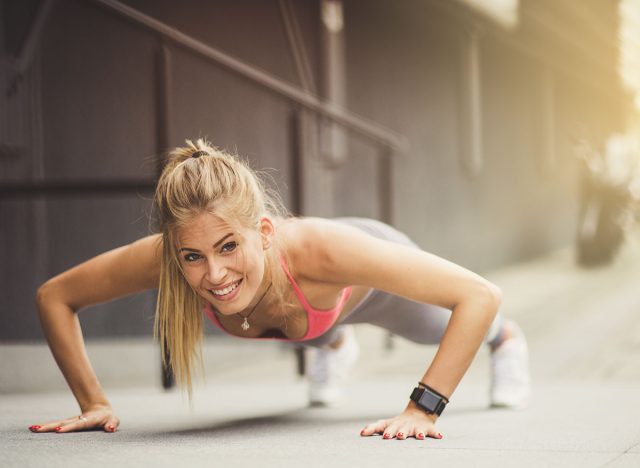
Bodyweight training works best when you treat it like real strength work. Choose variations that challenge you, control the lowering phase, and make the final reps feel meaningful. The goal is to build muscle, improve movement quality, and raise your total daily activity without needing a full gym plan.
- Train the main patterns: Push, squat, lunge, pull, and brace. These movements target the largest muscles and provide your body with a complete training signal.
- Use the right variation: Inclines, chairs, walls, and sturdy supports help you scale each exercise. The right version should feel challenging while still letting you move well.
- Slow down the reps: A controlled lowering phase builds more tension and makes bodyweight exercises feel much harder.
- Turn it into a circuit: Perform one set of each exercise, rest 60 to 90 seconds, and repeat for 2 to 4 rounds. This adds a conditioning effect while keeping the focus on strength.
- Progress weekly: Add reps, reduce assistance, increase range of motion, slow the tempo, or add pauses as your body adapts.
The best bodyweight exercises make your whole body work together. Push, squat, lunge, pull, and brace with control, and you’ll build strength, muscle tone, and movement confidence that carries well beyond the workout.
References
- Archila LR, Bostad W, Joyner MJ, Gibala MJ. Simple Bodyweight Training Improves Cardiorespiratory Fitness with Minimal Time Commitment: A Contemporary Application of the 5BX Approach. Int J Exerc Sci. 2021 Apr 1;14(3):93-100. doi: 10.70252/WEQD2681. PMID: 34055156; PMCID: PMC8136567.
- Delaire L, Courtay-Breuil A, Humblot J, Vidal H, Bonnefoy M, Meugnier E. Influence of Resistance Training Variables to Improve Muscle Mass Outcomes in Sarcopenia: A Systematic Review With Meta-Regressions. J Cachexia Sarcopenia Muscle. 2025 Dec;16(6):e70162. doi: 10.1002/jcsm.70162. PMID: 41365305; PMCID: PMC12688407.