6 Bodyweight Moves That Sculpt Your Body Faster Than the Gym After 60
A sculpted body after 60 comes from muscles that are still asked to work hard. Bodyweight training can do that surprisingly well because every rep uses your own body as resistance. You press, lower, brace, step, bridge, row, and stabilize without needing a machine to guide the movement for you.
The gym is great for loading muscles directly, but bodyweight training has a different advantage: it makes strength feel athletic and connected. Your arms work while your core holds position. Your legs train while your hips stabilize. Your shoulders, glutes, and abs stay active through movements that feel more lifelike than sitting on a machine.
This style of training also rewards control. A slow split squat, a crisp incline push-up, a strong bridge hold, and a steady plank row can create a serious muscle-building signal when the reps are clean. After 60, that combination of tension, balance, range of motion, and repeatability can help your body look firmer and feel more capable.
Use these six bodyweight moves as a simple sculpting routine two to four times per week. Keep the pace steady, make the final reps challenging, and choose variations that let you move with confidence from start to finish.
Close-Grip Incline Push-Up
Close-grip incline push-ups target your chest, shoulders, triceps, and core, with extra emphasis on the backs of your upper arms. The incline keeps the movement approachable, while the closer hand position makes your triceps work harder to finish each rep. This move helps sculpt the upper body by training pressing strength, arm firmness, and core control simultaneously. Use a wall, counter, bench, or sturdy table, depending on your current strength.
Muscles Trained: Chest, shoulders, triceps, core.
How to Do It:
- Place your hands on a sturdy, elevated surface slightly inside shoulder width.
- Step your feet back until your body forms a straight line.
- Brace your core and squeeze your glutes.
- Bend your elbows and lower your chest toward your hands.
- Press through your palms to return to the starting position.
- Repeat while keeping your elbows close to your sides.
Recommended Sets and Reps: Perform 3 sets of 8 to 12 reps. Rest for 45 to 60 seconds between each set.
Best Variations: Wall close-grip push-ups, counter close-grip push-ups, standard incline push-ups.
Form Tip: Keep your elbows angled back and press through your whole hand.
Split Squat
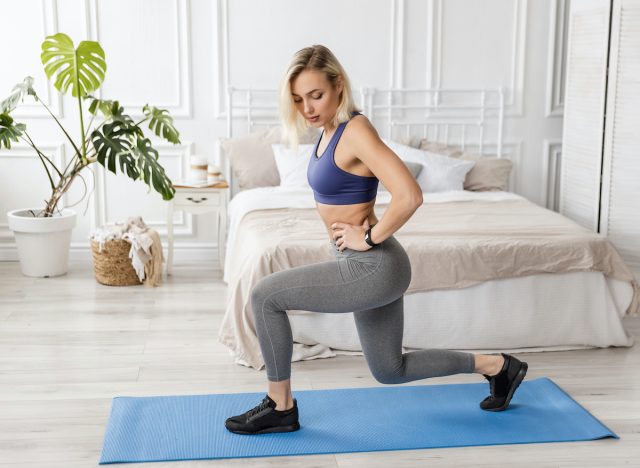
Split squats train your quads, glutes, hamstrings, hips, and core while giving each leg direct work. The stationary setup makes it easier to control than walking lunges, and the constant tension helps your legs feel strong quickly. This move helps sculpt the lower body by building muscle through the thighs and glutes while also improving balance and hip control. Use a wall or chair for light support if needed.
Muscles Trained: Quadriceps, glutes, hamstrings, hips, core.
How to Do It:
- Stand tall with one foot forward and one foot behind you.
- Keep your feet about hip-width apart for balance.
- Brace your core and keep your chest lifted.
- Bend both knees and lower straight down.
- Press through your front foot to return to standing.
- Complete all reps, then switch sides.
Recommended Sets and Reps: Perform 3 sets of 8 to 10 reps per side. Rest for 45 to 60 seconds between each set.
Best Variations: Assisted split squats, shorter-range split squats, tempo split squats.
Form Tip: Keep your front foot grounded and lower with control.
Glute Bridge
Glute bridges train your glutes, hamstrings, hips, lower back, and core. They’re simple, but they give the backside of your body a focused strength-building signal. Stronger glutes can help your hips look firmer, support your lower back, and make walking, stairs, and standing feel more powerful. Pause at the top of each rep to make the muscles work harder.
Muscles Trained: Glutes, hamstrings, hips, lower back, core.
How to Do It:
- Lie on your back with your knees bent and your feet flat on the floor.
- Place your arms by your sides.
- Brace your core and press through your heels.
- Lift your hips until your body forms a straight line from shoulders to knees.
- Squeeze your glutes at the top.
- Lower your hips with control.
Recommended Sets and Reps: Perform 3 sets of 12 to 15 reps. Rest for 30 to 45 seconds between each set.
Best Variations: Glute bridge holds, single-leg glute bridges, glute bridge walkouts.
Form Tip: Press through your heels and keep your ribs down as your hips lift.
Mountain Climbers
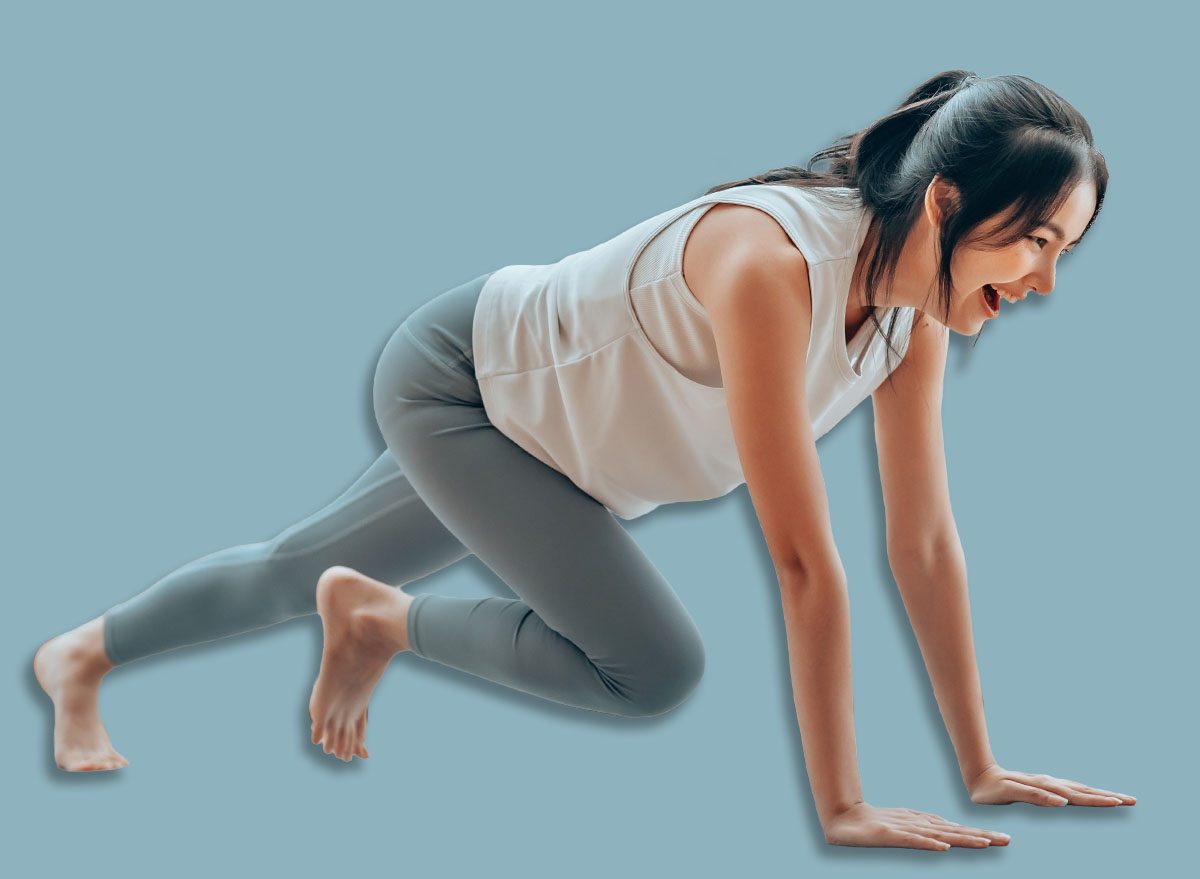
Mountain climbers train your abs, shoulders, hip flexors, glutes, and legs while adding a conditioning effect. Your core has to hold your plank position while your knees drive forward, which makes the movement active from head to toe. This move helps sculpt your body by pairing core work with a faster pace, increasing the session’s intensity. Start slow, then build speed as your control improves.
Muscles Trained: Abs, hip flexors, shoulders, glutes, quadriceps, core.
How to Do It:
- Start in a high plank with your hands under your shoulders.
- Brace your core and squeeze your glutes.
- Drive one knee toward your chest.
- Step that foot back to the starting position.
- Drive the opposite knee toward your chest.
- Continue alternating with steady control.
Recommended Sets and Reps: Perform 3 sets of 20 to 40 seconds. Rest for 30 to 45 seconds between each set.
Best Variations: Slow mountain climbers, incline mountain climbers, cross-body mountain climbers.
Form Tip: Keep your hips level and move your knees without bouncing through your lower back.
Bodyweight Renegade Rows
Bodyweight renegade rows train your abs, obliques, shoulders, chest, upper back, and glutes. Instead of rowing a dumbbell, you hold a strong plank and lift one hand at a time in a rowing motion. That small lift forces your core to resist rotation while your shoulders and upper back stay active. This is a strong sculpting move because it builds posture, core stability, and upper-body control in one floor exercise.
Muscles Trained: Abs, obliques, shoulders, upper back, chest, glutes.
How to Do It:
- Start in a high plank with your hands under your shoulders.
- Step your feet wider than hip-width apart.
- Brace your core and squeeze your glutes.
- Lift one hand off the floor and pull your elbow toward your ribs.
- Place your hand back down with control.
- Alternate sides while keeping your hips steady.
Recommended Sets and Reps: Perform 3 sets of 8 to 10 reps per side. Rest for 30 to 45 seconds between each set.
Best Variations: Incline bodyweight renegade rows, knee plank rows, slower plank rows.
Form Tip: Keep your hips quiet and pull your elbow back without twisting your torso.
Chair Dips
Chair dips train your triceps, shoulders, chest, and core. The backs of your upper arms get direct work as you bend and straighten your elbows, making this move useful for sculpting your arms after 60. Keep the range comfortable, use a sturdy chair, and let your legs help control the difficulty. A small, smooth range works well when you keep constant tension on the triceps.
Muscles Trained: Triceps, shoulders, chest, core.
How to Do It:
- Sit on the edge of a sturdy chair with your hands beside your hips.
- Walk your feet forward and slide your hips just off the chair.
- Brace your core and keep your chest lifted.
- Bend your elbows to lower your body a few inches.
- Press through your hands to straighten your arms.
- Repeat with slow, controlled reps.
Recommended Sets and Reps: Perform 3 sets of 8 to 10 reps. Rest for 45 seconds between each set.
Best Variations: Short-range chair dips, bent-knee chair dips, slower tempo chair dips.
Form Tip: Keep your shoulders down and bend through your elbows instead of dropping your hips straight down.
How to Sculpt Your Body With Bodyweight Training After 60
Bodyweight training works best when each rep creates real tension. Move slowly enough to feel the right muscles working, use full ranges you can control, and keep the final reps challenging. The goal is to train muscle strength, posture, balance, and core control in a single routine.
- Use upper-body pushing and pulling exercises: Close-grip incline push-ups, chair dips, and bodyweight renegade rows target your chest, shoulders, arms, upper back, and core.
- Build the lower body: Split squats and glute bridges train your legs and backside with enough tension to support a firmer look.
- Add conditioning: Mountain climbers raise your heart rate while keeping your core active, which helps the routine feel more complete.
- Control the tempo: Slow lowering phases, brief pauses, and clean reps make bodyweight exercises more effective.
- Repeat the routine consistently: Perform this workout two to four times per week, or use a few moves daily as short strength breaks.
A sculpted body after 60 comes from steady effort and strong movement. Press, dip, bridge, climb, row, and squat with control, and your body gets the consistent strength signal it needs to look firmer and move better.
References
- Briand M, Raffin J, Gonzalez-Bautista E, Ritz P, Abellan Van Kan G, Pillard F, Faruch-Bilfeld M, Guyonnet S, Dray C, Vellas B, de Souto Barreto P, Rolland Y. Body composition and aging: cross-sectional results from the INSPIRE study in people 20 to 93 years old. Geroscience. 2025 Feb;47(1):863-875. doi: 10.1007/s11357-024-01245-6. Epub 2024 Jul 19. PMID: 39028455; PMCID: PMC11872965.
- Archila LR, Bostad W, Joyner MJ, Gibala MJ. Simple Bodyweight Training Improves Cardiorespiratory Fitness with Minimal Time Commitment: A Contemporary Application of the 5BX Approach. Int J Exerc Sci. 2021 Apr 1;14(3):93-100. doi: 10.70252/WEQD2681. PMID: 34055156; PMCID: PMC8136567.