6 Standing Arm Exercises That Tighten Sagging Arms in 30 Days After 60
Sagging arms usually refers to the softer area around the upper arms, but the better training goal is simple: build stronger biceps, triceps, shoulders, and upper-back support. When those muscles get consistent resistance, your arms can start feeling firmer, more capable, and better shaped. 30 days is enough time to build momentum, improve tone, and notice changes in strength when the routine is done with purpose.
Standing arm exercises work well because they turn arm training into more than just curls and extensions. Your legs stay active, your core helps stabilize your body, and your shoulders learn to control the movement while your arms do the work. A good plan should include compound exercises first, then isolation work to target the biceps, triceps, and shoulders more directly.
For this type of routine, I’d coach the compound moves like your foundation and the isolation moves like your finishing work. Stand tall, keep your ribs stacked over your hips, and make the weight move because your muscles are working, not momentum. That small detail changes the whole session. The reps feel cleaner, the arms stay under tension longer, and the workout feels more focused.
Use these six standing exercises for the next 30 days, two to four times per week. Start with the compound moves, then finish with the isolation exercises. Choose a weight or band tension that lets you move well while making the final few reps feel challenging.
Dumbbell Push Press
The dumbbell push press targets your shoulders, triceps, upper chest, core, and legs in a single powerful standing movement. A small leg drive helps you press the weights overhead, while your arms and shoulders finish the rep with control. This makes it a strong compound exercise for tightening the upper arms because it trains pressing strength and shoulder shape together. Keep the dip small and finish each rep with your arms strong overhead.
Muscles Trained: Shoulders, triceps, upper chest, core, legs.
How to Do It:
- Stand tall with your feet hip-width apart.
- Hold a dumbbell in each hand at shoulder height.
- Brace your core and bend your knees slightly.
- Drive through your legs as you press the dumbbells overhead.
- Straighten your arms at the top without shrugging.
- Lower the dumbbells back to your shoulders with control.
Recommended Sets and Reps: Perform 3 sets of 8 to 10 reps. Rest for 60 seconds between each set.
Best Variations: Single-arm push press, strict dumbbell shoulder press, band overhead press.
Form Tip: Use your legs to start the press, then let your shoulders and triceps finish the movement.
Dumbbell Bent-Over Row
Dumbbell bent-over rows train your upper back, lats, rear shoulders, biceps, grip, and core. The pulling motion gives your biceps strong compound work while your upper back helps support better posture and shoulder position. Stronger posture muscles can make the arms look more lifted and supported, and the dumbbells add a clear strength-building challenge. Keep your hinge steady and row with control, rather than rushing the reps.
Muscles Trained: Upper back, lats, rear delts, biceps, core, grip.
How to Do It:
- Stand with your feet hip-width apart and hold a dumbbell in each hand.
- Soften your knees and hinge your hips back.
- Keep your spine long and brace your core.
- Let the dumbbells hang below your shoulders.
- Pull your elbows back toward your ribs.
- Lower the dumbbells with control.
Recommended Sets and Reps: Perform 3 sets of 8 to 12 reps. Rest for 45 to 60 seconds between each set.
Best Variations: Single-arm dumbbell rows, supported dumbbell rows, paused bent-over rows.
Form Tip: Keep your torso steady and pull through your elbows.
Dumbbell Curl to Press
The dumbbell curl-to-press trains your biceps, shoulders, triceps, and core. The curl targets your biceps directly, and the press engages your shoulders and triceps. Combining both movements keeps the routine efficient and gives your arms more total time under tension. Move smoothly from the curl into the press, then lower with control so the muscles stay active through the full rep.
Muscles Trained: Biceps, shoulders, triceps, core.
How to Do It:
- Stand tall with a dumbbell in each hand at your sides.
- Brace your core and keep your elbows near your ribs.
- Curl the dumbbells to shoulder height.
- Press the dumbbells overhead.
- Lower the dumbbells back to your shoulders.
- Return the weights to your sides with control.
Recommended Sets and Reps: Perform 3 sets of 8 to 10 reps. Rest for 60 seconds between each set.
Best Variations: Alternating curl to press, single-arm curl to press, band curl to press.
Form Tip: Keep your torso still during the curl and press the weights overhead without leaning back.
Dumbbell Biceps Curl
Dumbbell biceps curls give the front of your upper arms direct attention. After the compound pulling work, curls help finish the biceps with a clear, focused strength signal. Stronger biceps support lifting, carrying, pulling, and everyday tasks that require grip and elbow strength. Keep your elbows steady and control the lowering phase to make each rep more effective.
Muscles Trained: Biceps, forearms, grip.
How to Do It:
- Stand tall with a dumbbell in each hand.
- Keep your palms facing forward and your elbows near your sides.
- Brace your core and keep your shoulders relaxed.
- Curl the dumbbells toward your shoulders.
- Squeeze your biceps at the top.
- Lower the dumbbells with control.
Recommended Sets and Reps: Perform 3 sets of 10 to 12 reps. Rest for 30 to 45 seconds between each set.
Best Variations: Hammer curls, alternating curls, band curls.
Form Tip: Keep your elbows still and make the biceps lift the weight.
Band Triceps Pressdown
Band triceps pressdowns train the back of the upper arms, where many people notice sagging most. The band keeps tension on the triceps as you straighten your elbows, making the exercise simple and effective at home. Stronger triceps help your arms look firmer and also support pressing movements, getting up from chairs, and pushing tasks. Keep your upper arms pinned by your sides and finish each rep with a strong squeeze.
Muscles Trained: Triceps, shoulders, core.
How to Do It:
- Anchor a resistance band above chest height.
- Stand tall and hold one end of the band in each hand.
- Bend your elbows and keep them close to your sides.
- Brace your core and keep your chest lifted.
- Press your hands down until your arms straighten.
- Return to the starting position with control.
Recommended Sets and Reps: Perform 3 sets of 12 to 15 reps. Rest for 30 to 45 seconds between each set.
Best Variations: Single-arm pressdowns, overhead band triceps extensions, paused pressdowns.
Form Tip: Keep your elbows close to your ribs and squeeze the back of your arms at the bottom.
Dumbbell Lateral Raise
Dumbbell lateral raises target the shoulders, especially the side delts. Stronger shoulders help create more shape around the upper arms, making them look tighter and more defined. This is an isolation exercise, so light weights and clean reps work best. Raise the dumbbells with control, pause near shoulder height, and lower slowly.
Muscles Trained: Shoulders, side delts, core.
How to Do It:
- Stand tall with a light dumbbell in each hand.
- Keep your arms at your sides with a slight bend in your elbows.
- Brace your core and keep your shoulders relaxed.
- Raise the dumbbells out to your sides.
- Stop when your arms reach shoulder height.
- Lower the dumbbells with control.
Recommended Sets and Reps: Perform 3 sets of 10 to 15 reps. Rest for 30 to 45 seconds between each set.
Best Variations: Single-arm lateral raises, band lateral raises, slower tempo lateral raises.
Form Tip: Lead with your elbows and keep the movement smooth, rather than swinging the weights.
How to Tighten Sagging Arms in 30 Days After 60
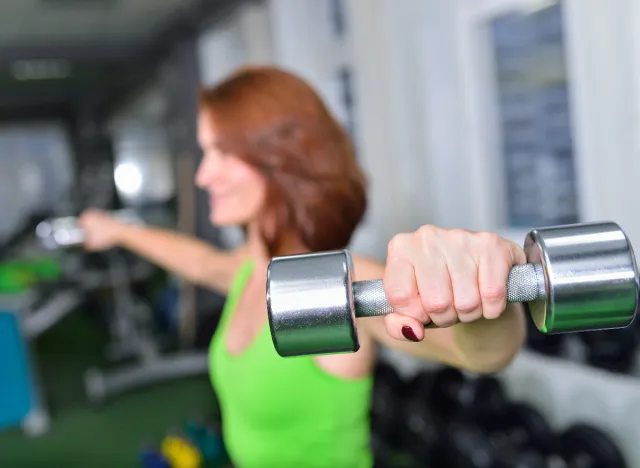
A 30-day arm plan works best when you train the arms directly while also using compound moves that involve more muscle. Start with the three compound exercises to build strength through the shoulders, upper back, biceps, and triceps. Then use the isolation exercises to give each key area extra work.
- Train arms two to four days per week: Give your arms consistent work while allowing enough recovery between sessions. Most people do well with a day between harder arm workouts.
- Start with compound exercises: Push presses, rows, and curl-to-press reps train multiple muscles at once. These movements increase overall effort and prepare your arms for isolation work.
- Finish with isolation exercises: Curls, press-downs, and lateral raises provide more direct tension to the biceps, triceps, and shoulders. These are the exercises where clean reps and a strong squeeze matter most.
- Make the final reps challenging: Choose weights or band tension that make the last two or three reps feel meaningful while your form stays solid.
- Support the visual changes: Daily walking, protein-focused meals, hydration, and consistent sleep all help your strength work show up more clearly.
Thirty days gives you enough time to build consistency and feel stronger in your upper body. Press, pull, curl, extend, and raise with control, and your arms will have a clear reason to feel firmer and look more supported.
References
- Ikezoe T. Age-Related Change in Muscle Characteristics and Resistance Training for Older Adults. Phys Ther Res. 2020 Dec 4;23(2):99-105. doi: 10.1298/ptr.R0009. PMID: 33489646; PMCID: PMC7814211.
- Brigatto FA, DE Camargo JBB, DE Ungaro WF, Germano MD, Marchetti PH, Aoki MS, Braz TV, Lopes CR. Multi-joint vs. Single-joint Resistance Exercises Induce a Similar Strength Increase in Trained Men: A Randomized Longitudinal Crossover Study. Int J Exerc Sci. 2020 Dec 1;13(4):1677-1690. doi: 10.70252/LLHU2255. PMID: 33414877; PMCID: PMC7745915.