4 Chair Exercises That Restore Glute Strength Faster Than Squats After 60
Glute strength plays a bigger role after 60 than most people give it credit for. Strong glutes help power your stride, support your hips, protect your lower back, and make it easier to stand up from a seated position without rocking or pushing off with your hands. When they lose strength, walking can feel flatter, stairs take more effort, and your hips may not feel as steady during daily movement.
Squats can help, but they’re not always the easiest starting point. They require enough mobility, balance, and confidence to move through the full pattern well. Chair exercises lower the entry point and let you focus on the muscles doing the work. For many people I’ve coached, that makes a huge difference. Once someone can press through their feet, squeeze their glutes, and control the movement from a supported position, strength starts coming back quickly.
The four exercises below train the glutes from different angles. Sit-to-stands build real-world strength from the chair. Chair-supported hip extensions target the backside directly. Banded abductions wake up the outer glutes and hip stabilizers. Chair reverse planks train hip extension and postural strength simultaneously. Use them consistently, keep the reps clean, and give your glutes a steady reason to get stronger.
Sit-to-Stands
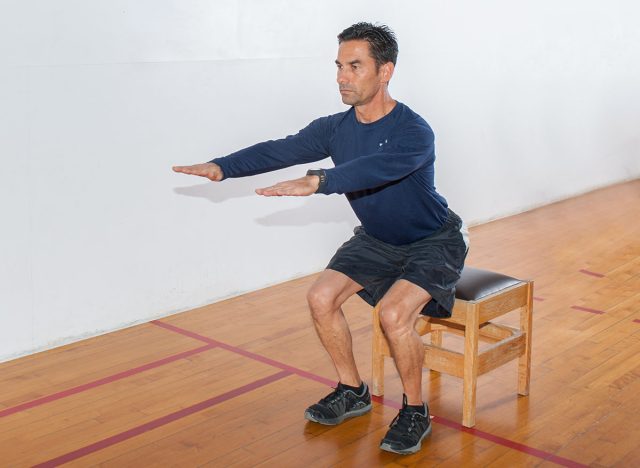
Sit-to-stands train your glutes, quads, hamstrings, and core while practicing one of the most important movements after 60. Every rep asks your hips and legs to create force from a seated position, which carries straight into getting off the couch, standing up from the car, or rising from a dining chair. Compared with squats, the chair gives you a clear target and helps you control depth without guessing. When you press through your feet and squeeze your glutes at the top, the movement becomes a strong glute-builder instead of just a basic up-and-down drill.
Muscles Trained: Glutes, quadriceps, hamstrings, core
How to Do It:
- Sit near the front edge of a sturdy chair.
- Place your feet flat on the floor about hip-width apart.
- Brace your core and lean your torso slightly forward.
- Press through your feet to stand tall.
- Squeeze your glutes at the top.
- Lower back to the chair with control.
Recommended Sets and Reps: Perform 3 sets of 8 to 12 reps. Rest for 45 seconds between each set.
Best Variations: No-hands sit-to-stands, slow tempo sit-to-stands, paused sit-to-stands
Form Tip: Press through your whole foot and avoid dropping into the chair.
Chair-Supported Hip Extensions
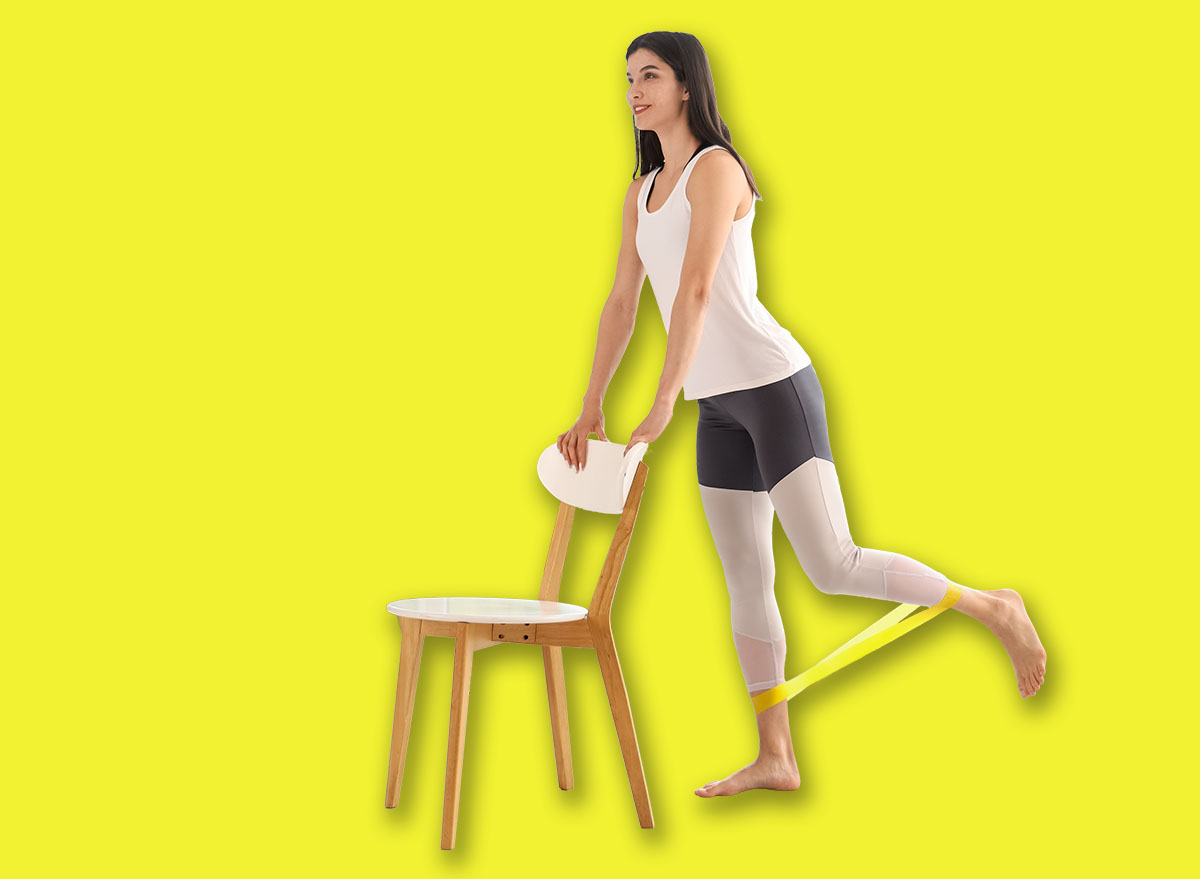
Chair-supported hip extensions train your glutes directly without putting much load on your knees. The chair gives you balance support while your working leg moves behind you. Your glute has to extend the hip, which is one of its main jobs during walking, climbing stairs, and standing tall. This move works well for rebuilding strength because it teaches the glute to fire without letting your lower back take over.
Muscles Trained: Glutes, hamstrings, core
How to Do It:
- Stand behind a sturdy chair and place your hands lightly on the backrest.
- Shift your weight into one foot.
- Brace your core and stand tall.
- Extend your opposite leg straight behind you.
- Squeeze your glute at the top of the movement.
- Lower your foot back to the floor with control.
Recommended Sets and Reps: Perform 3 sets of 10 to 12 reps per side. Rest for 30 to 45 seconds between each set.
Best Variations: Banded hip extensions, paused hip extensions, slower tempo hip extensions
Form Tip: Keep your ribs down and lift from your glute instead of arching your back.
Seated Banded Hip Abductions
Seated banded hip abductions train the outer glutes, which help keep your hips and knees steady when you walk, stand, or shift direction. These muscles often get overlooked, yet they play a major role in balance and hip control. Pressing your knees outward against the band adds direct resistance where many people need it most. Stronger outer glutes help your lower body move more cleanly and make squats, lunges, stairs, and walking feel more stable.
Muscles Trained: Outer glutes, hip stabilizers, core
How to Do It:
- Sit tall near the front edge of a sturdy chair.
- Place a mini band around your thighs just above your knees.
- Plant your feet flat on the floor.
- Brace your core and keep your chest lifted.
- Press your knees outward against the band.
- Return your knees inward with control.
Recommended Sets and Reps: Perform 3 sets of 12 to 15 reps. Rest for 30 seconds between each set.
Best Variations: Paused abductions, pulsing abductions, single-leg abductions
Form Tip: Keep your feet planted and move from your hips.
Chair Reverse Plank
Chair reverse planks train your glutes, hamstrings, core, and upper back while teaching your hips to stay extended. That hip extension piece matters because sitting can leave the glutes undertrained and the front of the hips tight. Pressing your hips up and holding the position gives your glutes steady tension without needing a deep squat pattern. The exercise also helps reinforce posture, which supports better walking mechanics and a stronger, more confident stance.
Muscles Trained: Glutes, hamstrings, core, upper back
How to Do It:
- Sit near the front edge of a sturdy chair.
- Place your hands on the sides of the seat.
- Walk your feet forward until your legs extend comfortably.
- Press through your heels and lift your hips off the chair.
- Squeeze your glutes and hold your body in a straight line.
- Lower your hips back to the chair with control.
Recommended Sets and Reps: Perform 3 sets of 15 to 25 second holds. Rest for 45 seconds between each set.
Best Variations: Bent-knee reverse plank, longer holds, alternating heel lift hold
Form Tip: Squeeze your glutes and keep your chest open.
How to Rebuild Glute Strength From a Chair
Chair exercises work best when each rep has intention behind it. The chair adds support, but your glutes still need to create tension, control the movement, and finish each rep with purpose. Treat these movements as strength work rather than easy mobility drills. A few focused sessions each week can make walking, standing, and stair climbing feel stronger and more controlled.
- Drive through your heels: Pressing through your heels helps shift more work into your glutes during sit-to-stands, hip extensions, and reverse planks. Keep your feet planted and avoid pushing only through your toes.
- Add pauses at the strongest positions: Hold the top of a hip extension, sit-to-stand, or reverse plank for a second or two. Pauses help your glutes stay under tension longer without adding extra weight.
- Keep your pelvis steady: Glute exercises lose their punch when your lower back arches or your hips twist. Brace lightly through your core and keep your ribs stacked over your hips.
- Train the outer glutes too: Banded abductions help strengthen the muscles that keep your hips stable. That stability supports walking, stairs, balance, and cleaner lower-body movement.
- Progress gradually: Add reps, hold longer, use a stronger band, or slow the tempo when the exercises start to feel easy. Small changes keep your glutes improving without making the routine hard to stick with.
References
- Inacio, Mario et al. “Gluteal muscle composition differentiates fallers from non-fallers in community dwelling older adults.” BMC geriatrics vol. 14 37. 25 Mar. 2014, doi:10.1186/1471-2318-14-37
- Klempel, Natalie et al. “The Effect of Chair-Based Exercise on Physical Function in Older Adults: A Systematic Review and Meta-Analysis.” International journal of environmental research and public health vol. 18,4 1902. 16 Feb. 2021, doi:10.3390/ijerph18041902