7 Simple Exercises To Shrink Hanging Belly Pooch Better Than HIIT Workouts After 60
A hanging belly pooch can be frustrating because it sits low, changes how your waistline looks, and often feels like the last place to tighten up. After 60, it can become more noticeable as muscle mass declines, daily activity slows, and overall body fat becomes harder to manage. Hormonal shifts, years of inconsistent strength work, and long stretches of sitting can all play a role, but the main target stays the same: improve body composition through steady movement, smart nutrition, and strength work you can actually repeat.
Spot reduction sounds nice, but it doesn’t work the way most people hope. You can’t pick the lower belly and force fat to leave from that exact spot with one “magic” exercise. Fat loss comes from burning more calories than you take in over time. Strength training helps by building lean muscle, which can make your body look firmer as overall body fat drops.
I’ve seen plenty of clients make better progress once they stop trying to crush every workout and start stacking consistent, lower-stress movement. HIIT has its place, but it can feel rough on the joints, recovery, and motivation after 60. Simple exercises can still challenge your core, legs, hips, and upper body while keeping the barrier to entry low. The seven moves below help train your midsection, support calorie burn, build lean muscle, and give your body a better reason to change without turning every session into a beatdown.
Incline Mountain Climbers
Incline mountain climbers train your core, shoulders, hip flexors, and legs while keeping the movement more joint-friendly than floor-based climbers. Elevating your hands makes the position easier to control, but your midsection still has to brace as your knees drive forward. This helps shrink a hanging belly pooch from the right angle: more total-body effort, better core control, and a steady heart-rate bump without the chaos of HIIT. Keep the pace controlled and make your abs hold your hips steady.
Muscles Trained: Core, shoulders, hip flexors, quads
How to Do It:
- Place your hands on a bench, counter, or sturdy elevated surface.
- Step your feet back into a plank position.
- Brace your core and keep your hips level.
- Drive one knee toward your chest.
- Return your foot to the starting position.
- Alternate legs with steady control.
Recommended Sets and Reps: Perform 3 sets of 30 to 45 seconds. Rest for 30 seconds between each set.
Best Variations: Slow incline climbers, cross-body incline climbers, higher incline climbers
Form Tip: Keep your hips quiet and avoid bouncing through the reps.
Dead Bugs
Dead bugs train your lower abs and deep core while your arms and legs move away from your body. You have to brace your midsection to keep your lower back from arching, which makes the exercise useful for building control in the lower belly. This won’t spot-reduce fat, but it can help your core feel tighter and more supportive as your body composition improves. The slower you move, the more your abs have to control the rep.
Muscles Trained: Lower abs, deep core, hip flexors, shoulders
How to Do It:
- Lie on your back with your arms reaching toward the ceiling.
- Lift your knees over your hips and bend them to 90 degrees.
- Press your lower back gently into the floor.
- Extend your right arm and left leg away from your body.
- Return to the starting position with control.
- Repeat on the opposite side.
Recommended Sets and Reps: Perform 3 sets of 8 to 10 reps per side. Rest for 30 seconds between each set.
Best Variations: Heel-tap dead bugs, same-side dead bugs, paused dead bugs
Form Tip: Keep your lower back pressed down during each rep.
Sit-to-Stand
Sit-to-stands train your glutes, quads, hamstrings, and core while practicing one of the most useful daily movements. Every rep asks your legs to create force and your midsection to keep your torso steady. This gives you more body-composition value than a small ab move because bigger muscle groups are doing real work. Stronger legs also help you move more throughout the day, which matters when fat loss depends on total energy burn.
Muscles Trained: Glutes, quadriceps, hamstrings, core
How to Do It:
- Sit near the front edge of a sturdy chair.
- Place your feet flat on the floor about hip-width apart.
- Brace your core and lean your torso slightly forward.
- Press through your feet to stand tall.
- Squeeze your glutes at the top.
- Lower back to the chair with control.
Recommended Sets and Reps: Perform 3 sets of 10 to 12 reps. Rest for 45 seconds between each set.
Best Variations: No-hands sit-to-stands, slow tempo sit-to-stands, paused sit-to-stands
Form Tip: Control the lowering phase and avoid dropping into the chair.
Glute Bridge Marches
Glute bridge marches train your glutes, hamstrings, and core while adding a small balance challenge from the floor. Your hips have to stay lifted as one foot leaves the ground, so your lower abs and glutes work together to keep your pelvis from shifting. This helps support a firmer waistline by building the muscles around your hips and midsection. It also helps counter all the sitting that can leave the glutes underactive and the lower belly feeling unsupported.
Muscles Trained: Glutes, hamstrings, lower abs, core
How to Do It:
- Lie on your back with your knees bent and your feet flat on the floor.
- Press through your heels and lift your hips.
- Brace your core and keep your hips level.
- Lift one foot a few inches off the floor.
- Place your foot back down with control.
- Alternate legs while keeping your hips lifted.
Recommended Sets and Reps: Perform 3 sets of 8 to 10 marches per side. Rest for 45 seconds between each set.
Best Variations: Regular glute bridges, bridge holds, mini-band glute bridges
Form Tip: Keep your hips steady as each foot lifts.
Standing Marches With Reach
Standing marches with reach train your core, hip flexors, and shoulders, and improve your balance while keeping you upright. As one knee lifts and your arms reach, your midsection has to brace to keep your posture tall. This gives you a simple way to increase calorie burn and train core control without jumping, sprinting, or pounding your joints. The movement also carries over to walking, stairs, and staying steady when one leg leaves the floor.
Muscles Trained: Core, hip flexors, shoulders, calves
How to Do It:
- Stand tall with your feet hip-width apart.
- Brace your core and lift your chest.
- Raise one knee toward your waist.
- Reach your opposite arm overhead or forward.
- Lower your foot and arm with control.
- Alternate sides in a steady rhythm.
Recommended Sets and Reps: Perform 3 sets of 10 to 12 reps per side. Rest for 30 seconds between each set.
Best Variations: Slower marches, higher knee marches, light dumbbell marches
Form Tip: Stay tall and avoid leaning back as your knee lifts.
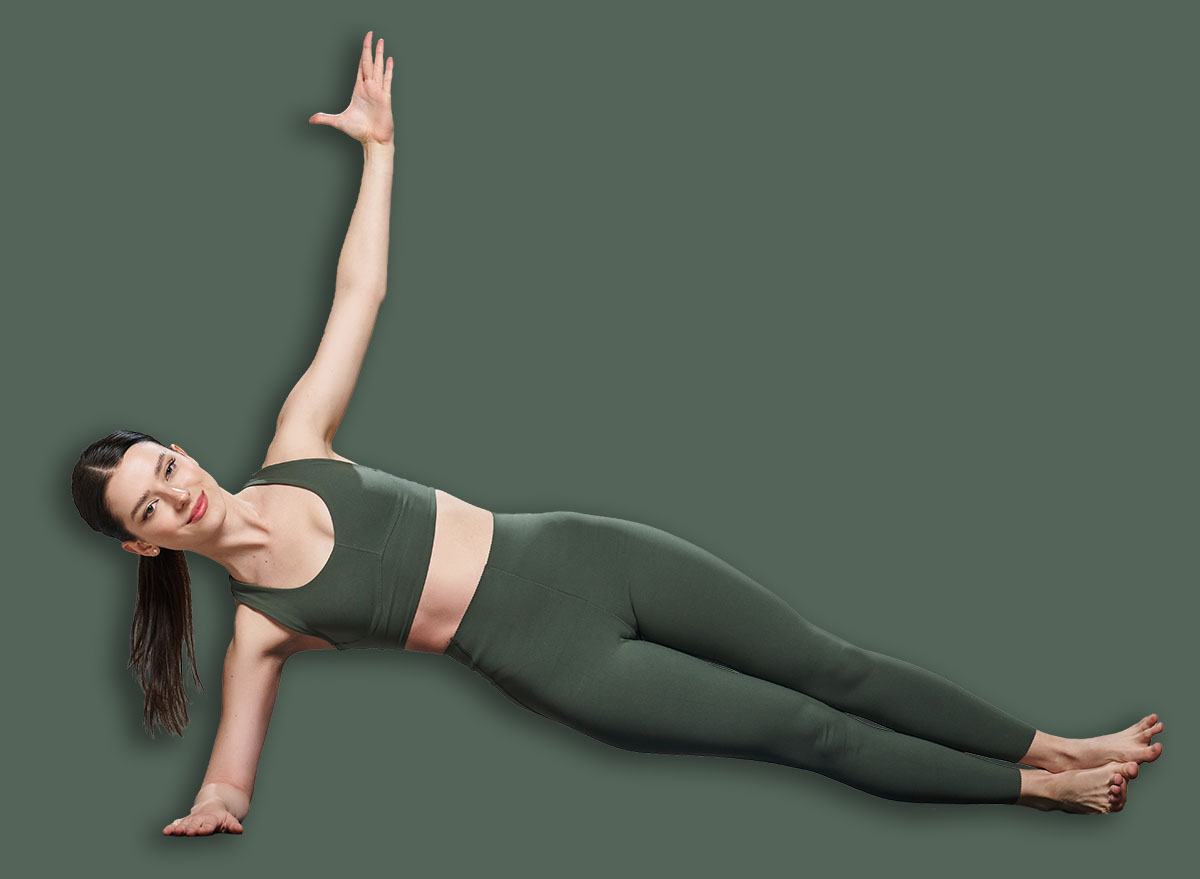
Side Plank Holds
Side plank holds train your obliques, hips, shoulders, and glutes while your body resists dropping toward the floor. The muscles along the side of your waist help keep your trunk steady when you walk, turn, carry something, or shift your weight. For a hanging belly pooch, side planks help build a stronger core, while overall fat loss addresses the visual change. Start with a version you can hold cleanly, rather than forcing a shaky full plank.
Muscles Trained: Obliques, core, shoulders, outer hips
How to Do It:
- Lie on your side with your forearm under your shoulder.
- Stack your feet or stagger them for more support.
- Brace your core and lift your hips off the floor.
- Keep your body in a straight line from head to heels.
- Hold the position while breathing steadily.
- Lower with control, then switch sides.
Recommended Sets and Reps: Perform 3 sets of 20 to 30 seconds per side. Rest for 30 seconds between each set.
Best Variations: Bent-knee side plank, staggered-feet side plank, side plank with top-leg lift
Form Tip: Press your forearm into the floor and keep your hips lifted.
Brisk Walking Intervals
Brisk walking intervals help shrink a hanging belly pooch by boosting calorie burning. Walking is low-impact, easy to repeat, and much easier to recover from than many HIIT workouts. Alternating between faster and easier paces keeps the session engaging while still letting you build consistency. The more often you move without beating yourself up, the easier it becomes to support fat loss and keep your body active.
Muscles Trained: Glutes, hamstrings, calves, core
How to Do It:
- Start with an easy walking pace for a few minutes.
- Pick up your pace until your breathing gets slightly heavier.
- Hold the faster pace for 30 to 60 seconds.
- Slow down and recover for 60 to 90 seconds.
- Repeat the interval cycle for your planned time.
- Finish with a few minutes of easy walking.
Recommended Sets and Reps: Perform 10 to 20 minutes of intervals. Rest as needed.
Best Variations: Incline walking, longer brisk intervals, steady moderate walking
Form Tip: Walk tall and swing your arms with purpose.
What Actually Helps a Hanging Belly Pooch Change

A hanging belly pooch responds best to a plan that combines core control, lean muscle, daily movement, and nutrition that supports fat loss. The exercises above give your body a stronger foundation without the joint stress or recovery hit that can come with constant HIIT. Keep the workouts simple enough to repeat, and focus on making each rep clean instead of chasing exhaustion.
- Keep calories aligned with fat loss: The lower belly changes when overall body fat trends down. Prioritize protein, balanced meals, and portions that fit your goal.
- Train your core for control: Dead bugs, side planks, and bridge marches teach your midsection to brace and support your pelvis. A stronger core helps your belly feel firmer as body composition improves.
- Use bigger muscles often: Sit-to-stands, marches, and walking intervals engage your legs and hips, which help increase total work without high-impact training.
- Choose consistency over punishment: HIIT can be useful, but soreness and fatigue can make people skip workouts. Simple daily movement keeps momentum going.
- Move outside of formal workouts: Walking, stairs, housework, and short movement breaks all add to daily calorie burn. Those small pieces matter more than most people realize.
A lower belly won’t change from one brutal workout. It changes when your body gets steady movement, enough strength work, and the right nutrition cues day after day. Keep the plan repeatable, and the progress becomes easier to sustain.
References
- Brobakken, Mathias Forsberg et al. “Abdominal aerobic endurance exercise reveals spot reduction exists: A randomized controlled trial.” Physiological reports vol. 11,22 (2023): e15853. doi:10.14814/phy2.15853
- Siparsky, Patrick N et al. “Muscle changes in aging: understanding sarcopenia.” Sports health vol. 6,1 (2014): 36-40. doi:10.1177/1941738113502296