If You Can Complete These 4 Moves at 60, Your Body’s Stronger Than Your Age

Let’s be real: Aging has a reputation problem. It’s a misconception that, after 60, your strength, balance, and physical abilities inevitably decline. But that’s not necessarily the case, and we’re here to tell a different story.
While muscle mass, bone density, and strength can decline with age (a condition called sarcopenia), the rate of decline is significantly influenced by the way you move, how often you train, and whether your workouts challenge the right muscles and movement patterns that matter most for daily life. In fact, research shows even moderate physical activity can reduce your sarcopenia risk by 35 percent.
Many of the strongest predictors of longevity and independence in older adults have nothing to do with how much weight you can lift in a gym. Instead, they come down to whether you can perform a handful of fundamental movements, such as standing up from a chair, pushing your body off the ground, climbing stairs, and stabilizing your trunk. These are more “life skills” than traditional gym exercises.
To find out which four essential moves reveal your body’s overall strength at 60, we spoke with James Brady, personal trainer at OriGym, who tells us, “Together, these four movements challenge strength, stability, and cardiovascular effort in a way that translates directly to real life. If you can train these exercises consistently at 60, your body is not just keeping up with your age, it is outperforming it.”
Read on for the exercises and explanations. When you’re finished, check out If You Can Hold a Plank This Long After 50, Your Core Is Stronger Than Most Athletes.
Squat
This classic lower-body movement closely mirrors one of the most common daily tasks: standing up from a seated position. That seemingly simple action relies on coordinated strength from your legs, glutes, and core, along with joint mobility. “Squats are one of the most effective full body exercises for burning calories and maintaining independence as you age,” says Brady.
How to do it:
- Stand with your feet about shoulder-width apart and toes slightly turned out.
- Flex your core and keep your chest upright.
- Push your hips back and bend your knees to lower into a squat.
- Lower as far as you can while maintaining control and upright posture.
- Drive through your heels to return to standing without locking your knees.
- Perform three sets of 10 to 12 reps, resting for 60 to 90 seconds between sets.
RELATED: 4 Bodyweight Moves That Flatten Lower Belly Better Than Crunches After 45
Push-ups
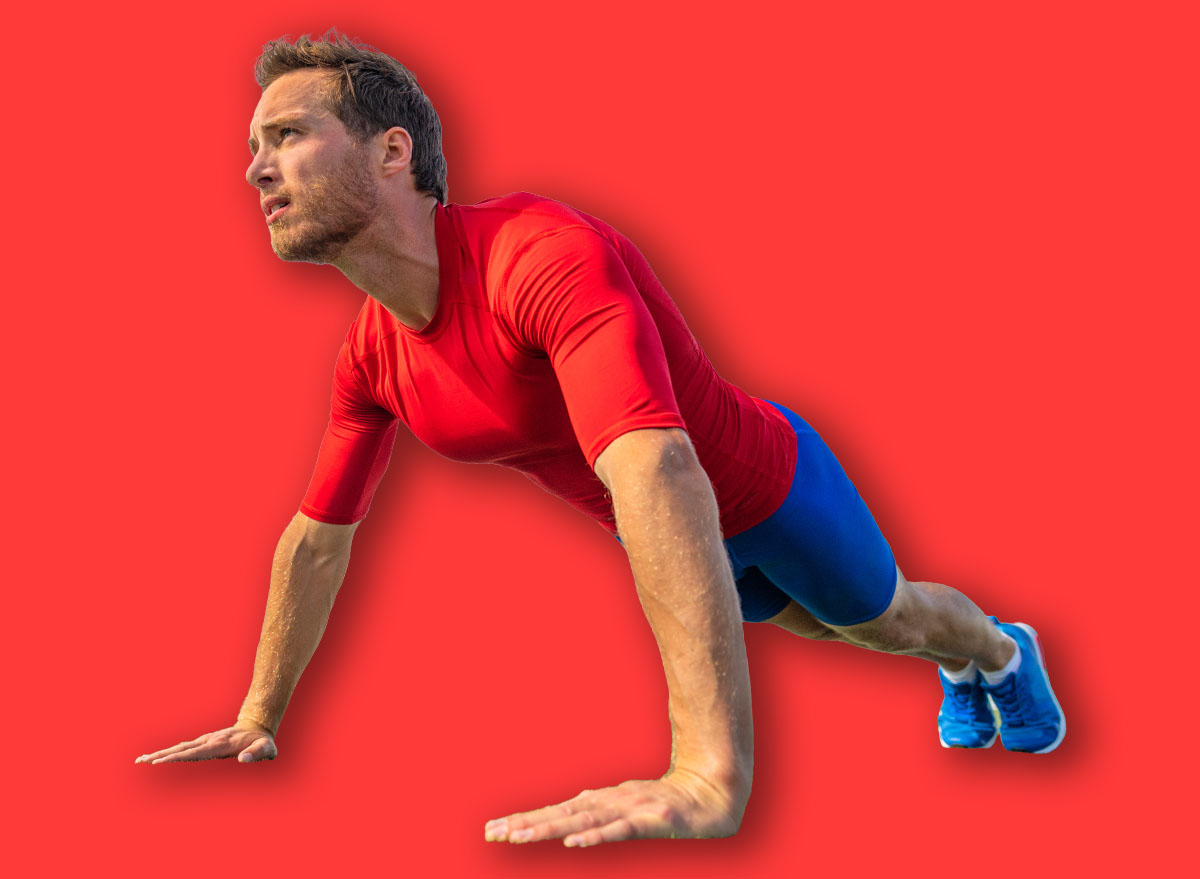
Push-ups are an excellent indicator of upper-body and core strength because they require you to control your entire body as one unit, which becomes increasingly important as coordination and muscle mass deteriorate.
“Push-ups can be done on the floor, on knees, or elevated on a bench or wall,” explains Brady. “When done correctly, they can help build upper body strength through the chest, shoulders, arms, and core, all of which tend to decline with age if not trained.”
How to do it:
- Place your hands slightly wider than shoulder-width apart on the floor, bench, or wall.
- Extend your legs or position your knees depending on the chosen variation.
- Engage your core and glutes to keep your body in a straight line.
- Bend your elbows to lower your chest toward your hands.
- Press through your palms to return to the starting position with control.
- Aim for three sets of 8 to 12 reps. Rest for 60 to 90 seconds between sets.
Step-ups
Step-ups are a true test of your lower-body strength, balance, and coordination. That’s because they mimic climbing stairs, a daily task that becomes increasingly challenging for many adults as they age, often due to weakness rather than joint issues.
“Step ups improve leg strength, balance, and coordination, which are all crucial for staying active and injury free in later life,” Brady says. “They also work large muscle groups and elevate your heart rate quickly.”
How to do it:
- Stand facing a sturdy step or platform.
- Place one foot fully on the step, keeping your weight centered.
- Press through the heel of your front foot to lift your body upward.
- Bring the trailing foot onto the step without pushing off excessively.
- Step back down with control and repeat before switching legs.
- Perform three sets of 10 reps per leg, resting 45 to 60 seconds between sets.
Plank
While the plank may look static, it’s one of the most effective ways to evaluate your core endurance and stability. Brady explains that “Planks strengthen the deep core muscles that support posture, protect the spine, and make all other movements more efficient. A stronger core also helps you train harder overall, which indirectly supports fat loss.”
How to do it:
- Place your forearms on the floor with your elbows under your shoulders.
- Extend your legs behind you while balancing on your toes.
- Engage your core and glutes to keep your body in a straight line.
- Avoid sagging through the hips or lifting them too high.
- Hold the position while breathing steadily and maintaining alignment.
- Hold for 20 to 40 seconds for three sets. Rest for 45 to 60 seconds between sets.