4 Daily Exercises To Regain Muscle Tone Better Than Gym Workouts After 55


Muscle tone after 55 is built through strength you can repeat. You want exercises that engage your legs, hips, back, arms, and core all at once, rather than spending a full session bouncing from one machine to the next. A short daily routine can give your body a clear signal of strength without turning the workout into a major time commitment.
As a coach, I’d build this routine around four movements that cover a lot of ground: hinge, lunge, pull, and brace. The kettlebell deadlift trains your backside and lifting strength. Goblet-forward lunges challenge your legs, one side at a time. Single-arm dumbbell rows build your back and arms. Planks with shoulder taps teach your core to stay steady while your body moves.
The goal is simple: clean reps, controlled tension, and enough effort to make the final few reps count. Use this as a daily strength check-in, or perform it three to five days per week if you’re newer to resistance training. Keep the movements strong, repeatable, and smooth.
Kettlebell Deadlift
Kettlebell deadlifts train your glutes, hamstrings, lower back, core, and grip. The movement teaches you how to hinge through your hips, pick the weight up from the floor, and stand tall with control. This makes it one of the most useful exercises for regaining muscle tone because it trains large muscles while reinforcing a movement you use constantly in daily life. Start with the kettlebell close to your feet and focus on driving through the floor.
Muscles Trained: Glutes, hamstrings, lower back, core, grip.
How to Do It:
- Stand with your feet hip-width apart and place a kettlebell between your feet.
- Brace your core and soften your knees.
- Push your hips back and reach both hands to the kettlebell handle.
- Keep your chest lifted and your spine long.
- Press through your feet and stand tall with the kettlebell.
- Hinge your hips back and lower the kettlebell with control.
Recommended Sets and Reps: Perform 3 sets of 8 to 12 reps. Rest for 60 seconds between each set.
Best Variations: Dumbbell deadlifts, elevated kettlebell deadlifts, suitcase deadlifts.
Form Tip: Keep the kettlebell close to your body and make your hips drive the movement.
Goblet Forward Lunge
Goblet forward lunges train your quads, glutes, hamstrings, hips, and core. Holding the weight at your chest makes your midsection work harder to keep your torso tall, while each step challenges one leg to lower, stabilize, and push back to standing. This exercise helps rebuild muscle tone in your lower body by combining strength, balance, and coordination in every rep. Use a lightweight at first and keep the step controlled.
Muscles Trained: Quadriceps, glutes, hamstrings, hips, core.
How to Do It:
- Stand tall with your feet hip-width apart.
- Hold a dumbbell or kettlebell at your chest.
- Brace your core and step one foot forward.
- Lower into a lunge until both knees bend comfortably.
- Press through your front foot to return to standing.
- Complete all reps on one side, then switch legs.
Recommended Sets and Reps: Perform 3 sets of 8 to 10 reps per side. Rest for 45 to 60 seconds between each set.
Best Variations: Bodyweight forward lunges, assisted forward lunges, goblet split squats.
Form Tip: Keep your front foot planted and your torso tall as you push back to standing.
Single-Arm Dumbbell Row
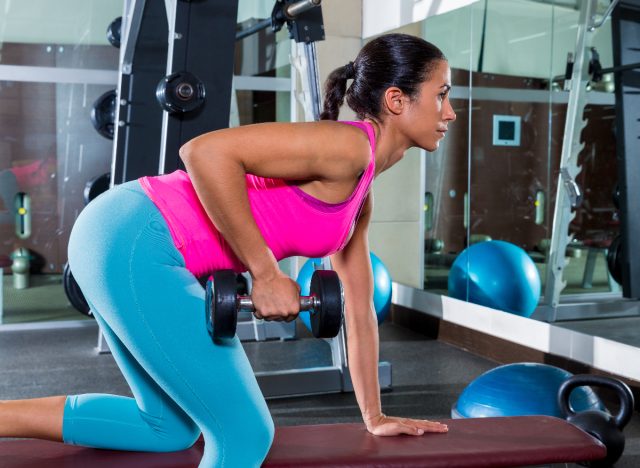
Single-arm dumbbell rows train your upper back, lats, rear shoulders, biceps, grip, and core. The one-arm setup lets you focus on each side while your trunk helps keep your body steady. Stronger pulling muscles support posture, shoulder strength, and the arm tone most people want after 55. Use a bench, chair, or your own thigh for support so your back can do the work without swinging the weight.
Muscles Trained: Upper back, lats, rear delts, biceps, core, grip.
How to Do It:
- Hold a dumbbell in one hand.
- Hinge slightly forward and place your opposite hand on a bench, chair, or thigh for support.
- Brace your core and let the dumbbell hang below your shoulder.
- Pull your elbow back toward your ribs.
- Squeeze your upper back at the top.
- Lower the dumbbell with control and switch sides after your reps.
Recommended Sets and Reps: Perform 3 sets of 8 to 12 reps per side. Rest for 45 to 60 seconds between each set.
Best Variations: Supported dumbbell rows, split-stance rows, band rows.
Form Tip: Pull through your elbow and keep your shoulder relaxed away from your ear.
Planks with Shoulder Taps
Planks with shoulder taps train your abs, obliques, shoulders, glutes, and deep core. The shoulder tap adds movement to the plank, so your midsection has to resist rocking side to side. This builds bracing strength that supports better posture, steadier movement, and a stronger-looking midsection. Start with a wider foot position to make the exercise more stable, then bring your feet closer as your control improves.
Muscles Trained: Abs, obliques, deep core, shoulders, glutes.
How to Do It:
- Start in a high plank with your hands under your shoulders.
- Step your feet wider than hip-width apart.
- Brace your core and squeeze your glutes.
- Lift one hand and tap the opposite shoulder.
- Place your hand back down with control.
- Alternate sides while keeping your hips steady.
Recommended Sets and Reps: Perform 3 sets of 8 to 12 taps per side. Rest for 30 to 45 seconds between each set.
Best Variations: Incline shoulder taps, knee plank shoulder taps, slower shoulder taps.
Form Tip: Keep your hips as still as possible and move your hand with control.
How to Regain Muscle Tone After 55
Regaining muscle tone takes consistent resistance training, steady daily movement, and enough recovery for your body to respond. These four exercises work well because they target large muscle groups and key movement patterns without making the routine overly complicated.
- Use compound movements first: Deadlifts, lunges, rows, and plank taps train multiple muscles at once. That gives your body a stronger stimulus than small isolation moves alone.
- Make the final reps meaningful: Choose a weight or variation that challenges you near the end of each set while your form stays strong.
- Keep the routine repeatable: Perform all four exercises in 20 minutes or less. A short routine you can repeat often will usually beat a long workout you only get to once in a while.
- Add a circuit option: Move from one exercise to the next with 30 to 45 seconds of rest. Repeat for 2 to 4 rounds to add a light conditioning effect while still building strength.
- Support muscle tone outside the workout: Daily walking, protein-focused meals, hydration, and quality sleep help your strength work show up more clearly.
Muscle tone improves when your body gets regular practice producing force and holding strong positions. Train the hinge, lunge, pull, and brace patterns with control, and you’ll build strength that shows up in your workouts and your daily movement.
References
- Ikezoe T. Age-Related Change in Muscle Characteristics and Resistance Training for Older Adults. Phys Ther Res. 2020 Dec 4;23(2):99-105. doi: 10.1298/ptr.R0009. PMID: 33489646; PMCID: PMC7814211.
- Wilk M, Zajac A, Tufano JJ. The Influence of Movement Tempo During Resistance Training on Muscular Strength and Hypertrophy Responses: A Review. Sports Med. 2021 Aug;51(8):1629-1650. doi: 10.1007/s40279-021-01465-2. Epub 2021 May 27. PMID: 34043184; PMCID: PMC8310485.