5 Bed Exercises That Firm Apron Belly Faster Than Gym Workouts After 60

An apron belly can be frustrating because it sits low across the abdomen and can change how your midsection feels when you move, sit, or stand. After 60, it can become more noticeable as muscle mass declines, daily movement drops, and overall body fat increases. Hormonal shifts and years of less consistent strength work can also play a role, but the main focus stays the same: build more lean muscle, move more often, and create habits that support steady fat loss.
Spot reduction doesn’t really work the way people want it to. You can’t pick the lower belly and force fat to leave that exact area with a few exercises. Calories in versus calories out still drives fat loss, while strength work and core training help improve how your body looks and functions as body composition changes. The goal is to strengthen the muscles underneath, improve control through your midsection, and stay consistent long enough for the visual changes to follow.
I’ve seen this with clients many times. The people who make the most progress usually stop chasing brutal ab workouts and start focusing on cleaner core work they can repeat. Bed exercises help because they lower the barrier to entry. You can do them in the morning before your feet hit the floor or at night before you wind down. They also provide a stable surface, making it easier to focus on bracing, pelvic control, and slow reps rather than fighting the floor.
The five exercises below target your lower abs, deep core, hips, and full midsection control. You’ll use dead bugs, heel taps, reverse crunches, glute bridges, and planks to build a stronger base from the inside out. Keep each rep controlled, avoid rushing, and make your core do the work.
Dead Bugs
Dead bugs train your lower abs and deep core while your arms and legs move away from your body. Your midsection has to brace to keep your lower back from arching, which is a strong choice for firming the area around an apron belly. Compared with most gym workouts that rush through big movements, dead bugs teach the control that many people need first. Better core control carries over into walking, standing, lifting, and keeping your lower back from doing extra work.
Muscles Trained: Lower abs, deep core, hip flexors, shoulders
How to Do It:
- Lie on your back with your arms reaching toward the ceiling.
- Lift your knees over your hips and bend them to 90 degrees.
- Press your lower back gently into the bed.
- Extend your right arm and left leg away from your body.
- Return to the starting position with control.
- Repeat on the opposite side.
Recommended Sets and Reps: Perform 3 sets of 8 to 10 reps per side. Rest for 30 seconds between each set.
Best Variations: Same-side dead bugs, paused dead bugs, heel-tap dead bugs
Form Tip: Keep your lower back pressed into the bed during every rep.
RELATED: If You Can Do This Many Sit-to-Stands After 60, Your Lower-Body Endurance Is Elite
Heel Taps
Heel taps train your lower abs by asking your core to control one leg at a time. Each tap forces your midsection to stay braced so your pelvis doesn’t tip and your lower back doesn’t lift. This helps firm the lower belly because the work stays focused on control rather than momentum. The movement also builds a stronger connection between your core and hips, which helps your midsection support you better during everyday movement.
Muscles Trained: Lower abs, deep core, hip flexors
How to Do It:
- Lie on your back with your knees bent over your hips.
- Press your lower back gently into the bed.
- Brace your core before moving your legs.
- Lower one heel toward the bed with control.
- Tap your heel lightly without relaxing your core.
- Bring your leg back up and switch sides.
Recommended Sets and Reps: Perform 3 sets of 10 to 12 reps per side. Rest for 30 seconds between each set.
Best Variations: Alternating heel taps, slower heel taps, extended-leg heel taps
Form Tip: Lower your heel only as far as your core can control.
Reverse Crunches
Reverse crunches train your lower abs by making your pelvis curl instead of relying on your neck, shoulders, or hip flexors to do the work. As your knees move toward your chest, your lower belly has to help lift and control the movement. This makes reverse crunches useful for apron belly work because the exercise targets the control that many people lose through the lower abdomen. Keep the range small and smooth so your abs guide the rep, not your legs swinging around.
Muscles Trained: Lower abs, deep core, hip flexors
How to Do It:
- Lie on your back with your knees bent and feet lifted.
- Place your arms at your sides for support.
- Brace your core and keep your movement small.
- Curl your hips slightly off the bed.
- Bring your knees toward your chest without swinging.
- Lower your hips back down with control.
Recommended Sets and Reps: Perform 3 sets of 8 to 12 reps. Rest for 30 seconds between each set.
Best Variations: Bent-knee reverse crunches, paused reverse crunches, slow tempo reverse crunches
Form Tip: Think about curling your pelvis instead of throwing your legs upward.
Glute Bridges
Glute bridges train your glutes and hamstrings while your core keeps your ribs and pelvis in a strong position. Stronger glutes matter for an apron belly because better hip strength helps your posture, pelvic position, and overall midsection control. Your lower abs have to stay engaged as your hips lift, especially if you avoid arching through your lower back. This move also gives you more lower-body muscle work than most ab-only routines, which supports better body composition after 60.
Muscles Trained: Glutes, hamstrings, core
How to Do It:
- Lie on your back with your knees bent and your feet flat on the bed.
- Place your arms at your sides.
- Brace your core and press through your heels.
- Lift your hips until your body forms a straight line from shoulders to knees.
- Squeeze your glutes at the top.
- Lower your hips with control.
Recommended Sets and Reps: Perform 3 sets of 12 to 15 reps. Rest for 45 seconds between each set.
Best Variations: Paused glute bridges, mini-band glute bridges, single-leg glute bridges
Form Tip: Finish with your glutes and avoid arching your lower back.
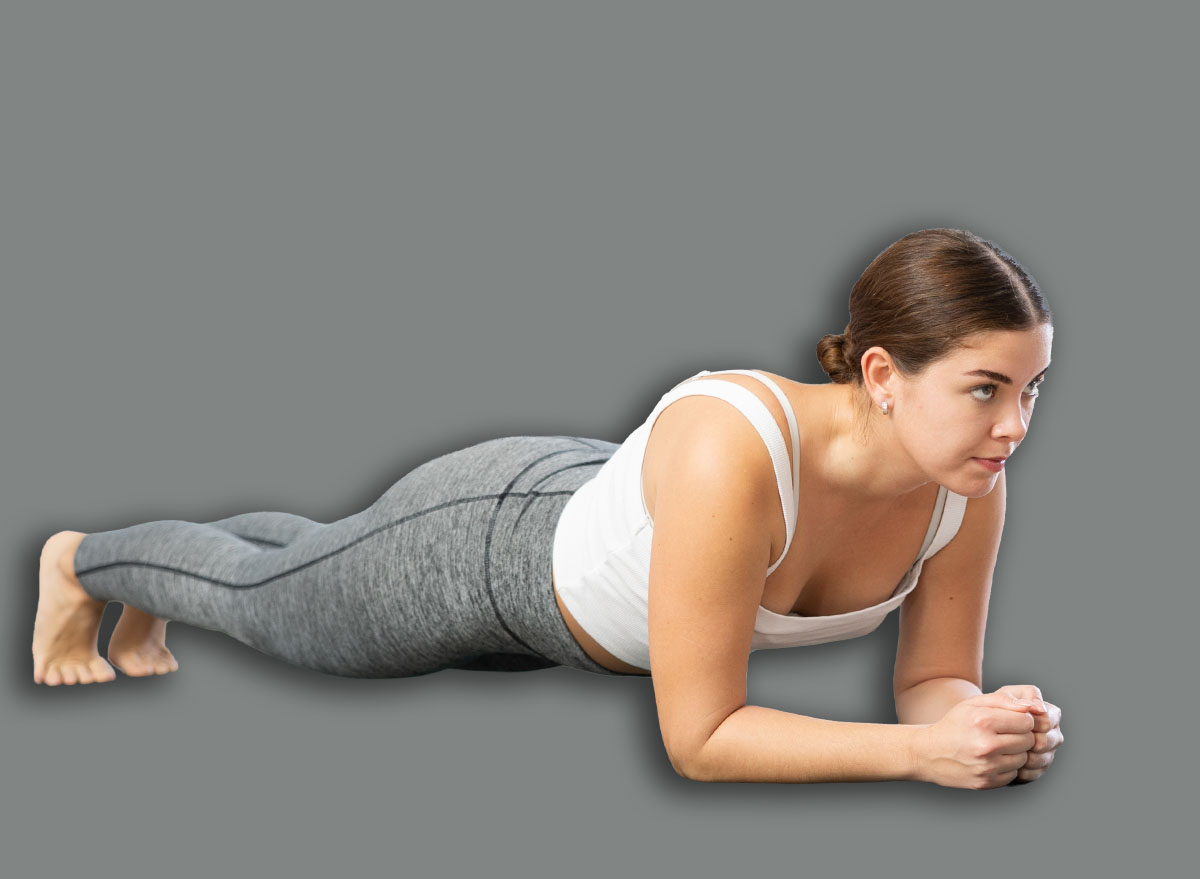
Forearm Plank
Forearm planks train your entire core while your lower belly works to keep your hips from sagging. Your abs, obliques, glutes, and shoulders all stay active, which gives the movement more total-body value than small crunch variations. For apron belly work, planks help build the bracing strength needed to support your midsection during standing, walking, lifting, and daily movement. Start with shorter holds and build strength in the position before adding more time.
Muscles Trained: Core, lower abs, obliques, shoulders, glutes
How to Do It:
- Place your forearms on the bed with your elbows under your shoulders.
- Step your feet back into a plank position.
- Brace your core and squeeze your glutes.
- Keep your body in a straight line from head to heels.
- Hold the position while breathing steadily.
- Lower your knees when your form starts to slip.
Recommended Sets and Reps: Perform 3 sets of 20 to 30 seconds. Rest for 30 seconds between each set.
Best Variations: Knee plank, longer holds, plank with alternating leg lifts
Form Tip: Keep your ribs down and your hips level.
How to Make Bed Core Work Count After 60

Bed exercises work best when you treat them like focused strength work, not throwaway movement. The softer surface can make control more challenging, so slow reps and strong positions matter. Your goal is to keep the work in your lower abs and deep core, rather than letting your hip flexors or lower back take over. Pair these movements with walking, full-body strength training, and nutrition that supports fat loss, and you’ll have a much better setup for firming the lower belly.
- Set your pelvis before each rep: gently press your lower back into the bed during dead bugs, heel taps, and reverse crunches. This helps your lower abs stay involved and keeps your lower back from taking over.
- Move slower than feels natural: Slow reps force your core to control the movement. If your legs swing or your hips bounce, momentum has taken over.
- Use a range you can control: Smaller, cleaner reps work better than big reps with poor position. Stop each movement before your back arches or your ribs flare.
- Add full-body strength during the week: Core work helps build control, but muscles across your legs, back, and hips support better body composition. Squats, rows, presses, and hinges still belong in the plan.
- Walk daily when possible: Walking helps increase calorie burn without beating up your joints. That matters because apron belly changes come from overall fat loss, not one perfect ab move.
References
- Beekman, Marian et al. “Lifestyle-Intervention-Induced Reduction of Abdominal Fat Is Reflected by a Decreased Circulating Glycerol Level and an Increased HDL Diameter.” Molecular nutrition & food research vol. 64,10 (2020): e1900818. doi:10.1002/mnfr.201900818
- Cox, Carla E. “Role of Physical Activity for Weight Loss and Weight Maintenance.” Diabetes spectrum : a publication of the American Diabetes Association vol. 30,3 (2017): 157-160. doi:10.2337/ds17-0013