5 Standing Exercises That Shrink Belly Overhang Faster Than Gym Machines After 50
Your core plays a major role in how your midsection looks and feels over the years. The muscles around your abdomen help support posture and movement, but they also influence how firmly the stomach sits against the abdominal wall. After 50, the lower portion of the midsection often becomes an area people want to tighten and strengthen. When the core receives consistent training, those muscles grow stronger and provide better support for the abdomen, which can help reduce the appearance of belly overhang over time.
Working with clients in their 50s and beyond, I’ve found that standing core exercises tend to light up the midsection in a way machines often don’t. When you’re upright, your body has to stabilize itself, rather than relying on the support of a machine. The abs, hips, and lower back automatically work together to keep you balanced and controlled. That natural coordination builds stronger support around the waist while helping the core engage more effectively.
The five exercises below train the core through real-world movement patterns that strengthen the midsection and improve stability. Each exercise targets the muscles that support a tighter waistline while helping your body move with better control. Perform them regularly, and you’ll build the kind of strength that supports a firmer midsection and better overall movement.
Pallof Press
The pallof press trains the core to resist rotation, which strengthens the deep stabilizing muscles around the abdomen. This anti-rotation strength helps tighten the midsection and supports the lower back. Because the body must remain steady while pressing the weight away from the torso, the abs stay fully engaged throughout the movement. Over time, that consistent tension strengthens the entire core. The result is better posture and stronger abdominal support.
Muscles Trained: Transverse abdominis, obliques, rectus abdominis, and shoulders.
How to Do It:
- Attach a resistance band or cable handle at chest height.
- Stand sideways to the anchor point and hold the handle with both hands.
- Step away from the anchor to create tension in the band.
- Press the handle straight out from your chest while keeping your torso still.
- Bring the handle back toward your chest with control.
Recommended Sets and Reps: Perform 3 sets of 10 to 12 reps per side. Rest for 45 seconds between each set.
Best Variations: Tall-kneeling Pallof press, overhead Pallof press, Pallof press hold.
Form Tip: Brace your core and keep your torso steady throughout the press.
Suitcase Carry
The suitcase carry builds core stability while challenging the body to resist leaning to one side. Carrying weight on one side forces the obliques to engage continuously to keep the torso upright. This creates long periods of core tension that strengthen the abdominal wall. The movement also improves posture and overall body control. Over time, these muscles grow stronger and help support a tighter midsection.
Muscles Trained: Obliques, transverse abdominis, forearms, and shoulders.
How to Do It:
- Stand tall while holding a dumbbell or kettlebell in one hand.
- Keep your shoulders level and your core braced.
- Walk forward with controlled, steady steps.
- Maintain an upright posture as you move.
- Switch hands and repeat after completing the distance.
Recommended Sets and Reps: Perform 3 sets of 30 to 40 seconds per side. Rest for 45 seconds between each set.
Best Variations: Kettlebell suitcase carry, farmer carry, front rack carry.
Form Tip: Keep your shoulders level and avoid leaning toward the weight.
Dumbbell Chops
Dumbbell chops train the core through a diagonal pattern that closely mirrors real-world movement. The rotation forces the abs and obliques to coordinate while stabilizing the spine. This combination strengthens the muscles that tighten the waistline and support trunk rotation. The movement also improves coordination between the upper and lower body. When performed consistently, chops help build a stronger and more responsive core.
Muscles Trained: Obliques, rectus abdominis, shoulders, and hips.
How to Do It:
- Stand with your feet shoulder-width apart, holding a dumbbell in both hands.
- Raise the dumbbell near one shoulder.
- Rotate your torso and bring the weight diagonally across your body.
- Finish the movement near your opposite hip.
- Return the weight to its starting position, then repeat.
Recommended Sets and Reps: Perform 3 sets of 10 to 12 reps per side. Rest for 45 seconds between each set.
Best Variations: Cable chops, band chops, low-to-high chops.
Form Tip: Rotate through your torso while keeping your hips stable.
Kettlebell Swings
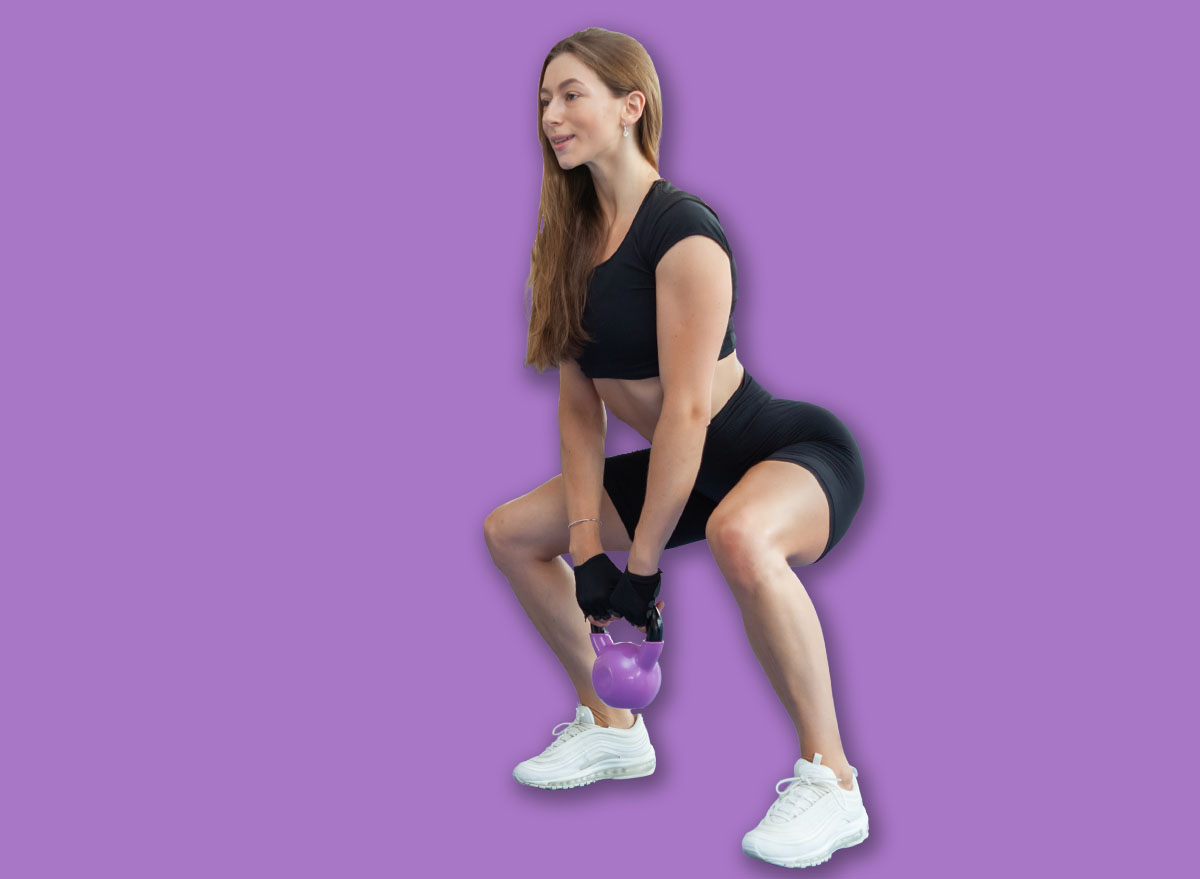
Kettlebell swings strengthen the glutes and core while teaching the body to generate powerful hip movement. Each swing requires the abs to brace and stabilize the spine as the weight moves forward and backward. This repeated core engagement builds strength across the entire midsection. The explosive hip motion also increases calorie expenditure, supporting fat loss around the abdomen. With regular practice, swings develop a stronger and more capable core.
Muscles Trained: Glutes, hamstrings, core, and lower back stabilizers.
How to Do It:
- Stand with your feet slightly wider than shoulder width.
- Hold a kettlebell with both hands in front of your hips.
- Hinge your hips back while swinging the kettlebell between your legs.
- Drive your hips forward to swing the kettlebell to chest height.
- Allow the kettlebell to swing back down and repeat.
Recommended Sets and Reps: Perform 3 sets of 12 to 15 reps. Rest for 60 seconds between each set.
Best Variations: Two-hand swing, single-arm swing, alternating swing.
Form Tip: Snap your hips forward while keeping your core braced.
Dumbbell Thrusters
Dumbbell thrusters combine a squat with an overhead press, creating a full-body movement that heavily recruits the core. As the body drives upward from the squat, the abs stabilize the spine and transfer force to the arms. This constant core engagement strengthens the abdominal wall while improving overall strength and coordination. The movement also elevates the heart rate and encourages higher energy output. Over time, this combination supports both muscle development and midsection tightening.
Muscles Trained: Quads, glutes, shoulders, and core.
How to Do It:
- Stand with a dumbbell in each hand at shoulder height.
- Lower into a squat while keeping your chest upright.
- Drive through your heels and stand up explosively.
- Press the dumbbells overhead as you reach full standing position.
- Lower the weights back to your shoulders and repeat.
Recommended Sets and Reps: Perform 3 sets of 8 to 10 reps. Rest for 60 seconds between each set.
Best Variations: Single-dumbbell thruster, kettlebell thruster, goblet thruster.
Form Tip: Brace your core before pressing the weights overhead.
Best Daily Core Tips for Belly Tightening After 50

Shrinking belly overhang after 50 comes down to strengthening the muscles that support posture, stability, and movement. Standing exercises work especially well because the body must stabilize naturally while the core remains engaged. As these muscles strengthen, they provide better support for the abdomen and spine. Consistent training also improves coordination and movement quality throughout the entire body.
- Train your core through movement patterns: Exercises that involve squatting, carrying, and rotating recruit the entire core rather than isolating a single small area.
- Focus on bracing your core: Lightly tighten your abdominal muscles during each exercise to improve stability and core activation.
- Prioritize consistency: Short workouts performed regularly tend to produce better results than occasional long sessions.
- Strengthen your hips and glutes: Strong hips support pelvic alignment and allow the abdominal muscles to function more effectively.
- Support training with healthy habits: Adequate protein intake, hydration, and quality sleep help the body recover and maintain muscle strength.
Stick with these standing exercises and your core will become stronger, more stable, and better equipped to support a tighter midsection.
References:
- Hunter, Gary R et al. “Age Related Shift in Visceral Fat.” International journal of body composition research vol. 8,3 (2010): 103-108.
- Tomiyama, Naoki & Islam, Mohammod & Rogers, Michael E. & Koizumi, Daisuke & Takeshima, Nobuo. (2015). Effects of Seated vs. Standing Exercises on Strength and Balance in Community-Dwelling Older Women. Activities, Adaptation & Aging. 39. 280-290. 10.1080/01924788.2015.1089703.