The 12-Minute Standing Workout That Beats Full Gym Sessions After 45

After 45, the biggest barrier to fitness isn’t ability; it’s time and energy. Long gym sessions stop fitting around real life, and most people end up doing nothing at all. I’ve been a personal trainer for almost 4 decades, and I’ve spent the last 20 years educating personal trainers at TRAINFITNESS, the UK’s leading fitness education company. What I’ve learned is that a 12-minute standing workout done a few times a week, in the kitchen or the bedroom, can do more for the body than the two-hour Saturday session that never quite happens. These six standing moves can help you rebuild strength, balance and energy without ever leaving the house.
Why Full Gym Sessions Fail
The session itself isn’t usually the problem. It’s everything around it. Getting there, getting changed, queuing for machines, getting home. A 60-minute workout swallows two hours of the day, which is hard to find when work, family and house all want a piece of you.
Recovery is the other issue. After 45, a hard session can leave you sore for two or three days, which kills any chance of consistency. People do a punishing workout, hobble around for a week, and then give up going.
There’s also boredom. Most gym programs for adults are basically gym programs for 25-year-olds with the weights dropped, and they don’t hold attention for very long.
Why 12 Minutes Wins

Consistency beats intensity at every age, and increasingly so after 45. A 12-minute session you actually do four or five times a week adds up to 50 to 60 minutes of focused work, every week, every month, every year. That’s more than most over-45s manage at the gym across a year.
The standing format is the second piece. Every move trains balance and the deep trunk muscles without ever needing a sit-up. The whole body is working, the joints stay happy because nothing is hammered, and the heart rate climbs without smashing the legs.
The third factor is friction. No kit, no commute, no excuse. It fits in the gap between getting up and making the kids’ breakfast, and people stick with it.
Bodyweight Squat
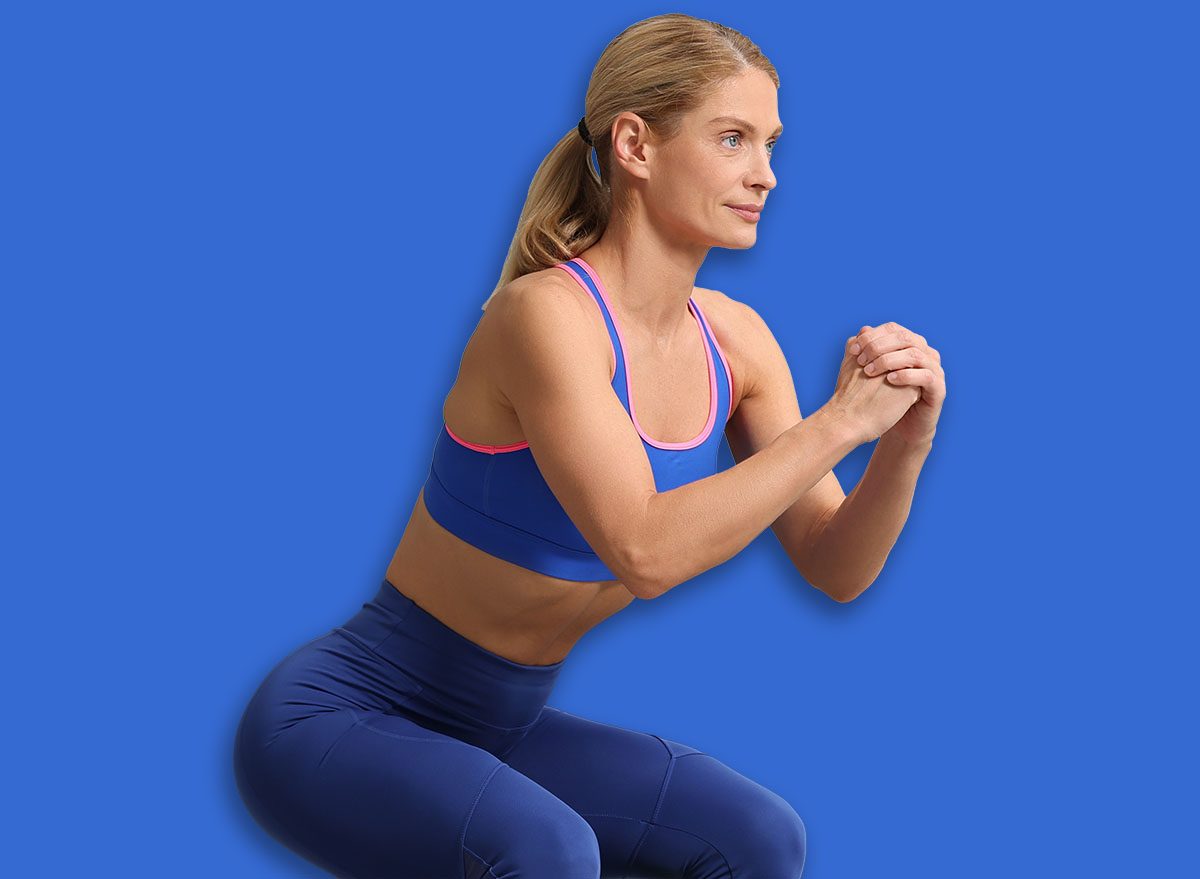
Trains the legs and glutes, which are the two biggest muscle groups in the body and the first to weaken after 45. Squatting also works the ankles, the hips and the trunk together, which is what protects the lower back in daily life.
Muscles Trained: Legs, glutes, ankles, hips, trunk
How to Do It:
- Do 40 seconds of squats
- Stand with feet hip-width apart, toes pointing slightly outwards
- Push the hips back as if sitting onto a low chair, bending the knees
- Lower until thighs are roughly parallel to the floor or as deep as your hips comfortably allow
- Push back up through the heels
- Aim for one rep every 3 seconds, around 13 reps inside the 40 seconds
- Rest 20 seconds
Avoid These Mistakes:
- Don’t let your knees collapse inwards under load
- Don’t lift your heels off the floor
- Don’t rush the descent, which loads the knees rather than the muscles
Form Tip: Easier version, squat onto a sturdy chair or sofa, lightly touching the seat before standing back up. Use your hands on a worktop for support if needed.
Counter Press Up
Trains the chest, shoulders and triceps, plus the deep stabilizers that hold the spine in line. Pressing strength tends to vanish quickly after 45 because most people stop reaching, pushing and carrying heavy things.
Muscles Trained: Chest, shoulders, triceps, spinal stabilizers
How to Do It:
- Do 40 seconds of press-ups against a kitchen worktop
- Place hands on the worktop edge, shoulder-width apart
- Walk the feet back until the body is straight from heels to head
- Bend the elbows and lower the chest towards the worktop in 2 seconds
- Push back up in 1 second
- Aim for roughly 12 to 14 reps
- Rest 20 seconds
Avoid These Mistakes:
- Don’t let your hips sag
- Don’t lift your chin to look up at the worktop
- Don’t flare your elbows out to 90 degrees, which puts the shoulder in a vulnerable spot
Form Tip: Easier version, do the press up against a wall instead of a worktop. The more upright you are, the lighter the load.
Reverse Lunge
Trains one leg at a time, which exposes the side-to-side strength differences most people don’t know they have and rebuilds the balance that fades after 45.
Muscles Trained: Legs, glutes, balance and stability
How to Do It:
- Do 40 seconds, alternating legs
- Stand tall, hand on a chair or worktop if you need it
- Step one foot back roughly two foot lengths
- Lower the back knee towards the floor until the front thigh is parallel to the floor
- Push through the front heel to return to standing
- Alternate legs, around 12 reps total
- Rest 20 seconds
Avoid These Mistakes:
- Don’t step back too short, which pushes the front knee out over the toes
- Don’t let your torso fall forward
- Don’t slam your back knee into the floor
Form Tip: Easier version, hold onto a chair or worktop with both hands, and reduce the depth of the lunge. Start with a small dip and build the range over weeks.
Doorway Row
Pulls the shoulder blades back together and strengthens the upper back, which is the antidote to the slumped posture most desk workers carry around by 45.
Muscles Trained: Upper back, shoulder blades, arms
How to Do It:
- Do 40 seconds of rows
- Stand facing a sturdy door frame, feet either side of the threshold
- Hold the frame at chest height with both hands
- Lean back, keeping the body straight, until your arms are extended
- Pull your chest towards the frame, leading with the elbows back and down
- Lower under control, around one rep every 3 to 4 seconds
- Rest 20 seconds
Avoid These Mistakes:
- Don’t shrug your shoulders up to the ears
- Don’t let your hips sag forward
- Don’t use a flimsy door; test it loaded before relying on it
Form Tip: Easier version, stand more upright. The closer to vertical you are, the lighter the load on the arms. A sturdy banister at the top of the stairs also works well.
High Knee March With Arm Punches
Builds heart-and-lung fitness without any pounding on the joints. The arm punches add upper-body work and force the trunk to stabilise against rotation, which is the muscle pattern that protects the lower back.
Muscles Trained: Heart and lungs, trunk, shoulders, hip flexors
How to Do It:
- Go 40 seconds at a comfortable pace
- Stand tall, feet hip-width apart
- Lift one knee to hip height while punching the opposite arm out in front
- Lower, then repeat on the other side
- Keep the trunk tall, and the punches controlled, not flung
- Rest 20 seconds
Avoid These Mistakes:
- Don’t hunch forwards as the knee comes up
- Don’t punch too hard and yank the shoulder
- Don’t go too fast and lose form
Form Tip: Easier version, march on the spot without the high knee. Keep the arm punches gentle and small.
Lateral Lunge
Works the hips and inner thighs in a side-to-side pattern that’s almost never trained in normal life. After 45, the loss of side-to-side strength is one of the biggest hidden causes of hip and knee pain.
Muscles Trained: Hips, inner thighs, glutes
How to Do It:
- Do 40 seconds, alternating sides
- Stand tall with feet together
- Step one foot wide to the side, two to three foot lengths
- Bend that knee and push the hips back, keeping the other leg straight
- Push back through the working heel to return to standing
- Alternate sides, around 10 to 12 reps total
- Rest 20 seconds
Avoid These Mistakes:
- Don’t let your working knee collapse inwards
- Don’t bend forwards from the lower back; push the hips back instead
- Don’t step too narrow, which forces the knee over the toes
Form Tip: Easier version, hold onto a chair or worktop and reduce the depth of the step. A small dip is fine to begin with, then build the range over weeks.
How To Structure Your 12 Minutes
Run the 6 moves in the order above, 40 seconds of work followed by 20 seconds of rest for each. That’s 6 minutes for the first round. Take a 30-second breather, then repeat the whole sequence for the second round. Total time, give or take, is 12 minutes 30 seconds.
The order matters. Big leg moves first, while you’re fresh. Pushing and pulling next. Then the cardio move in the middle so the legs get a brief reset, and the lateral lunge at the end while you’re warm enough to handle the range.
Four to five days a week is the realistic target. Three is the minimum for change.
Seven days is fine if you want to, because the loading is low enough that the body recovers quickly. Take a break on any day you feel run down. One day off doesn’t undo anything.
What To Expect In 4 To 6 Weeks
By the end of the second week, most people notice that the workout itself feels easier and that day-to-day tasks like climbing stairs and carrying shopping take less effort. The body adapts fast in the first month.
By 4 weeks, the visible changes start. The waist drops a little, the shoulders sit back more, and clothes fit slightly differently. Resting heart rate usually comes down by 4 to 8 beats per minute, which is a real measure of improved heart health.
By 6 weeks, strength gains in the moves themselves are typically 30 to 50 percent. You’ll be doing more squats, holding the press-up position longer, and feeling steadier on one leg.
The bit that doesn’t show up in the mirror but matters most is mood and energy. Twelve minutes of standing work most mornings reliably lifts both. Almost everyone who sticks with it says the same thing.
Before You Start

Anyone with unmanaged blood pressure, heart conditions, a recent injury, or a history of joint surgery should talk to a GP before starting. The same goes for anyone who’s been completely sedentary for a year or more.
If you have known back, knee or shoulder issues, start with the easier versions of each move and build slowly. The patterns are safe when done well, but personalized advice from a physio is worth the cost.
Warning signs to stop the workout are sharp pain rather than muscle effort, chest pain or tightness, dizziness when changing position, and numbness or tingling down a limb. Any of those, stop and get checked before carrying on.