Over 55? If You Can Perform These 5 Upper Body Moves, You’re in Good Shape


Upper-body strength after 55 says a lot about how well your body handles the daily stuff. Pushing yourself up from the floor, carrying bags, reaching overhead, pulling your body into position, and keeping your posture strong all depend on more than just arm strength. Your shoulders, chest, back, grip, and core all have to work together.
This is also where assessments can be more useful than another random workout. A move like a push-up tells you how well your chest, shoulders, triceps, and core work as one unit. A chin-up hold gives you a quick read on pulling strength and grip. A single-arm plank or Pallof press shows how well your core resists movement instead of folding under pressure.
I’ve used moves like these with clients because they reveal a lot without needing a complicated setup. You don’t have to max out or grind through sloppy reps. You’re looking for clean positions, control, steady breathing, and the ability to hold tension without falling apart. If you can perform these five upper-body moves with solid form, you’re in a strong place.
Push-Ups
Push-ups test your chest, shoulders, triceps, and core while forcing your whole body to stay organized. As you lower and press back up, your midsection has to brace so your hips don’t sag and your shoulders stay in a strong position. This makes push-ups a solid marker of upper-body strength after 55 because they measure pressing power, trunk control, and bodyweight strength simultaneously. Strong push-ups carry over to getting up from the floor, pushing doors open, bracing with your hands, and maintaining upper-body strength during daily tasks.
Muscles Trained: Chest, shoulders, triceps, core
How to Do It:
- Place your hands on the floor slightly wider than shoulder-width apart.
- Step your feet back into a strong plank position.
- Brace your core and squeeze your glutes.
- Lower your chest toward the floor with control.
- Press through your hands to return to the starting position.
Recommended Sets and Reps: Perform 3 sets of 6 to 12 reps. Rest for 60 seconds between each set.
Best Variations: Incline push-ups, knee push-ups, slow tempo push-ups
Form Tip: Keep your elbows angled slightly back and your hips level.
Single-Arm Plank
A single-arm plank checks shoulder stability, core strength, and the ability to control rotation. Lifting one hand off the floor gives your body less support, so your midsection has to work harder to keep your hips from shifting. Your shoulder also has to stay packed and steady while your core holds the rest of your frame in place. This matters after 55 because upper-body strength works better when your trunk can support it during reaching, carrying, and pushing.
Muscles Trained: Core, shoulders, chest, glutes
How to Do It:
- Start in a high plank position with your hands under your shoulders.
- Set your feet wider than hip-width for balance.
- Brace your core and squeeze your glutes.
- Lift one hand a few inches off the floor.
- Hold the position without letting your hips rotate.
- Lower your hand and repeat on the other side.
Recommended Sets and Reps: Perform 3 sets of 10 to 20 second holds per side. Rest for 45 seconds between each set.
Best Variations: Incline single-arm plank, shoulder-tap hold, wider-stance plank hold
Form Tip: Keep your hips square to the floor as your hand lifts.
Chin-Up Hold
A chin-up hold tests your back, biceps, grip, and shoulder control. Holding your body near the top of the bar takes serious pulling strength, even if you’re not doing full chin-up reps yet. Your shoulder blades have to stay active, your arms have to hold tension, and your grip has to hang on. This is a strong sign of upper-body fitness after 55 because pulling strength supports posture, carrying, climbing, and shoulder health.
Muscles Trained: Lats, upper back, biceps, forearms, grip
How to Do It:
- Grip a pull-up bar with your palms facing you.
- Use a step or box to get your chin near the bar.
- Pull your shoulders down and keep your chest lifted.
- Hold your position with your chin above or near the bar.
- Lower with control when the hold ends.
Recommended Sets and Reps: Perform 3 sets of 5 to 15 second holds. Rest for 60 to 90 seconds between each set.
Best Variations: Band-assisted holds, flexed-arm hangs, slow negatives
Form Tip: Keep your shoulders active and avoid hanging from your neck.
Pallof Press
The Pallof press tests how well your core resists rotation while your arms move. As you press the band or cable forward, the resistance tries to pull your torso sideways, and your midsection has to fight to stay square. Your shoulders and arms do the pressing, but your core does the stabilizing. This move belongs in an upper-body assessment because strong arms and shoulders need a steady trunk to work from during lifting, carrying, and reaching.
Muscles Trained: Core, obliques, shoulders, glutes
How to Do It:
- Anchor a resistance band or cable at chest height.
- Stand sideways to the anchor point with your feet shoulder-width apart.
- Hold the handle or band at your chest with both hands.
- Brace your core and press your hands straight forward.
- Hold briefly without letting your torso turn.
- Bring your hands back to your chest with control.
Recommended Sets and Reps: Perform 3 sets of 8 to 12 reps per side. Rest for 30 to 45 seconds between each set.
Best Variations: Pallof press hold, half-kneeling Pallof press, overhead Pallof press
Form Tip: Keep your torso facing forward and avoid letting the band pull you sideways.
Standing Single-Arm Shoulder Press
The standing single-arm shoulder press tests overhead strength, shoulder control, and core stability. Pressing one dumbbell overhead creates an uneven load, so your midsection has to brace to keep your ribs down and your body from leaning. Your shoulder and triceps drive the press while your core keeps the rest of you steady. This carries over to reaching overhead, lifting items to shelves, carrying weight, and keeping your upper body strong without relying on a machine.
Muscles Trained: Shoulders, triceps, core, upper back
How to Do It:
- Stand tall with your feet hip-width apart.
- Hold one dumbbell at shoulder height.
- Brace your core and squeeze your glutes.
- Press the dumbbell overhead until your arm is straight.
- Lower the dumbbell back to shoulder height with control.
- Complete all reps, then switch sides.
Recommended Sets and Reps: Perform 3 sets of 6 to 10 reps per side. Rest for 60 seconds between each set.
Best Variations: Half-kneeling single-arm press, seated single-arm press, neutral-grip press
Form Tip: Keep your ribs down and avoid leaning away from the weight.
What These Moves Say About Your Upper Body
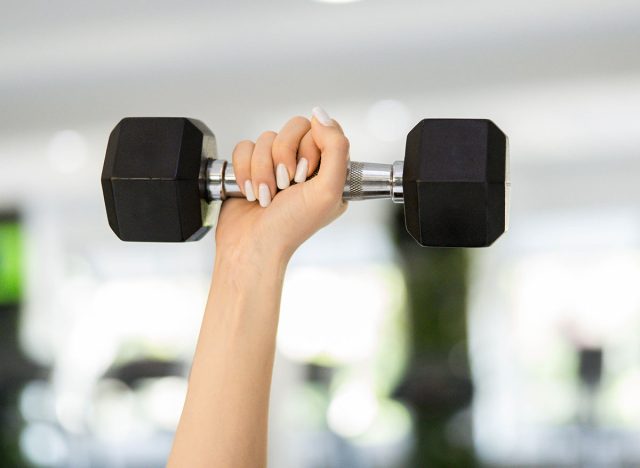
These five moves give you a practical snapshot of strength after 55. Push-ups show pressing strength. Chin-up holds reveal pulling strength and grip. Single-arm planks and Pallof presses test whether your core can keep you steady. One-arm presses show how well your shoulders handle overhead load. Together, they cover the main areas that keep your upper body strong, capable, and ready for daily movement.
- Look for clean control first: Strong reps should look smooth and steady. If your hips sag, shoulders shrug, or torso twists, scale the move and build from there.
- Use easier versions without ego: Incline push-ups, assisted chin-up holds, and lighter presses still count when the effort is honest. Better form gives you a clearer read on your strength.
- Train both sides evenly: Single-arm planks, Pallof presses, and shoulder presses can expose side-to-side gaps. Give the weaker side the attention it needs, rather than letting the stronger side carry the work.
- Build grip and pulling strength: Grip often fades faster than people expect. Holds, rows, carries, and assisted chin-ups can help bring it back.
- Retest every few weeks: Pick one or two moves and track reps, hold time, or load. Small improvements tell you your upper body is getting stronger.
Use these moves as checkpoints, not pass-or-fail tests. If a few feel tough right now, you’ve got a clear training target. If you can perform them with control, your upper body strength is in a good place.
References
- Yang, Justin et al. “Association Between Push-up Exercise Capacity and Future Cardiovascular Events Among Active Adult Men.” JAMA network open vol. 2,2 e188341. 1 Feb. 2019, doi:10.1001/jamanetworkopen.2018.8341
- Marterer, Natalie et al. “Effects of Upper Body Exercise Training on Aerobic Fitness and Performance in Healthy People: A Systematic Review.” Biology vol. 12,3 355. 23 Feb. 2023, doi:10.3390/biology12030355