The 12-Minute Standing Routine That Restores Full-Body Balance After 60

Balance has a huge influence on how strong and confident your body feels after 60. It shows up when you step off a curb, walk across uneven ground, climb stairs, or quickly change direction in the kitchen or garage. Strong balance also helps your body move more efficiently because your muscles and joints work together with better timing and control. The great part is that balance responds incredibly well to consistent practice, especially when strength and coordination are trained together.
Over the years, I’ve noticed that many adults improve their balance fastest when the exercises stay practical and movement-focused. Long, complicated routines usually lose steam quickly. Short standing sessions tend to work better because they challenge the body in positions you actually use during daily life. When clients start feeling steadier on their feet during normal activities, their confidence tends to climb right along with it.
The 12 Minute Standing Routine That Restores Full-Body Balance After 60 trains your legs, hips, core, and posture muscles through controlled standing movements that reinforce stability from head to toe. These exercises help strengthen the muscles responsible for balance while improving coordination and body awareness. All you need is a little open space and twelve focused minutes.
The 12-Minute Standing Balance Routine
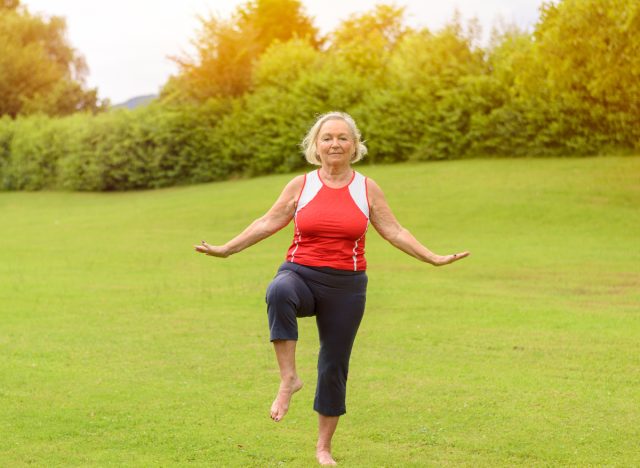
What you need: Open floor space and a sturdy chair or a nearby wall for light support, if needed.
The Routine:
- Standing March Holds
- Heel-to-Toe Walks
- Single-Leg Reaches
- Standing Calf Raises
Complete 3 rounds total.
Directions
Perform the exercises in order. Move slowly and focus on maintaining control during every rep. Use light support when needed, but try to let your body do most of the stabilizing work. Rest briefly between rounds as needed. Read on for the detailed instructions.
Standing March Holds
Standing marches strengthen the hips, core, and stabilizing muscles that help maintain single-leg balance. This movement closely mimics the balance demands of walking and stair climbing, which makes it highly practical for daily life. I use march holds often because they build coordination and posture while helping clients feel more stable quickly. Over time, stronger single-leg control improves confidence during movement.
Muscles Trained: Hip flexors, glutes, calves, and core.
How to Do It:
- Stand tall with feet hip-width apart.
- Brace your core and keep your chest lifted.
- Lift one knee toward hip height.
- Hold the position for 2 to 3 seconds.
- Lower with control.
- Switch sides and repeat.
Recommended Sets and Reps: Perform 3 sets of 8 reps per side. Rest for 30 seconds between each set.
Best Variations: Supported march holds, slower holds, higher knee holds.
Form Tip: Stay tall through your torso and avoid leaning backward.
Heel-to-Toe Walks
Heel-to-toe walking improves coordination, posture, and walking stability by forcing your body to control weight shifts carefully. This movement strengthens the small stabilizers around the ankles and hips while sharpening body awareness. I like using this exercise because it dynamically challenges your balance instead of keeping you fixed in one spot. Consistent practice helps everyday walking feel smoother and more controlled.
Muscles Trained: Calves, hips, core, and lower-leg stabilizers.
How to Do It:
- Stand tall in an open space.
- Step one foot directly in front of the other.
- Place your heel directly in front of your back toes.
- Shift your weight forward slowly.
- Continue walking in a straight, controlled line.
- Turn carefully and repeat.
Recommended Sets and Reps: Perform 3 sets of 20 to 30 steps. Rest for 30 seconds between each set.
Best Variations: Slower walks, supported walks, narrower line walks.
Form Tip: Keep your eyes forward instead of looking down constantly.
Single-Leg Reaches
Single-leg reaches train your hips and core to stabilize your body as it moves through space. This helps improve balance during bending, reaching, and stepping activities that occur frequently throughout the day. I often include this exercise because it builds both strength and control together. Over time, stronger hip stability helps reduce wobbling and improves lower-body coordination.
Muscles Trained: Glutes, hips, hamstrings, and core.
How to Do It:
- Stand tall with feet hip-width apart.
- Shift your weight onto one leg.
- Reach the opposite leg slightly behind you.
- Hinge forward a few inches at the hips.
- Reach your hands forward slightly for balance.
- Return to standing with control.
- Switch sides after completing the reps.
Recommended Sets and Reps: Perform 3 sets of 6 to 8 reps per side. Rest for 30 seconds between each set.
Best Variations: Toe-tap reaches, supported reaches, and slower tempo reaches.
Form Tip: Move slowly enough to keep your hips level throughout the movement.
Standing Calf Raises
Strong calves play a major role in balance and walking control because they help stabilize the ankle during every step. Calf raises improve lower-leg strength while reinforcing proper foot control and posture. I use calf raises frequently because they are simple, effective, and highly functional for adults over 60. Stronger calves often lead to smoother walking and quicker balance corrections.
Muscles Trained: Calves, feet, and ankle stabilizers.
How to Do It:
- Stand tall with feet hip-width apart.
- Brace your core and keep your posture upright.
- Press through the balls of your feet to rise onto your toes.
- Pause briefly at the top.
- Lower slowly with control.
- Repeat for the target reps.
Recommended Sets and Reps: Perform 3 sets of 12 to 15 reps. Rest for 30 seconds between each set.
Best Variations: Single-leg calf raises, slow tempo raises, and supported raises.
Form Tip: Lower slowly to increase muscle control and stability.
Best Daily Habits to Improve Balance After 60

Balance improves fastest when targeted exercises are paired with steady daily movement. Your body responds well to frequent practice because balance relies heavily on coordination and nervous system control. In my coaching experience, adults over 60 tend to make the biggest improvements when they challenge their balance regularly in small, manageable doses. The goal is not perfection. The goal is to build confidence and control through repetition. Use the habits below to support your progress.
- Practice balance exercises several days per week. Frequent exposure improves coordination faster.
- Walk daily. Regular walking reinforces balance and lower-body endurance.
- Strength train consistently. Stronger legs and hips support steadier movement.
- Move with control during daily tasks. Slowing down transitions improves body awareness.
- Focus on posture throughout the day. Tall posture helps your body stabilize more efficiently.
- Progress gradually over time. Small increases in difficulty keep your balance improving.
Stick with this 12-minute standing routine and these habits, and many adults over 60 begin to notice steadier movement, stronger coordination, and greater confidence during everyday activities.
References
- Wang, Jixian et al. “Age-Related Dysfunction in Balance: A Comprehensive Review of Causes, Consequences, and Interventions.” Aging and disease vol. 16,2 714-737. 24 Jan. 2024, doi:10.14336/AD.2024.0124-1
- Šarabon, Nejc, and Žiga Kozinc. “Effects of Resistance Exercise on Balance Ability: Systematic Review and Meta-Analysis of Randomized Controlled Trials.” Life (Basel, Switzerland) vol. 10,11 284. 15 Nov. 2020, doi:10.3390/life10110284