5 Bed Exercises That Restore Posture After 60, According to a Coach

Posture often slips after 60 for simple reasons. More time sitting, less time moving, and gradual muscle weakness that keeps you upright all start to stack up. Over time, the shoulders round forward, the head drifts ahead of the body, and standing tall begins to feel uncomfortable instead of natural.
Alleviating aches and pain may not always require complicated tools or constant appointments if you stay on top of consistent body work. Posture improves when the muscles responsible for alignment get stronger and relearn how to work together. The right exercises teach your body how to support itself again, leading to better positioning not just during workouts but all day long as you walk, sit, and move.
Bed exercises make that process easier. They reduce joint stress, remove balance challenges, and let you focus on control and positioning without distraction. Below are five bed-based exercises that help restore posture by strengthening your hips, core, and upper back, so standing taller feels automatic again.
Glute Bridge Hold
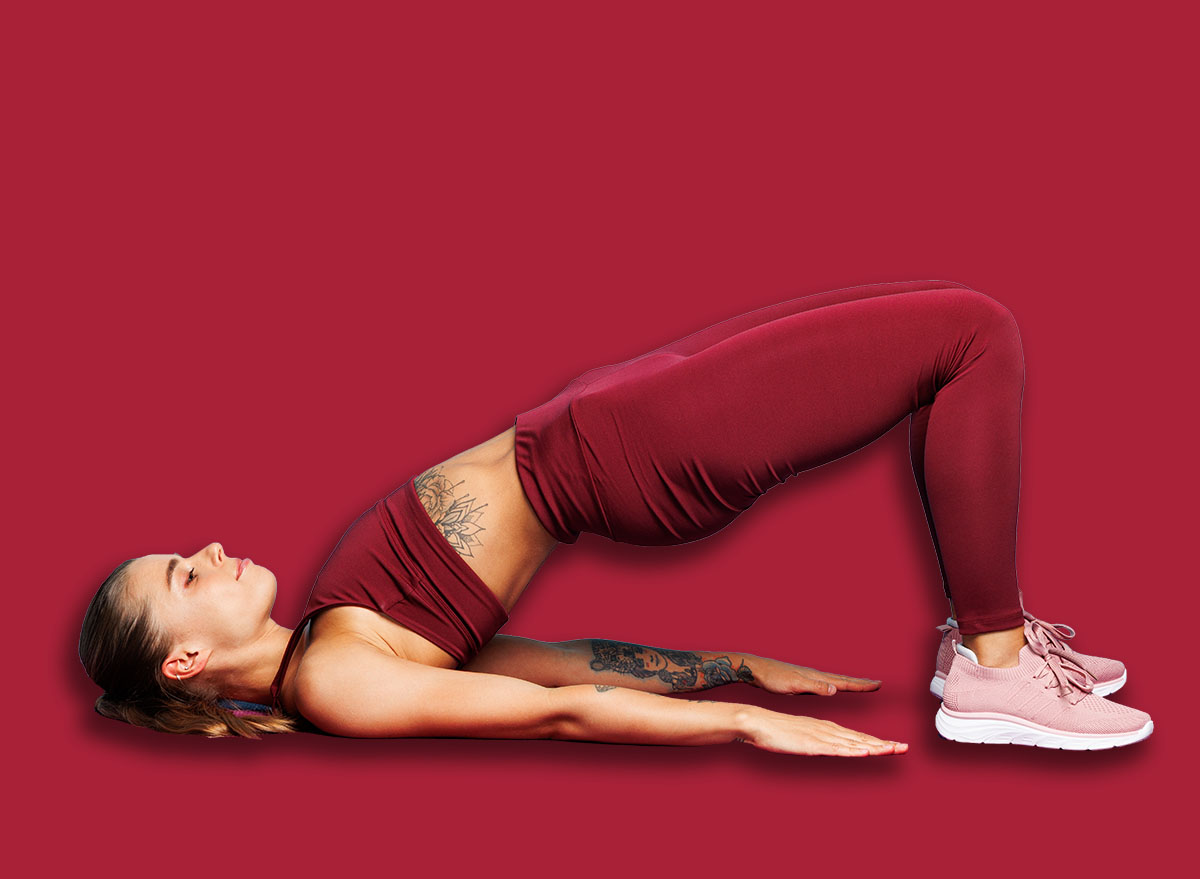
Posture starts at the hips, not the shoulders. Weak glutes allow the pelvis to tip forward or backward, disrupting spinal alignment. Glute bridge holds retrain hip extension and teach your body to stack the ribs over the pelvis. That foundation makes it easier to maintain an upright posture throughout the day.
Muscles Trained: Glutes, hamstrings, lower back stabilizers, and core.
How to Do It:
- Lie on your back with your knees bent and feet flat on the bed.
- Brace your core and press through your heels.
- Lift your hips until your body forms a straight line from shoulders to knees.
- Hold the position while breathing calmly.
- Lower your hips back down with control.
Recommended Sets and Reps: Perform 3 sets of 20 to 30 second holds. Rest for 40 seconds between each set.
Best Variations: Single leg bridge hold, marching bridge, longer holds.
Form Tip: Keep your ribs down and avoid arching your lower back.
Supine Chin Tucks
Forward head posture is one of the most common issues after 60. Supine chin tucks strengthen the deep neck flexors that pull your head back into alignment. This improves neck positioning without straining the spine. Over time, it reduces the tendency to jut your chin forward while sitting or standing.
Muscles Trained: Deep neck flexors, upper cervical stabilizers, and postural muscles of the neck.
How to Do It:
- Lie on your back with your head resting comfortably on the bed.
- Gently tuck your chin as if making a double chin.
- Hold the position while keeping your head on the bed.
- Relax back to neutral.
- Repeat with slow, controlled reps.
Recommended Sets and Reps: Perform 3 sets of 8 to 12 reps. Rest for 30 seconds between each set.
Best Variations: Longer holds, towel-assisted chin tucks, alternating hold reps.
Form Tip: Think slide your head back, not lifting it up.
Prone Y Raises
Upper back weakness is a major driver of rounded shoulders. Prone Y raises activate the muscles that hold your shoulder blades down and back. This helps counteract years of slouching and screen time. Strengthening these muscles makes upright posture feel natural instead of forced.
Muscles Trained: Lower trapezius, mid back, rear delts, and spinal stabilizers.
How to Do It:
- Lie face down on the bed with your arms overhead in a Y shape.
- Gently brace your core and squeeze your shoulder blades.
- Lift your arms a few inches off the bed.
- Pause briefly at the top.
- Lower your arms back down with control.
Recommended Sets and Reps: Perform 3 sets of 10 to 14 reps. Rest for 45 seconds between each set.
Best Variations: T raises, W raises, alternating arm lifts.
Form Tip: Lift with your upper back, not momentum.
Dead Bug Hold
Core stability plays a huge role in posture, especially through the midsection. Dead bug holds teach your core to stabilize while your arms and legs move. This mirrors how posture is maintained during walking and daily activity. A stronger, more responsive core helps keep your spine aligned all day.
Muscles Trained: Transverse abdominis, rectus abdominis, hip flexors, and spinal stabilizers.
How to Do It:
- Lie on your back with your arms pointed toward the ceiling and knees bent at ninety degrees.
- Brace your core and press your lower back gently into the bed.
- Extend one arm and the opposite leg away from your body.
- Hold briefly without arching your back.
- Return to the start and switch sides.
Recommended Sets and Reps: Perform 3 sets of 8 to 10 reps per side. Rest for 40 seconds between each set.
Best Variations: Longer holds, arms only dead bug, legs only dead bug.
Form Tip: If your lower back lifts, shorten the range.
Side-lying Thoracic Openers
Stiffness through the upper spine limits your ability to stand tall. Thoracic openers restore rotation and extension in the mid back. This helps your shoulders sit back naturally and reduces the rounded posture that creeps in with age. It also feels great on tight upper backs.
Muscles Trained: Thoracic spine muscles, obliques, upper back, and shoulder stabilizers.
How to Do It:
- Lie on your side with your knees bent and arms extended in front of you.
- Keep your knees stacked as you rotate your top arm open toward the bed.
- Follow your hand with your eyes as you rotate.
- Pause briefly at the end range.
- Return to the starting position and repeat.
Recommended Sets and Reps: Perform 2 to 3 sets of 6 to 8 reps per side. Rest for 30 seconds between each set.
Best Variations: Longer pauses, arm sweep circles, deeper range rotations.
Form Tip: Let the movement come from your upper back, not your lower spine.
Best Posture Reset Tips for Adults After 60

Restoring posture after 60 works best when strength, mobility, and awareness improve together. Bed exercises give you a controlled environment to retrain alignment without fighting gravity or balance. The key is consistency and attention to detail.
- Practice daily resets: Doing these movements once or twice per day reinforces better posture patterns.
- Move slowly on purpose: Slower reps improve muscle activation and body awareness.
- Check posture during the day: Use mirrors, reflections, or brief posture scans to reinforce progress.
- Breathe with intention: Calm breathing helps reduce tension that pulls posture out of alignment.
- Progress gradually: Increase holds and reps before adding difficulty or range.
Stick with these exercises for a few weeks, and you’ll likely notice you’re standing taller, sitting straighter, and feeling more comfortable in your body throughout the day.
References
- Rath, Ruth, and Michael G Wade. “The Two Faces of Postural Control in Older Adults: Stability and Function.” EBioMedicine vol. 21 (2017): 5-6. doi:10.1016/j.ebiom.2017.03.030
- Daneshmandi, Hadi et al. “Adverse Effects of Prolonged Sitting Behavior on the General Health of Office Workers.” Journal of lifestyle medicine vol. 7,2 (2017): 69-75. doi:10.15280/jlm.2017.7.2.69