5 Home Exercises That Firm Arm Jiggle Faster Than Gym Sessions After 60
If you’ve reached 60, you may have noticed a bit of an arm jiggle action—and are not too happy about it. This occurs due to several reasons, including the loss of lean muscle and collagen, and an accumulation of fat in the triceps. This fat stores in the upper arms as metabolism declines, skin gets thinner, and it doesn’t snap back in place like it used to. You may have a few words for this pesky fat, but it’s also known as “bat wings” or “turkey wings.”
“As we age, one of the most common areas where people notice changes is their upper arms. Your skin can appear looser and start to sag, your muscle mass gradually declines, and the back of the arms, in particular, can start to lose their firmness,” explains Emily Schofield, Certified Personal Trainer and Gym Manager at Ultimate Performance, the global benchmark in personal training since 2009. “The march of Father Time is inevitable, and as we get older, we have to accept that the physiology of our bodies is going to change. But what is not inevitable is accepting that being over 60 means you can’t build stronger, more sculpted arms. I’ve trained hundreds of clients in their 60s who are proof that, with the right strength training-based exercises and following the principles of progressive overload, older adults can significantly improve their upper arm strength and muscularity.”
When training your upper arms effectively, it’s less about performing countless toning exercises that require hundreds of reps.
“Building firmer arms actually requires a good understanding of the anatomy of the upper arm, training both the biceps and triceps effectively, and progressively challenging the muscles over time,” Schofield adds.
Below, she shares five at-home exercises you can do to firm arm jiggle faster than gym sessions after 60.
Dumbbell Hammer Curls
“Hammer curls are one of the best arm exercises for older adults because they train not just the biceps, but also the brachialis and brachioradialis muscles that contribute to fuller-looking arms and improved grip strength,” Schofield explains. “Unlike traditional curls, hammer curls use a neutral grip, which is often more joint-friendly for aging wrists, elbows, and shoulders. As a general rule, neutral-grip pressing and pulling variations can be more comfortable for older trainees dealing with shoulder issues.”
- Begin seated with your feet flat on the floor.
- Hold a dumbbell in each hand, using a neutral grip.
- Keep your arms completely extended at your sides and relax your shoulders.
- With your palms facing inward, curl the weights up toward your shoulders.
- Use control to lower.
Overhead Tricep Extension
“If the goal is firmer-looking upper arms, overhead triceps extensions should be a priority. Since the long head of the triceps contributes heavily to arm mass, training the arm overhead is particularly effective because it places the muscle into a fully lengthened position. Overhead extension exercises are one of the best ways to train the long head of the triceps through its full range,” Schofield notes.
- Stand tall, feet hip-width apart, holding a dumbbell with both hands. (Alternatively, begin seated on a sturdy chair or workout bench with your feet planted on the ground.)
- Lift the weight overhead.
- Keep your elbows close to your ears as you slowly lower the dumbbell toward the back of your head, feeling the stretch in your triceps.
- Use control to press the weight back overhead.
Incline Pushups
“Pushups remain one of the most effective upper-body exercises because they simultaneously train the chest, shoulders, and triceps. However, standard floor push-ups may be too difficult for many adults over 60, at least initially,” Schofield says. “Instead, using an elevated variation, for example by using a countertop, sturdy bench, or even your sofa, makes the movement more accessible while still delivering excellent arm-training benefits.”
- Use a stable surface like a wall, countertop, plyometric box, or workout bench, and place your hands on it, shoulder-width apart.
- Walk your legs back so you’re at a straight incline from your head to your heels.
- Keep your legs together and rise onto the balls of your feet. Engage your core and keep your gaze forward.
- Bend your elbows to lower your body until your chest lines up with your elbows.
- Return to straight arms.
Resistance Band Rows
“Although rows are typically thought of as a back exercise, they are excellent for improving arm firmness because they heavily recruit the biceps and forearms while strengthening the upper back and posture,” Schofield tells us. “Poor posture tends to worsen with age due to muscle loss and inactivity, and this can make the arms appear softer and less defined. Strengthening the upper back improves shoulder positioning and creates a more athletic-looking upper body overall.”
- Begin by anchoring a resistance band to a sturdy pole at chest level.
- Stand tall, facing the anchor point.
- Hold the handles with both hands.
- Bend your elbows and pull the band toward your body.
- Squeeze your shoulder blades together.
- Extend your arms back to the start position.
RELATED: Are Pushups Every Day Enough to Build Upper Body Strength?
Dumbbell Split Squats
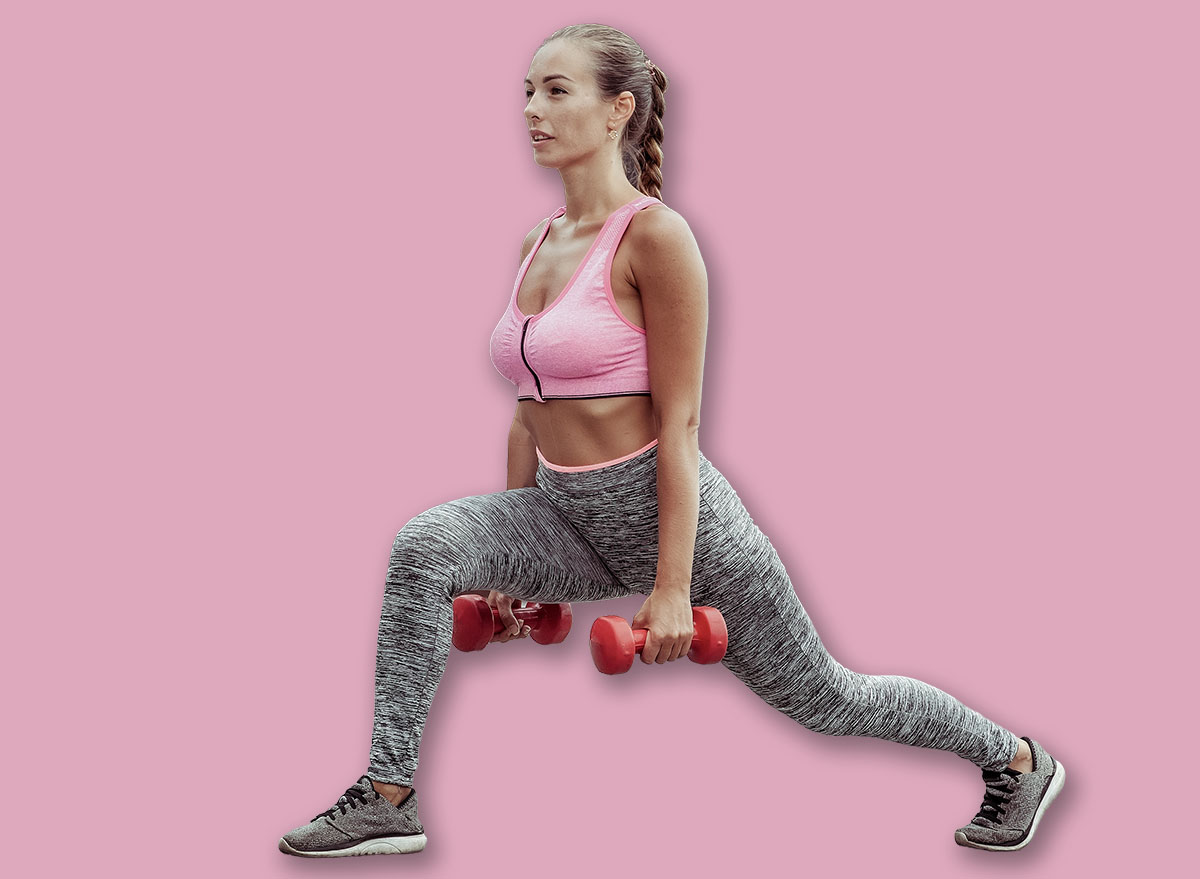
“At first glance, split squats may not seem like an arm exercise, but they are one of the best total-body movements for older adults because they allow your arms to hold significant resistance while the lower body works,” Schofield explains. “Holding dumbbells during split squats forces the arms, shoulders, grip, and upper back to stabilize the load throughout the exercise. This creates additional muscular tension across the entire upper body while also improving lower-body strength, balance, and coordination.”
- Begin standing tall in a split stance with a dumbbell in each hand.
- Maintain a tall chest and braced core.
- Bend both knees to lower toward the floor.
- Descend until your front thigh becomes parallel to the ground.
- Press through your front heel to rise back up.
- Repeat on the other side.