5 Home Exercises That Firm Bra Bulge Faster Than Gym Sessions After 55
“Bra bulge” is the catchy phrase people often use for the area around the upper back, sides of the chest, and underarm line. The term gets attention, but the real focus is upper-body strength, posture, and overall body composition. After 55, training the muscles around your back, shoulders, chest, and arms can help that area look firmer, feel stronger, and sit better in the way your body carries itself.
The best approach combines muscle-building work with habits that support overall fat loss. Your body changes shape when you build lean muscle, move consistently, and keep nutrition aligned with your goals. Training the upper back and shoulders can make the area look more lifted and supported, while regular movement helps your body composition shift in the right direction over time.
As a coach, I’d treat this as an upper-body tone-and-posture routine. Rows, pull-aparts, push-ups, raises, and loaded carries all target the muscles that frame the upper back and underarms. You can get plenty done at home with a band, a pair of dumbbells, and your own bodyweight. The setup stays simple, but the work still delivers when your reps stay controlled and intentional.
This routine gives your upper body a practical mix of pulling, pressing, raising, carrying, and bracing. You’ll strengthen your back, shoulders, chest, arms, and core in a way that supports a firmer look and better posture. Keep the resistance challenging, move with control, and let consistency do what it does best.
Standing Band Rows
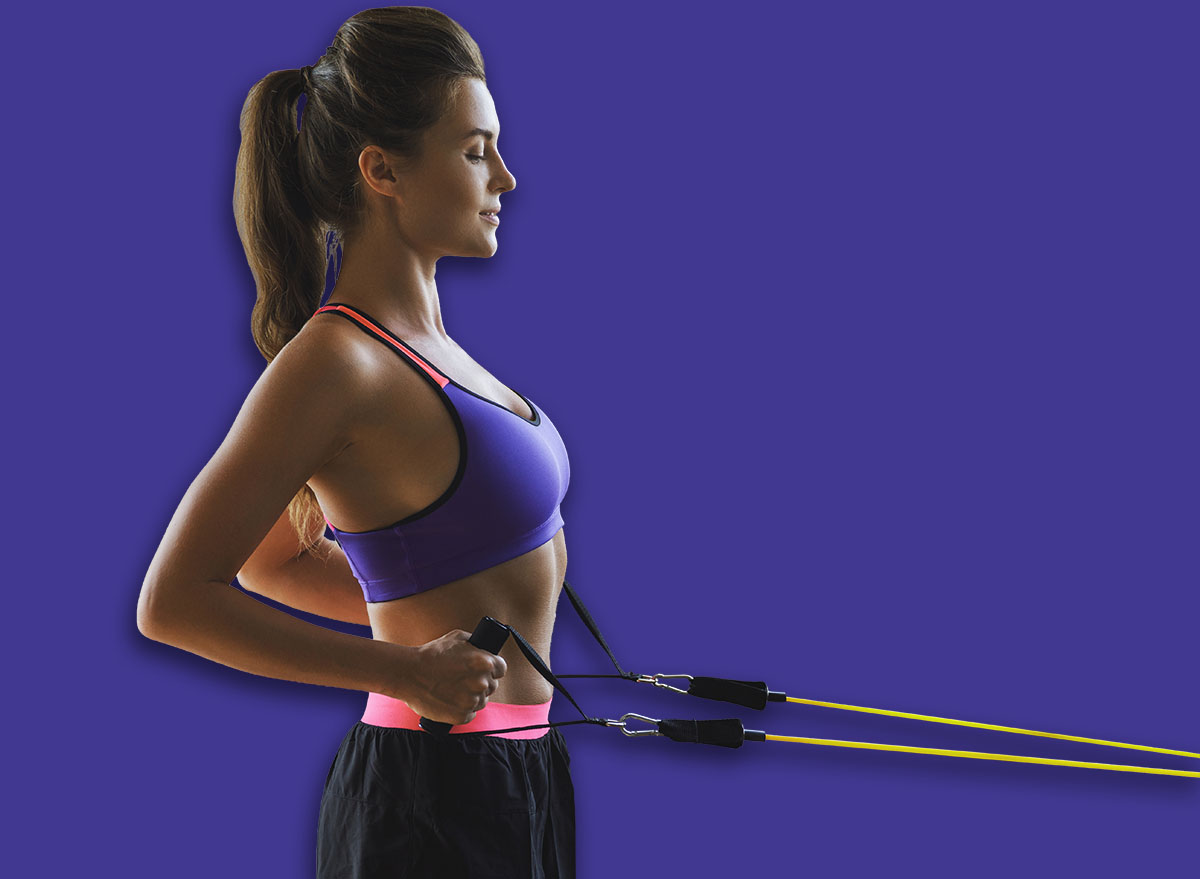
Standing band rows train your upper back, lats, rear shoulders, biceps, and core. The upper back plays a big role in how the area around the bra line and underarms looks, because stronger back muscles help your shoulders sit in a better position. The band provides smooth tension throughout the full rep, making the movement easy to control and repeat at home. Focus on pulling your elbows back and squeezing your shoulder blades so your back does the work, not your arms.
Muscles Trained: Upper back, lats, rear delts, biceps, core.
How to Do It:
- Anchor a resistance band at chest height.
- Stand tall and hold one end of the band in each hand.
- Step back until the band has light tension.
- Brace your core and keep your chest lifted.
- Pull your elbows back toward your ribs.
- Return your hands forward with control.
Recommended Sets and Reps: Perform 3 sets of 10 to 15 reps. Rest for 45 seconds between each set.
Best Variations: Single-arm band rows, paused band rows, seated band rows.
Form Tip: Pull through your elbows and keep your shoulders away from your ears.
Band Pull-Aparts
Band pull-aparts train your rear shoulders and upper back, two areas that help create a stronger, more supported upper-body frame. Pulling the band apart strengthens the muscles that help your shoulders sit tall and your chest stay open. That can help the upper back and underarm area look firmer while also improving how your posture feels during the day. Keep the movement smooth, pause at the end, and squeeze between your shoulder blades before returning to the start.
Muscles Trained: Rear delts, upper back, rhomboids, core.
How to Do It:
- Stand tall and hold a resistance band at chest height.
- Place your hands slightly wider than shoulder width.
- Brace your core and keep a soft bend in your elbows.
- Pull the band apart until your hands move toward your sides.
- Squeeze your shoulder blades together.
- Return to the starting position with control.
Recommended Sets and Reps: Perform 3 sets of 12 to 15 reps. Rest for 30 to 45 seconds between each set.
Best Variations: Underhand pull-aparts, diagonal pull-aparts, paused pull-aparts.
Form Tip: Keep your ribs down and avoid shrugging as the band stretches.
Incline Push-Ups
Incline push-ups train your chest, shoulders, triceps, and core while keeping the setup friendly for home workouts. The chest and shoulders help frame the area around the underarm line, and the triceps add firmness through the back of the upper arm. The incline gives you room to build clean pressing strength before moving closer to the floor. Choose a counter, bench, or sturdy surface that lets you move with control and finish each rep strong.
Muscles Trained: Chest, shoulders, triceps, core.
How to Do It:
- Place your hands on a counter, bench, or sturdy elevated surface.
- Step your feet back until your body forms a straight line.
- Brace your core and keep your hips level.
- Lower your chest toward the surface with control.
- Press through your hands to return to the starting position.
- Repeat without letting your hips sag.
Recommended Sets and Reps: Perform 3 sets of 8 to 12 reps. Rest for 45 to 60 seconds between each set.
Best Variations: Wall push-ups, counter push-ups, lower incline push-ups.
Form Tip: Keep your elbows angled slightly back and press through your whole hand.
Prone Y Raises
Prone Y raises train your lower traps, rear shoulders, and upper back. These smaller posture muscles help your shoulders sit in a stronger position, which can make the upper back look more lifted and supported. The movement doesn’t need a big range to work well. Small, controlled lifts with a gentle squeeze at the top can quickly light up the right muscles. Think of this as a posture-strength drill that brings more shape and support to the upper back.
Muscles Trained: Rear delts, lower traps, upper back, shoulders.
How to Do It:
- Lie on your stomach with your arms reaching overhead in a Y shape.
- Point your thumbs toward the ceiling.
- Brace your core lightly and keep your neck long.
- Lift your arms a few inches off the floor.
- Squeeze your shoulder blades gently.
- Lower your arms with control.
Recommended Sets and Reps: Perform 3 sets of 10 to 12 reps. Rest for 30 seconds between each set.
Best Variations: Prone T raises, prone W raises, paused Y raises.
Form Tip: Lift from your upper back and keep your shoulders away from your ears.
Farmer Carry
Farmer carries train your grip, shoulders, upper back, core, and posture while you walk under load. Holding weights at your sides gives your upper back a strong reason to stay active, and your core helps keep your body tall with every step. Carries also bring more total-body effort into the routine, which helps support body-composition goals. A simple walk with dumbbells can do a lot when you stay tall, keep the weights controlled, and move with purpose.
Muscles Trained: Upper back, shoulders, grip, core, glutes.
How to Do It:
- Hold a dumbbell or kettlebell in each hand.
- Stand tall with your shoulders down and back.
- Brace your core before you start walking.
- Walk forward with controlled steps.
- Keep your chest lifted and your posture strong.
- Set the weights down with control when the carry ends.
Recommended Sets and Reps: Perform 3 carries of 30 to 45 seconds. Rest for 60 seconds between each carry.
Best Variations: Lighter farmer carries, heavier farmer carries, suitcase carries.
Form Tip: Walk tall and avoid letting the weights pull your shoulders forward.
How to Firm the Upper Back Area After 55

A firmer upper back comes from building muscle, improving posture, and supporting healthy body composition. The exercises above train the muscles that shape your back, shoulders, chest, and arms, while regular movement and smart nutrition help the visual changes show over time. Keep the routine simple enough to repeat and challenging enough to make your muscles respond.
- Train your upper back often: Rows, pull-aparts, and Y raises strengthen the muscles that support better shoulder position. A stronger upper back can help the area look more lifted and athletic.
- Balance pulling and pressing: Rows and pull-aparts build the back, while incline push-ups train the chest, shoulders, and triceps. That balance gives your upper body a stronger overall frame.
- Use carries for posture and total-body work: Farmer carries train the upper back while also challenging your grip, core, and legs. They’re simple, practical, and highly effective.
- Keep your reps smooth: Controlled reps keep tension on the muscles you want to train. Slow down, pause briefly, and make each set feel intentional.
- Support the work with daily movement: Walking, stairs, chores, and short movement breaks help increase daily calorie burn. Those habits pair well with strength work when body composition is the goal.
Think of “bra bulge” as an upper-back strength and body-composition goal. Build the muscles around your shoulders and back, maintain strong posture, and let consistent movement help the area look firmer over time.
References
- Eglseer D, Traxler M, Embacher S, Reiter L, Schoufour JD, Weijs PJM, Voortman T, Boirie Y, Cruz-Jentoft A, Bauer S; SO-NUTS consortium. Nutrition and Exercise Interventions to Improve Body Composition for Persons with Overweight or Obesity Near Retirement Age: A Systematic Review and Network Meta-Analysis of Randomized Controlled Trials. Adv Nutr. 2023 May;14(3):516-538. doi: 10.1016/j.advnut.2023.04.001. Epub 2023 Apr 6. PMID: 37028708; PMCID: PMC10201832.
- Roberts CK, Segovia DE, Lankford DE. Effects of Home-Based Exercise Training Systems, Combined with Diet, on Cardiometabolic Health. Int J Exerc Sci. 2019 May 1;12(2):871-885. doi: 10.70252/WEFP3647. PMID: 31156746; PMCID: PMC6533109.