5 Bed Exercises That Flatten Waist Thickening Faster Than Crunches After 60
Waist thickening can feel sneaky. One day, your midsection feels normal, then slowly your pants fit differently, your core feels less firm, and the area around your lower belly and sides starts to feel softer than before. After 60, that shift often comes from a mix of lower daily movement, gradual muscle loss, hormonal changes, and more time spent sitting than your core would prefer.
Crunches can make your abs burn, but they don’t solve the whole problem. Your waist won’t shrink because you hammer one small motion over and over. Your body loses fat through a calorie deficit, which means burning more calories than you take in over time. Core work still matters because stronger abs, obliques, hips, and deep core muscles help your midsection feel tighter and more supported as your body composition improves.
I like bed exercises for this goal because they give you a simple way to add more quality movement without making the day feel like it needs another workout appointment. You can do them before your feet hit the floor or before you wind down at night. The setup feels easy, but the right exercises still ask your core to brace, rotate, resist movement, and control your hips. That’s where they beat basic crunches.
These five moves train your lower abs, obliques, deep core, hips, and glutes from a supported position. Keep the reps slow, make the muscles do the work, and treat the bed like your built-in reminder to sneak in a few focused minutes.
Dead Bugs
Dead bugs train your lower abs and deep core while your arms and legs move away from your body. Your midsection has to keep your ribs and pelvis steady, which helps tighten the area around your waist better than crunches that only flex your spine. The movement also teaches your core to stay active while your limbs move, which carries over to walking, lifting, reaching, and getting out of bed with more control. Move slowly and keep your lower back gently pressed into the bed.
Muscles Trained: Lower abs, deep core, hip flexors, shoulders
How to Do It:
- Lie on your back with your arms reaching toward the ceiling.
- Lift your knees over your hips and bend them to 90 degrees.
- Press your lower back gently into the bed.
- Extend your right arm and left leg away from your body.
- Return to the starting position with control.
- Repeat on the opposite side.
Recommended Sets and Reps: Perform 3 sets of 8 to 10 reps per side. Rest for 30 seconds between each set.
Best Variations: Heel-tap dead bugs, same-side dead bugs, paused dead bugs
Form Tip: Move only as far as you can while keeping your lower back set.
Side Plank Holds
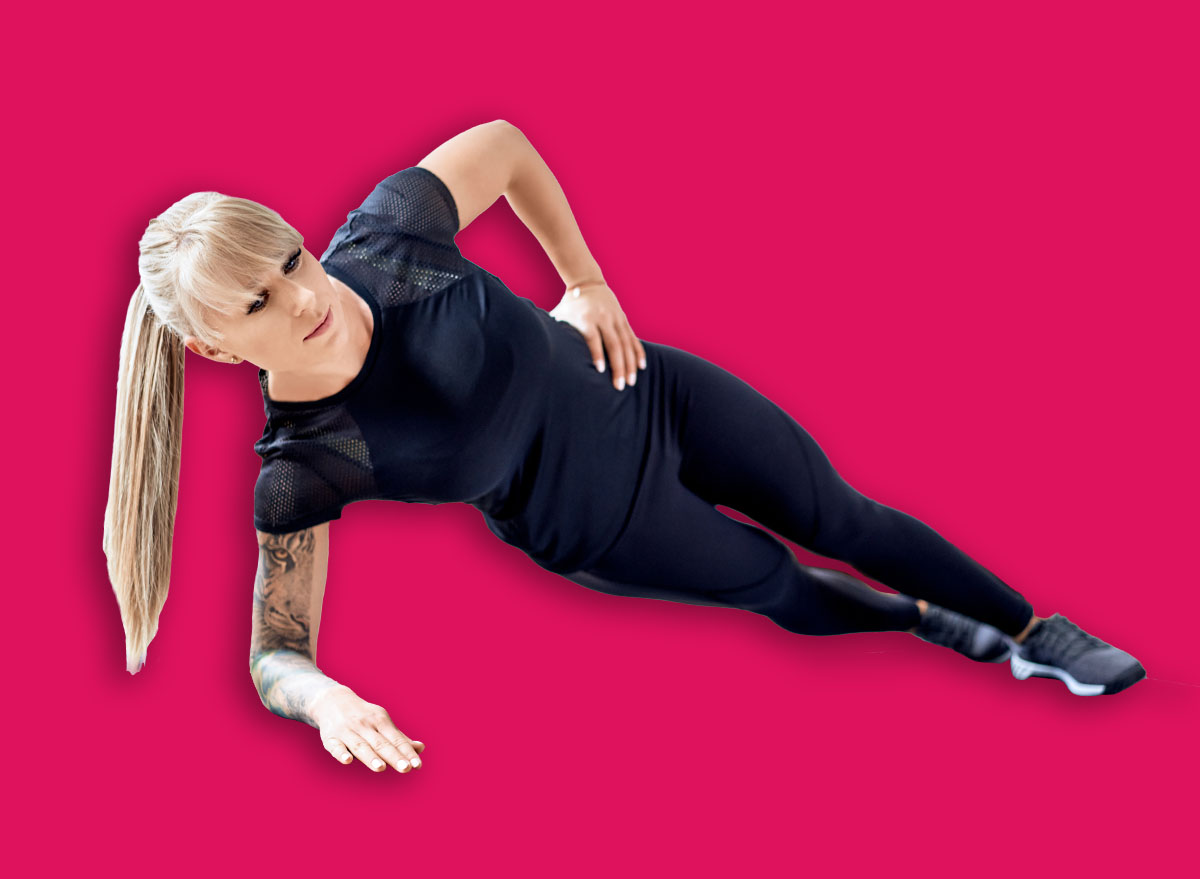
Side plank holds train your obliques, deep core, shoulders, and outer hips while your waist fights gravity. The muscles along the sides of your midsection have to stay engaged for the full hold, which makes side planks a strong choice for firming and thickening. Crunches mainly hit the front of your abs, while side planks build the side-body strength that helps your waist feel more supported. Start with the bent-knee version if the full hold feels too aggressive.
Muscles Trained: Obliques, core, shoulders, outer hips
How to Do It:
- Lie on your side with your forearm under your shoulder.
- Stack your feet or stagger them for more support.
- Brace your core and lift your hips off the bed.
- Keep your body in a straight line from head to heels.
- Hold the position while breathing steadily.
- Lower with control, then switch sides.
Recommended Sets and Reps: Perform 3 sets of 20 to 30 seconds per side. Rest for 30 seconds between each set.
Best Variations: Bent-knee side plank, staggered-feet side plank, side plank with top-leg lift
Form Tip: Press your forearm into the bed and keep your hips lifted.
Heel Taps
Heel taps train your lower abs by making your core control one leg at a time. As your heel lowers, your pelvis tends to tip forward, and your midsection has to stop it. That control helps your waist feel tighter because your core learns how to hold position instead of relying on momentum. Compared with crunches, heel taps do a better job of teaching the lower belly and deep core to work together.
Muscles Trained: Lower abs, deep core, hip flexors
How to Do It:
- Lie on your back with your knees bent over your hips.
- Press your lower back gently into the bed.
- Brace your core before moving your legs.
- Lower one heel toward the bed with control.
- Tap your heel lightly without relaxing your core.
- Bring your leg back up and switch sides.
Recommended Sets and Reps: Perform 3 sets of 10 to 12 reps per side. Rest for 30 seconds between each set.
Best Variations: Alternating heel taps, slower heel taps, extended-leg heel taps
Form Tip: Lower your heel only as far as your core can control.
Glute Bridge Marches
Glute bridge marches train your glutes, hamstrings, lower abs, and core while your hips stay lifted. Every time one foot leaves the bed, your waist and pelvis have to stay steady instead of shifting side to side. That makes the movement useful for flattening waist thickening because your core and hips learn to work together. Stronger glutes also help your posture and pelvic position, which can make your midsection feel more supported during the day.
Muscles Trained: Glutes, hamstrings, lower abs, core
How to Do It:
- Lie on your back with your knees bent and your feet flat on the bed.
- Press through your heels and lift your hips.
- Brace your core and squeeze your glutes.
- Lift one foot a few inches off the bed.
- Place your foot back down with control.
- Alternate sides while keeping your hips lifted.
Recommended Sets and Reps: Perform 3 sets of 8 to 10 marches per side. Rest for 45 seconds between each set.
Best Variations: Glute bridge holds, mini-band glute bridges, single-leg glute bridge holds
Form Tip: Keep your hips level as each foot lifts.
Bent-Knee Windshield Wipers
Bent-knee windshield wipers train your obliques and deep core while your hips rotate side to side. Your waist has to control the motion as your knees move, building strength in the muscles that help shape and support your midsection. The bent-knee setup keeps the exercise more manageable than straight-leg versions while still giving your obliques real work. Keep the range small at first and let your core guide the movement.
Muscles Trained: Obliques, lower abs, deep core, hips
How to Do It:
- Lie on your back with your knees bent over your hips.
- Extend your arms out to your sides for support.
- Brace your core and keep your shoulders on the bed.
- Lower your knees toward one side with control.
- Bring your knees back to center.
- Lower your knees toward the opposite side and continue alternating.
Recommended Sets and Reps: Perform 3 sets of 8 to 10 reps per side. Rest for 30 seconds between each set.
Best Variations: Short-range wipers, slower wipers, feet-on-bed knee drops
Form Tip: Keep your shoulders down and move only as far as your waist can control.
How to Make Bed Core Work Help Your Waist

Flattening waist thickening takes more than a few ab exercises, but the right core work can help your midsection feel stronger, tighter, and more connected. Bed exercises make consistency easier because the routine has almost no setup. The key is staying controlled, keeping tension in the right muscles, and pairing the work with habits that support overall fat loss.
- Remember how fat loss works: Your waist changes as overall body fat trends down. Keep meals protein-focused, watch portions, and aim for a steady calorie deficit instead of chasing quick fixes.
- Train your core beyond crunches: Dead bugs, heel taps, side planks, and windshield wipers teach your abs and obliques to brace, rotate, and control your pelvis. That gives your waist more useful strength.
- Slow every rep down: Bed exercises lose value when your legs swing or your hips bounce. Slower reps keep tension in your lower abs and obliques longer.
- Keep your hips involved: Glute bridge marches help your core and hips work together. Stronger hips can improve posture and make your midsection feel more supported.
- Move more during the day: Walking, stairs, chores, and short movement breaks all add to calorie burn. Those small pieces matter when waist fat is the goal.
A flatter waist after 60 usually starts with a stronger, more responsive core and a routine you can repeat. Use these bed exercises as a low-friction way to build that consistency, then let daily movement and nutrition handle the body-composition side of the equation.
References
- Harris, M Brennan, and Chia-Hua Kuo. “Scientific Challenges on Theory of Fat Burning by Exercise.” Frontiers in physiology vol. 12 685166. 6 Jul. 2021, doi:10.3389/fphys.2021.685166