5 Morning Exercises That Firm Waist Thickening Faster Than Crunches After 60

If your goal is to firm up your waist, doing more crunches usually isn’t what moves the needle. Most people have gone down that road at some point, stacking reps, feeling a bit of a burn, and expecting that to translate into a tighter midsection. It rarely plays out that way, especially after 60. You might feel like you did something, but it doesn’t always carry over into how your waist actually looks or feels.
What I’ve seen work better, more often than not, is shifting toward exercises that engage your core while the rest of your body moves. That’s where things start to change. You’re not just isolating one small area; you’re getting more muscle involved, your heart rate comes up a bit, and your core has to stay engaged the entire time. That combination is what helps tighten things up in a more noticeable way.
Mornings are a great time to build this in because it sets the tone for the rest of your day. You don’t need a long routine or anything complicated. Just a few well-executed movements that wake your body up and get your core doing its job early. When you stay consistent with that, you’ll start to feel your midsection engage more naturally, and that’s when you begin to see the difference.
RELATED: 5 Daily Walking Moves That Restore Stair-Climbing Power Faster Than Gym Machines After 55
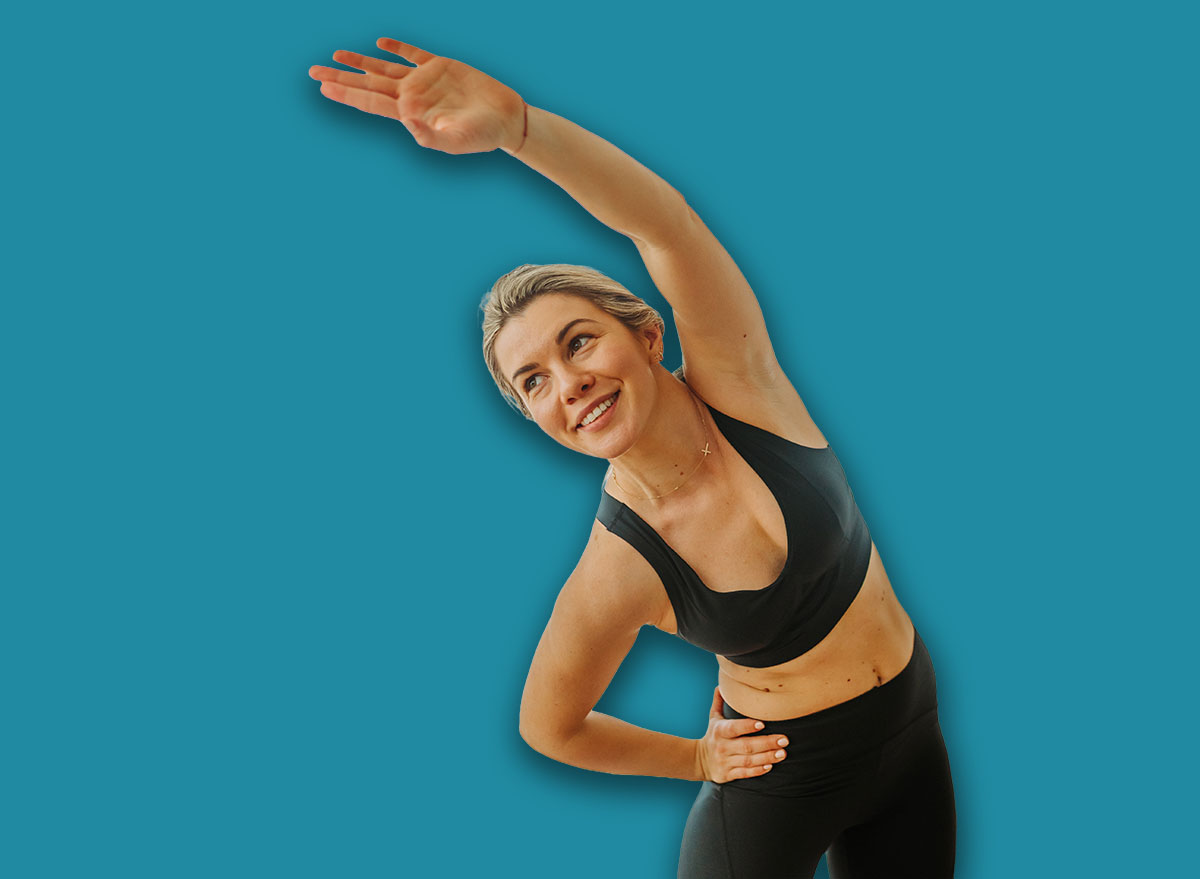
Standing Side Bend (Light Weight or Bodyweight)
Standing side bends are a great way to bring your obliques into the mix early without overcomplicating things. When you slow the movement down and stay in control, you can feel your side core working through the entire range. Most people go too fast or lean too far, but dialing it in makes a big difference.
Muscles Trained: Obliques and core stabilizers
How to Do It:
- Stand tall with your feet shoulder-width apart.
- Hold a lightweight in one hand or keep your hands at your sides.
- Slowly bend to one side.
- Keep your hips steady as you move.
- Return to the starting position with control.
- Alternate sides.
Recommended Sets and Reps: Perform 2 to 3 sets of 10 to 12 reps per side. Rest for 30 to 45 seconds between each set.
Best Variations: Bodyweight side bend, offset hold, slow tempo bend
Form Tip: Think about shortening the space between your ribcage and hip.
Marching in Place with Core Focus
Marching in place is one of the easiest ways to wake up your core first thing in the morning. Each time you lift a knee, your core has to stabilize to keep you from shifting. When you slow it down and stay tall, it hits more than you’d expect.
Muscles Trained: Core stabilizers, hip flexors, and lower abs
How to Do It:
- Stand tall with your hands at your sides.
- Lift one knee up toward hip height.
- Lower it back down with control.
- Alternate legs in a steady rhythm.
- Keep your posture tall throughout.
- Continue for the full set.
Recommended Sets and Reps: Perform 2 to 3 sets of 10 to 12 reps per leg. Rest for 30 to 45 seconds between each set.
Best Variations: Weighted march, slow march, hold and march
Form Tip: Avoid leaning back as you lift your knee.
Standing Rotation (Band or Bodyweight)
Standing rotations help loosen things up while getting your core to work through a range that is often ignored. Keeping the movement controlled lets your obliques actually do the work instead of just swinging through it.
Muscles Trained: Obliques, core stabilizers, and shoulders
How to Do It:
- Stand tall with your feet shoulder-width apart.
- Hold a light band or keep your hands together in front of you.
- Rotate your torso to one side.
- Keep your hips facing forward.
- Return to the center with control.
- Alternate sides.
Recommended Sets and Reps: Perform 2 to 3 sets of 10 to 12 reps per side. Rest for 30 to 45 seconds between each set.
Best Variations: Banded rotation, slow tempo rotation, pause rotation
Form Tip: Rotate through your torso, not just your arms.
Step-Back Lunges
Step-back lunges bring your lower body into the mix while your core works to keep everything steady. Stepping back gives you more control and usually feels better on the joints, especially first thing in the morning.
Muscles Trained: Glutes, quads, hamstrings, and core
How to Do It:
- Stand tall with your feet hip-width apart.
- Step one foot back into a lunge.
- Lower your back knee toward the ground.
- Keep your front knee stacked over your ankle.
- Push through your front foot to return to standing.
- Alternate legs.
Recommended Sets and Reps: Perform 2 to 3 sets of 8 to 10 reps per leg. Rest for 45 to 60 seconds between each set.
Best Variations: Bodyweight lunge, weighted lunge, slow tempo lunge
Form Tip: Stay tall and avoid leaning forward.
Plank with Shoulder Taps
Planks with shoulder taps clean things up a bit compared to just holding a plank. Instead of sitting there waiting for time to pass, you’re forcing your core to stay engaged while your body shifts side to side. That added movement is where it starts to feel different. You’ll notice pretty quickly if your hips start moving around, which is a good sign your core needs to step in and do more.
Muscles Trained: Core stabilizers, shoulders, and obliques
How to Do It:
- Start in a high plank position with your hands under your shoulders.
- Keep your body in a straight line from head to heels.
- Lift one hand and tap the opposite shoulder.
- Place your hand back down with control.
- Alternate sides with each tap.
- Keep your hips as steady as possible throughout.
Recommended Sets and Reps: Perform 2 to 3 sets of 10 to 12 taps per side. Rest for 30 to 45 seconds between each set.
Best Variations: Knee plank taps, slow tempo taps, pause taps
Form Tip: If your hips start rocking, slow it down and tighten your core before continuing.
The Best Tips for Firming Your Waist After 60

This is the part where most people either try to do too much or start bouncing between different routines. What tends to work better is keeping things simple and sticking with it long enough to actually see progress. Rather than a long list of exercises or a full morning workout to firm up your waist, a few solid movements, done well and consistently, will take you a lot further. I’ve seen people make more progress in 10 minutes a day than in workouts they do only once or twice a week. The key is making sure your core is actually working during those movements, not just going through the motions. When you start to feel that engagement carry over into the rest of your day, that’s when things really start to change.
- Keep it consistent: A short routine you’ll actually stick with will always beat something more intense that you skip.
- Slow your reps down: The more control you have, the more your core has to stay engaged.
- Stay on your feet: Standing exercises tend to carry over better into daily movement.
- Use more than one direction: Side-to-side and rotational work help bring your waist in more effectively.
- Focus on how it feels: If you’re not feeling your core, adjust the movement instead of just pushing through it.
- Keep moving throughout the day: Even light activity helps reinforce what you’re building in the morning.
References
- Harris, M Brennan, and Chia-Hua Kuo. “Scientific Challenges on Theory of Fat Burning by Exercise.” Frontiers in physiology vol. 12 685166. 6 Jul. 2021, doi:10.3389/fphys.2021.685166
- Schumacher, Leah M et al. “Consistent Morning Exercise May Be Beneficial for Individuals With Obesity.” Exercise and sport sciences reviews vol. 48,4 (2020): 201-208. doi:10.1249/JES.0000000000000226