4 Wall Exercises That Restore Leg Strength Faster Than Yoga After 60
Yoga can be a great tool after 60. It helps with mobility, breathing, balance, and body awareness, and it can make stiff joints feel a lot less cranky. Restoring leg strength, though, usually needs a more direct strength signal. Your quads, glutes, hamstrings, calves, and hips need to push, hold, stabilize, and control your body through positions that carry over to daily life.
Wall exercises give you a strong middle ground. You get support from the wall, but your legs still have to do the work. That support can make training feel more approachable if balance, knee comfort, or confidence limit how hard you push during regular lower-body exercises. The wall also gives you instant feedback on posture, depth, and control, which helps you clean up your reps without overthinking every detail.
I like wall-based lower-body work because it makes strength training feel simple without watering it down. A wall sit can light up your quads fast. Wall marches build hip and single-leg control. Wall-supported split squats train each leg with more confidence. Wall hip hinges teach your glutes and hamstrings to help support your lower body. Together, these moves build the kind of leg strength that helps with stairs, walking, standing up, and moving through the day with more confidence.
Wall Sits
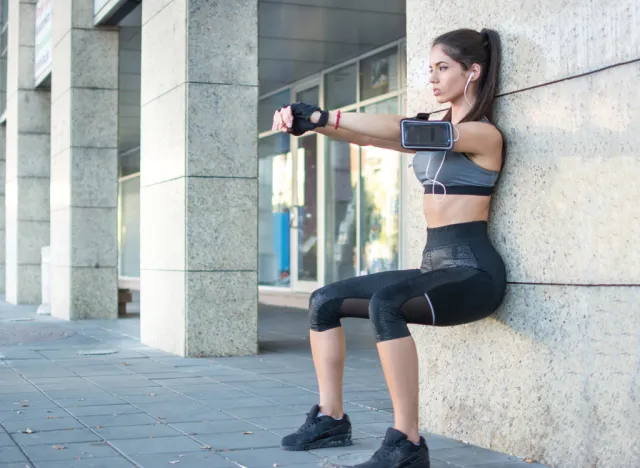
Wall sits train your quads, glutes, hamstrings, and core while your back stays supported against the wall. Holding the position builds strength and endurance through your legs without requiring repeated squatting. That makes wall sits useful after 60 because your legs have to stay active under tension, which carries over to standing longer, climbing stairs, and lowering yourself into a chair with more control. Compared with yoga, this move gives your legs a more direct strength challenge while still keeping the setup simple.
Muscles Trained: Quadriceps, glutes, hamstrings, core.
How to Do It:
- Stand with your back against a wall.
- Walk your feet forward slightly.
- Slide down the wall until your knees bend comfortably.
- Brace your core and keep your back against the wall.
- Hold the position while breathing steadily.
- Stand back up with control.
Recommended Sets and Reps: Perform 3 sets of 20 to 30 second holds. Rest for 45 seconds between each set.
Best Variations: Higher wall sits, lower wall sits, wall sits with heel raises.
Form Tip: Keep your feet flat and your knees tracking over your toes.
Wall Marches
Wall marches target your hip flexors, quads, glutes, calves, and core while providing support as you shift weight from one leg to the other. Each knee lift asks the standing leg to stabilize while the lifted leg moves with control. That single-leg demand helps rebuild strength for walking, stairs, stepping over objects, and staying steady when your weight shifts. The wall provides enough support to move confidently while your legs and hips do the work.
Muscles Trained: Hip flexors, quadriceps, glutes, calves, core.
How to Do It:
- Stand facing a wall with your hands lightly placed against it.
- Step your feet hip-width apart.
- Brace your core and stand tall.
- Lift one knee toward your waist.
- Lower your foot back to the floor with control.
- Alternate legs in a steady rhythm.
Recommended Sets and Reps: Perform 3 sets of 10 to 12 reps per leg. Rest for 30 seconds between each set.
Best Variations: Paused wall marches, slower wall marches, hands-free marches.
Form Tip: Stay tall and avoid leaning your chest into the wall.
Wall-Supported Split Squats
Wall-supported split squats target your quads, glutes, hamstrings, and core while also providing a little balance help. The staggered stance makes your front leg work harder, while the wall keeps the movement from turning into a wobble contest. This helps restore leg strength because each leg gets direct work through a useful range of motion, and your hips have to stay steady as you lower and stand. Stronger split squats carry over to stairs, stepping, walking, and getting up from lower positions.
Muscles Trained: Quadriceps, glutes, hamstrings, core.
How to Do It:
- Stand beside a wall with one hand lightly touching it.
- Step one foot forward and one foot back into a split stance.
- Brace your core and keep your torso tall.
- Lower your back knee toward the floor with control.
- Press through your front foot to return to standing.
- Complete all reps, then switch sides.
Recommended Sets and Reps: Perform 3 sets of 8 to 10 reps per leg. Rest for 45 seconds between each set.
Best Variations: Shorter stance split squats, split squat holds, and assisted reverse lunges.
Form Tip: Use the wall for balance, not to pull yourself up.
Hip Hinge to Wall
The hip hinge to wall trains your glutes, hamstrings, lower back, and core while teaching your hips to move with control. Reaching your hips back toward the wall gives you a clear target, which helps you learn the hinge pattern without guessing. That pattern matters after 60 because bending, lifting, walking uphill, and standing tall all rely on stronger glutes and hamstrings. Yoga can help you move better, but hip hinges give the backs of your legs a more direct role in strength building.
Muscles Trained: Glutes, hamstrings, lower back, core.
How to Do It:
- Stand about a foot in front of a wall with your back facing it.
- Place your feet hip-width apart.
- Brace your core and soften your knees.
- Push your hips back toward the wall.
- Tap the wall lightly with your hips.
- Drive your hips forward to return to standing.
Recommended Sets and Reps: Perform 3 sets of 10 to 12 reps. Rest for 45 seconds between each set.
Best Variations: Bodyweight good mornings, banded good mornings, dumbbell RDLs.
Form Tip: Move through your hips and keep your spine long.
How to Build Stronger Legs With Wall Support
Wall exercises work best when the wall helps you move better without taking the effort away from your legs. Keep your contact light, slow the reps down, and focus on feeling your quads, glutes, hamstrings, and hips do their share. The wall should give you confidence, not a free ride.
- Use holds to build strength: Wall sits and split squat holds keep your legs under tension. That steady effort helps rebuild strength without needing heavy equipment.
- Train one-leg control: Wall marches and split squats give each leg its own work. Single-leg control matters for walking, stairs, curbs, and balance.
- Strengthen the back of your legs: Hip hinges teach your glutes and hamstrings to support bending and standing. Stronger hips can make your legs feel more powerful and your lower back feel less overworked.
- Keep the range comfortable: You don’t need to slide into the deepest wall sit or longest split squat stance on day one. Start where the movement feels clean, then build from there.
- Progress gradually: Add a few seconds to holds, add reps, slow the tempo, or reduce the amount of support you use. Small progressions keep the routine productive without making it feel overwhelming.
Wall work gives you a simple way to build leg strength without needing a yoga mat, gym machines, or a complicated routine. Use the support, keep your reps clean, and let your legs earn more strength one controlled set at a time.
References
- García-Hermoso A, Cavero-Redondo I, Ramírez-Vélez R, Ruiz JR, Ortega FB, Lee DC, Martínez-Vizcaíno V. Muscular Strength as a Predictor of All-Cause Mortality in an Apparently Healthy Population: A Systematic Review and Meta-Analysis of Data From Approximately 2 Million Men and Women. Arch Phys Med Rehabil. 2018 Oct;99(10):2100-2113.e5. doi: 10.1016/j.apmr.2018.01.008. Epub 2018 Feb 7. PMID: 29425700.
- Zabarmawi J, Miller CT, Owen PJ, Mundell NL, Meny A, Aldhafri S, Banjar R, Alzahrani H. Efficacy of an acute bout of isometric wall squat exercise on pain sensitivity and clinical pain intensity in adults with knee osteoarthritis: a randomised controlled trial in outpatient physiotherapy clinics in Saudi Arabia. BMJ Open. 2025 Dec 11;15(12):e103756. doi: 10.1136/bmjopen-2025-103756. PMID: 41381113; PMCID: PMC12699666.