5 Chair Exercises That Firm Lower Belly Faster Than Crunches After 60
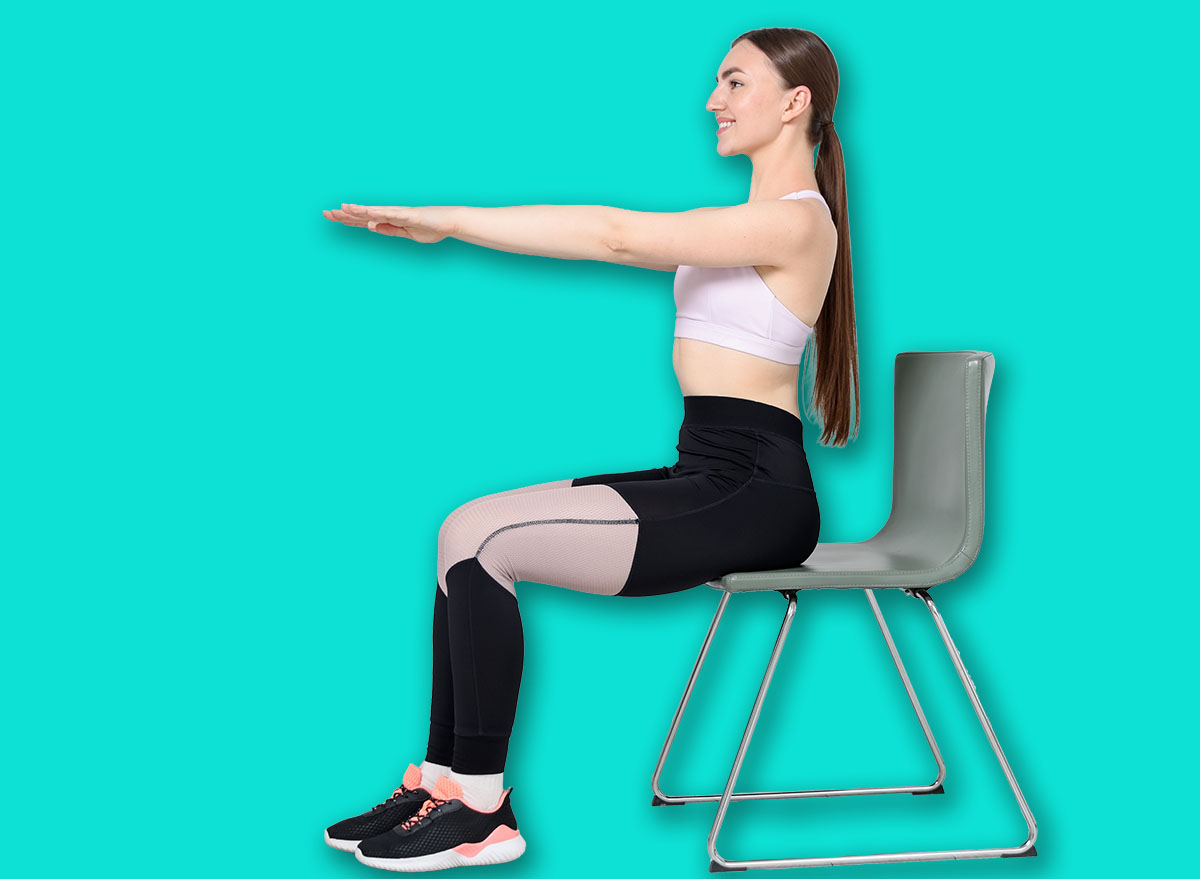

Many people believe that crunches are an effective way to burn stubborn belly fat. While this classic ab exercise can be a solid addition to a well-rounded workout, it isn’t the best way to address this area of the body. Tightening and toning the lower belly requires establishing a calorie deficit, adopting healthy lifestyle habits, and following just the right workout.
The good news is, if getting down on—and up from—the ground feels challenging in this stage of life, all you really need is a sturdy chair to get started on a productive, sustainable fitness routine. We spoke with Dr. Andrew Gorecki, PT, DPT, FAFS, Owner of Superior Physical Therapy in Traverse City, MI, and co-founder/CEO of MovementRx, a remote therapeutic monitoring platform used by PT clinics nationwide, who suggests including chair exercises in your routine. Dr. Gorecki works regularly with older adults on core function, balance, and fall prevention, and shares five stellar chair exercises that can help firm your lower belly.
Before getting started, it’s important to keep in mind that you cannot spot-reduce fat. When you shed fat, you lose it throughout your entire body—not just in one specific area.
“What chair exercises *can* do, and what matters far more after 60, is rebuild deep core control, lumbopelvic stability, and the kind of trunk function that protects the low back, improves posture, and reduces fall risk,” Dr. Gorecki explains. “The ‘firmer-looking’ midsection people see is usually the result of better postural control and deep core activation, not fat loss.”
Crunches fire up the surface six-pack muscles, while your lower belly is controlled by the transverse abdominis (TA), otherwise known as the “corset muscle.” According to Dr. Gorecki, you train the TA by intentional breathing and bracing your core—not by simply curling up off the mat. That’s where these chair exercises come into play.
“After 60, the best core exercise is the one you’ll actually do every day. A chair-based routine you can do during a TV commercial beats a perfect floor program you’ll skip,” Dr. Gorecki shares.
Seated Marches
“This exercise targets the transverse abdominis and hip flexors together—the foundation of lower-core control,” Dr. Gorecki says.
- Begin seated on a chair with your feet placed hip-width apart on the floor.
- Gently draw your lower belly inward.
- Slowly lift one knee up to hip height.
- Lower.
- Alternate sides in a “marching” fashion.
Seated Heel Slides
“This exercise trains the lower abdominals to stabilize the pelvis while a limb moves—the exact pattern that protects the low back in daily life,” Dr. Gorecki shares.
- Begin seated on a chair with your feet placed hip-width apart on the floor.
- Gently draw your lower belly inward.
- Slide one heel forward along the ground until your leg is almost straight.
- Return to the start position.
- Alternate sides.
Seated Knee-To-Chest With Exhale
“The full exhale is the key—it engages the deep core (transverse abdominis and pelvic floor) far more than holding the breath,” Dr. Gorecki tells us.
- Begin seated on a chair with your feet placed hip-width apart on the floor.
- Gently draw your lower belly inward.
- As you brace your core, fully exhale and draw one knee in toward your chest.
- Return to the start position.
- Repeat on the other side.
Seated Trunk Rotations With Reach
“This exercise targets the obliques, which form the ‘corset’ of the waistline and are dramatically underused after 60,” Dr. Gorecki says.
- Begin seated on a chair with your feet placed hip-width apart on the floor.
- Place one hand lightly on the opposite knee or armrest of the chair.
- Rotate your trunk slowly toward the side where your hand rests on the knee.
- Return.
- Alternate sides.
Seated Pelvic Tilts
“This exercise looks subtle, works the deep stabilizers, and restores the lumbopelvic rhythm most adults lose by their 60s,” Dr. Gorecki says.
- Begin seated on a chair with your feet placed hip-width apart on the floor.
- Rock your pelvis forward and back in small, controlled movements.