5 Standing Exercises That Flatten Your Stomach Faster Than Gym Machines After 60
A flatter stomach after 60 usually takes more than sitting on an ab machine and cranking through reps. Your midsection has to brace when you carry weight, stay steady when you squat, control rotation when you turn, and help your hips and shoulders work together. That’s why standing exercises can feel so much more useful. They train your core while the rest of your body actually moves.
Gym machines can help you work your abs, but they often take away the balance and full-body control your stomach needs during real life. Standing work brings those pieces back in. A dumbbell, kettlebell, or resistance band provides enough load to challenge your muscles, while your core must keep your posture strong from start to finish.
When I coach stomach-focused training, I’m not looking for the fanciest ab move in the room. I’m looking for exercises that make the core do its real job: brace, resist twisting, control the ribs and pelvis, and support bigger movement. That approach gives you more value than another round of machine crunches, especially when you pair the work with walking, strength training, and nutrition that supports fat loss.
These five standing exercises blend core work and compound strength. You’ll squat, carry, press, rotate, and resist rotation using dumbbells, kettlebells, and bands. The result is a stomach-focused routine that trains your abs while also engaging your legs, glutes, shoulders, back, and grip.
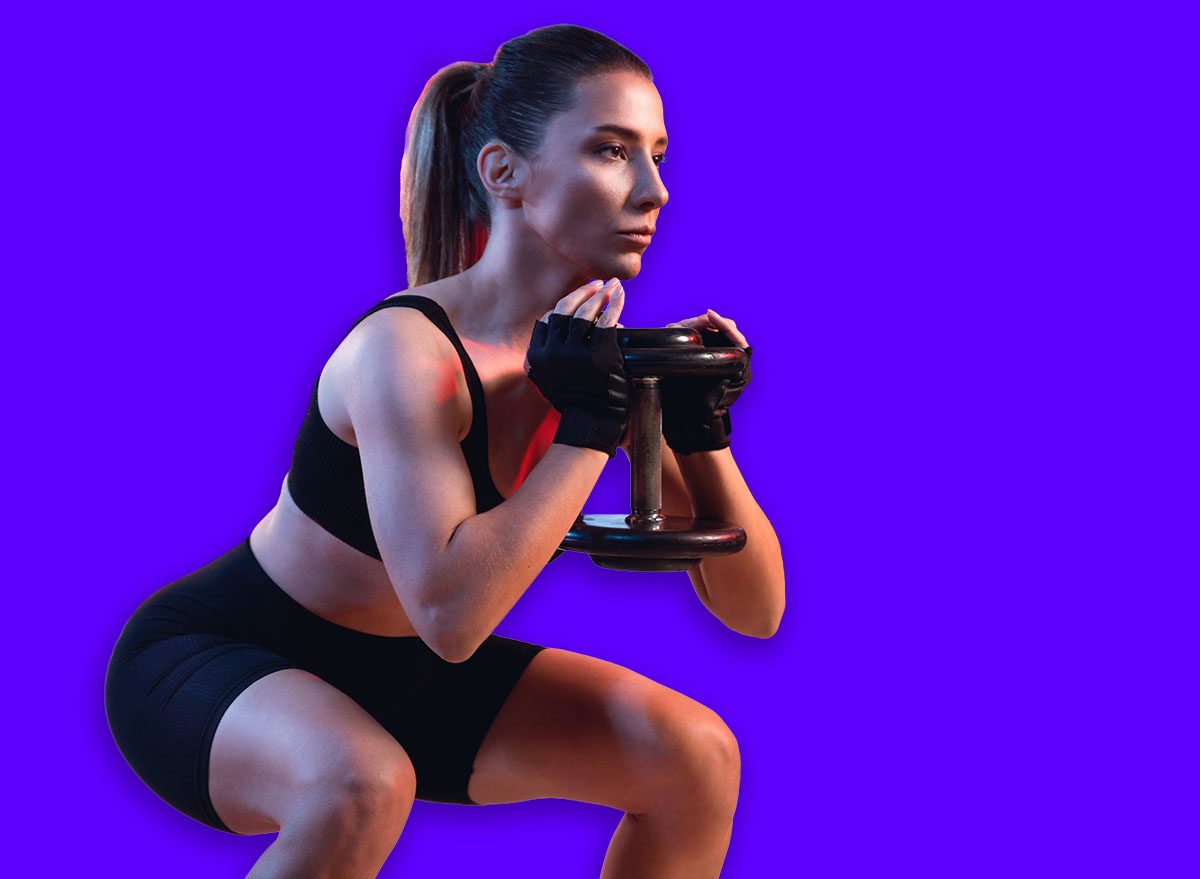
Goblet Squat
Goblet squats train your legs and glutes while your core works hard to keep your torso upright. Holding a dumbbell or kettlebell at your chest forces your abs to brace, keeping your ribs down and your body from folding forward. That makes the movement a strong stomach-flattening option because you’re training large muscles while keeping your midsection engaged the entire time. Compared with gym machines, goblet squats give your core a real job while your lower body builds strength.
Muscles Trained: Quadriceps, glutes, hamstrings, core.
How to Do It:
- Stand with your feet about shoulder-width apart.
- Hold a dumbbell or kettlebell at your chest.
- Brace your core and keep your chest lifted.
- Lower into a squat by bending your hips and knees.
- Drive through your feet to return to standing.
- Squeeze your glutes at the top.
Recommended Sets and Reps: Perform 3 sets of 8 to 12 reps. Rest for 60 seconds between each set.
Best Variations: Box goblet squats, pause goblet squats, tempo goblet squats.
Form Tip: Keep the weight close to your chest and stay tall through your torso.
Band Pallof Press
The band Pallof press trains your abs and obliques to resist rotation. As you press the band away from your chest, the tension tries to pull your torso sideways, and your core has to keep you square. That bracing makes the Pallof press one of the best standing core drills after 60 because it builds strength you can use when carrying groceries, reaching, turning, or walking with uneven loads. Move slowly and make your waist do the stabilizing instead of letting the band twist you around.
Muscles Trained: Core, obliques, shoulders, glutes.
How to Do It:
- Anchor a resistance band at chest height.
- Stand sideways to the anchor point with your feet shoulder-width apart.
- Hold the band at your chest with both hands.
- Brace your core and keep your torso facing forward.
- Press your hands straight out without rotating.
- Bring your hands back to your chest with control.
Recommended Sets and Reps: Perform 3 sets of 10 to 12 reps per side. Rest for 30 to 45 seconds between each set.
Best Variations: Pallof press holds, split stance Pallof presses, overhead Pallof presses.
Form Tip: Keep your ribs down and resist the band as it pulls you sideways.
Suitcase Carry
Suitcase carries train your abs and obliques by loading one side of your body at a time. The dumbbell or kettlebell tries to pull you toward the weight, and your core has to fight to keep your shoulders and hips level. That makes the carry a strong choice for flattening your stomach because your midsection braces under load while you walk. It also trains your grip, shoulders, glutes, and posture, giving you more total-body value than most seated ab machines.
Muscles Trained: Abs, obliques, grip, shoulders, glutes.
How to Do It:
- Hold a dumbbell or kettlebell in one hand.
- Stand tall with your shoulders level.
- Brace your core and keep your ribs down.
- Walk forward with controlled steps.
- Avoid leaning toward the weight.
- Switch hands and repeat on the other side.
Recommended Sets and Reps: Perform 3 carries of 30 to 45 seconds per side. Rest for 45 to 60 seconds between carries.
Best Variations: Lighter suitcase carries, heavier suitcase carries, suitcase marches.
Form Tip: Walk tall and keep your shoulders level throughout.
Dumbbell Squat to Press
Dumbbell squat to presses train your legs, glutes, shoulders, triceps, and core in one movement. Your lower body drives the squat, your upper body finishes the press, and your abs have to brace so your lower back doesn’t arch as the weights go overhead. That combination makes the exercise great for building lean muscle and increasing total-body effort, two factors that support a flatter stomach as body fat decreases. Use weights you can control and keep the rep smooth from the squat to the press.
Muscles Trained: Quadriceps, glutes, shoulders, triceps, core.
How to Do It:
- Stand with your feet shoulder-width apart and hold dumbbells at shoulder height.
- Brace your core and keep your chest lifted.
- Lower into a squat with control.
- Drive through your feet to stand tall.
- Press the dumbbells overhead as you finish standing.
- Lower the dumbbells back to shoulder height.
Recommended Sets and Reps: Perform 3 sets of 8 to 10 reps. Rest for 60 seconds between each set.
Best Variations: Single dumbbell squat to press, slower squat to press, squat to push press.
Form Tip: Keep your ribs down as the dumbbells move overhead.
Standing Band Woodchop
Standing band woodchops train your abs and obliques through rotation while your hips and shoulders move together. The band provides steady tension to your core as you pull it across your body, and your midsection has to control the path rather than letting your arms yank the band around. That makes woodchopping useful for stomach-focused training because it builds rotational strength in a standing position. Stronger rotation control helps with reaching, turning, lifting, and moving with more confidence.
Muscles Trained: Obliques, abs, shoulders, glutes.
How to Do It:
- Anchor a resistance band at shoulder height or slightly above.
- Stand sideways to the anchor point with your feet shoulder-width apart.
- Hold the band with both hands near one shoulder.
- Brace your core and pull the band diagonally across your body.
- Finish with your hands near the opposite hip.
- Return to the starting position with control and switch sides after your reps.
Recommended Sets and Reps: Perform 3 sets of 8 to 12 reps per side. Rest for 45 seconds between each set.
Best Variations: Low-to-high woodchops, high-to-low woodchops, shorter-range woodchops.
Form Tip: Rotate through your torso and hips together without twisting through your lower back.
How to Make Standing Ab Work Flatten Your Stomach After 60
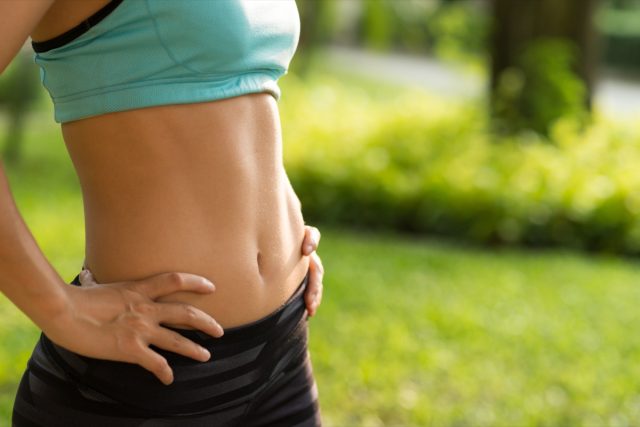
Standing ab exercises work best when they fit into a bigger body-composition plan. Your stomach flattens as overall body fat comes down, and that takes consistent movement, smart nutrition, and enough strength work to maintain lean muscle. These exercises help because they train your core while also engaging larger muscles.
- Use compound movements for more total work: Goblet squats and squat-to-presses engage your legs, glutes, shoulders, and core. More muscle involvement yields a stronger training effect than small, isolated ab moves.
- Train your core to brace and resist movement: Pallof presses and suitcase carries teach your midsection to stay strong under tension. That kind of core strength carries over into daily movement.
- Control your rotation: Woodchops work best when your abs guide the movement. Slow the reps down and avoid pulling with your arms.
- Keep the load challenging but clean: Dumbbells, kettlebells, and bands should make you work without pulling you out of position. If your posture breaks, lighten the load.
- Pair strength training with daily activity: Walking, stairs, cycling, and regular movement help burn the calories needed for fat loss. Strength builds the muscle, and movement helps the stomach-flattening process along.
A flatter stomach after 60 doesn’t come from chasing one perfect machine. Build your routine around loaded carries, smart core drills, and full-body strength moves that make your abs work while the rest of your body joins in.
References
- Palmer AK, Jensen MD. Metabolic changes in aging humans: current evidence and therapeutic strategies. J Clin Invest. 2022 Aug 15;132(16):e158451. doi: 10.1172/JCI158451. PMID: 35968789; PMCID: PMC9374375.
- Oliva-Lozano JM, Muyor JM. Core Muscle Activity During Physical Fitness Exercises: A Systematic Review. Int J Environ Res Public Health. 2020 Jun 16;17(12):4306. doi: 10.3390/ijerph17124306. PMID: 32560185; PMCID: PMC7345922.