5 Bed Exercises That Restore Glute Strength Faster Than Gym Machines After 60
Strong glutes make daily movement feel better. They help power your walk, support your hips, make stairs feel smoother, and provide more support to your lower back during everyday tasks. After 60, giving your glutes focused attention can make a real difference in how steady, strong, and capable your lower body feels.
Gym machines can be useful, especially when you want to add load or target a specific muscle. Bed exercises offer a different advantage: they’re simple, comfortable, and easy to repeat. You can slow down, focus on the right muscles, and build better hip strength without needing a full workout setup. That makes them a smart option in the morning, before bed, or anytime you want a quick strength reset.
In coaching, I like exercises that help people feel the target muscle right away. Glute work should feel purposeful, controlled, and connected. These bed-based moves provide a supported way to train hip extension, outer-hip strength, and single-leg control while keeping the routine approachable. The goal is to build stronger glutes that support walking, standing, balance, and everyday confidence.
Think of this routine as a simple hip strength builder you can do almost anywhere. Clam shells and banded hip abductions target the outer glutes, banded bridges and frog bridges build strong hip extension, and single-leg bridges challenge each side on its own. The setup stays simple, but the work still delivers when you slow down and squeeze with intent.
Side Lying Clam Shell
Side-lying clam shells train the outer glutes and deep hip stabilizers, which help keep your knees, hips, and pelvis aligned when you walk or climb stairs. The movement looks small, but the payoff comes from keeping your pelvis still while your top knee opens. Gym machines can train hip abduction, but clam shells make you control the hip without letting the rest of your body roll around. Stronger outer glutes can help your lower body feel steadier and make daily movement feel more supported.
Muscles Trained: Outer glutes, hip stabilizers, core
How to Do It:
- Lie on your side with your knees bent and your legs stacked.
- Keep your feet together and your hips facing forward.
- Brace your core lightly to keep your pelvis steady.
- Lift your top knee without rolling your hips backward.
- Pause briefly at the top of the movement.
- Lower your knee with control and complete all reps before switching sides.
Recommended Sets and Reps: Perform 3 sets of 12 to 15 reps per side. Rest for 30 seconds between each set.
Best Variations: Mini band clam shells, paused clam shells, slower tempo clam shells
Form Tip: Move from your hip and keep your pelvis quiet.
Banded Glute Bridges
Banded glute bridges train your glutes, hamstrings, and outer hips while your core keeps your pelvis steady. The band encourages your knees to stay slightly pressed outward, which helps draw your glutes into the movement rather than letting your knees drift inward. Pressing through your heels and squeezing at the top builds the hip extension strength you need for walking, stairs, and standing up. Compared with a machine, this exercise gives you a cleaner way to feel your glutes finish each rep.
Muscles Trained: Glutes, hamstrings, outer hips, core
How to Do It:
- Place a mini band around your thighs just above your knees.
- Lie on your back with your knees bent and your feet flat on the bed.
- Press your knees slightly outward to create tension in the band.
- Brace your core and drive through your heels.
- Lift your hips and squeeze your glutes at the top.
- Lower your hips with control.
Recommended Sets and Reps: Perform 3 sets of 12 to 15 reps. Rest for 45 seconds between each set.
Best Variations: Paused banded bridges, slower banded bridges, feet elevated banded bridges
Form Tip: Keep tension on the band and finish the rep with your glutes, not your lower back.
Single Leg Glute Bridge
Single-leg glute bridges train one glute at a time while your core works to keep your hips level. Training each side separately helps expose strength gaps that two-leg bridges can hide. Your working leg has to drive the lift, hold the position, and control the lowering phase without help from the other side. That makes this exercise especially useful after 60 because stronger single-side hip strength carries into walking, stairs, balance, and standing from lower positions.
Muscles Trained: Glutes, hamstrings, core
How to Do It:
- Lie on your back with one knee bent and one foot flat on the bed.
- Extend your opposite leg or keep it bent over your hip.
- Brace your core and press through your planted heel.
- Lift your hips until your body forms a straight line from your shoulders to your knees.
- Squeeze your glute at the top.
- Lower with control and switch sides after your reps.
Recommended Sets and Reps: Perform 3 sets of 8 to 10 reps per side. Rest for 45 seconds between each set.
Best Variations: Single-leg bridge holds, two-leg glute bridges, and elevated single-leg bridges
Form Tip: Keep your hips level and avoid twisting as you lift.
Banded Hip Abductions
Banded hip abductions train the outer glutes by making your hips press outward against resistance. Those outer hip muscles help control your pelvis, support your knees, and keep your lower body steadier when you walk or shift your weight. The band adds a clear strength challenge without requiring a machine or heavy load. Move slowly enough to feel the outer glutes working, and avoid letting the band snap your legs back together.
Muscles Trained: Outer glutes, hip stabilizers, core
How to Do It:
- Place a mini band around your thighs just above your knees.
- Lie on your back with your knees bent and your feet flat on the bed.
- Brace your core and keep your feet planted.
- Press your knees outward against the band.
- Pause briefly when you feel your outer glutes working.
- Bring your knees back in with control.
Recommended Sets and Reps: Perform 3 sets of 12 to 20 reps. Rest for 30 seconds between each set.
Best Variations: Paused abductions, pulsing abductions, single-leg abductions
Form Tip: Keep your feet planted and move from your hips instead of your ankles.
Frog Glute Bridge
Frog glute bridges train your glutes from a different angle by placing the soles of your feet together and letting your knees open. This position reduces hamstring involvement and places greater emphasis on the glute squeeze at the top. It’s a strong finisher for restoring glute strength because you can focus on a short, controlled range and a hard contraction. Stronger glutes help support your hips, posture, lower back, and daily movements like standing, walking, and climbing stairs.
Muscles Trained: Glutes, outer hips, core
How to Do It:
- Lie on your back with your knees bent.
- Bring the soles of your feet together and let your knees open.
- Keep your feet close enough that your position feels comfortable.
- Brace your core and press the edges of your feet together.
- Lift your hips and squeeze your glutes at the top.
- Lower your hips with control.
Recommended Sets and Reps: Perform 3 sets of 12 to 15 reps. Rest for 45 seconds between each set.
Best Variations: Paused frog bridges, slow tempo frog bridges, frog bridge pulses
Form Tip: Keep the movement small and squeeze your glutes hard at the top.
How to Make Bed Glute Work Count After 60
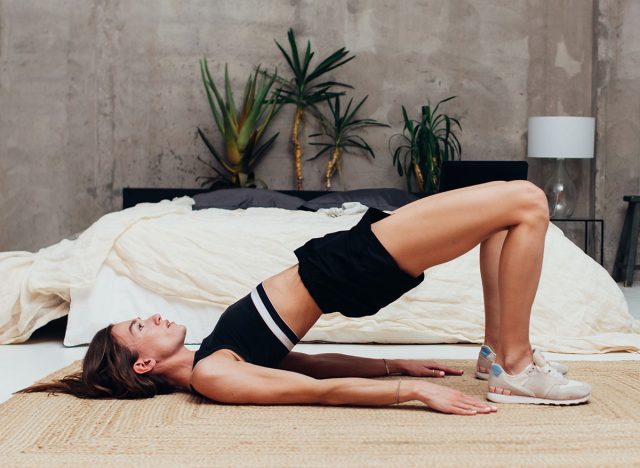
Bed exercises work best when you treat them as real strength work rather than casual stretching. The surface may feel comfortable, but your glutes still need tension, control, and enough effort to respond. Slow the reps down, pause where the muscle works hardest, and pay attention to whether your glutes or lower back are doing most of the work.
- Squeeze with intent: Glute bridges, frog bridges, and single-leg bridges work better when you pause at the top. That small hold helps your glutes stay under tension longer.
- Keep your pelvis steady: Clam shells, abductions, and single-leg bridges lose value when your hips roll or twist. Brace lightly and keep your movement clean.
- Train the outer glutes: Clam shells and banded abductions strengthen the muscles that help control your hips and knees. Those muscles matter for balance, walking, and lower body stability.
- Use the band well: A mini band should create steady resistance, not sloppy movement. Press out with control, and return slowly so the glutes keep working in both directions.
- Progress without rushing: Add reps, longer pauses, a stronger band, or slower tempo once the exercises feel easy. Small changes keep your glutes improving without making the routine feel like a chore.
A few focused minutes on the bed can give your glutes the direct work they’ve been missing. Build strength through clean reps, steady tension, and strong pauses, and your hips will have more support when your feet hit the floor.
References
- Inacio, Mario et al. “Gluteal muscle composition differentiates fallers from non-fallers in community dwelling older adults.” BMC geriatrics vol. 14 37. 25 Mar. 2014, doi:10.1186/1471-2318-14-37
- Maccarone, Maria Chiara et al. “Effects of the Full-Body in-Bed Gym program on quality of life, pain and risk of sarcopenia in elderly sedentary individuals: preliminary positive results of a Padua prospective observational study.” European journal of translational myology vol. 33,3 11780. 26 Sep. 2023, doi:10.4081/ejtm.2023.11780