5 Bed Exercises That Restore Hip Strength Faster Than Gym Workouts After 60

When you think of gaining strength, what likely comes to mind is lifting heavy weights or doing bodybuilding exercises like bench press and squats. But one of the most underrated aspects of staying fit and active as you age is hip strength. Walking, climbing stairs, getting out of a chair, maintaining balance, and even standing upright all depend heavily on strong, stable hips. But as muscle mass naturally declines with age (a condition called sarcopenia), your hips can weaken faster than you might realize.
This decline can create a negative chain reaction throughout your body. Weak hip muscles may contribute to instability, reduced walking speed, poor posture, knee discomfort, and increased fall risk. Research published in PLOS One has found that lower body weakness, especially around your hips, is strongly associated with reduced mobility and functional decline in older adults.
Fortunately, you can restore hip strength at any age. How? Bed exercises. These movements reduce pressure on your joints while allowing targeted activation of your hip stabilizers, glutes, and surrounding muscles. Studies show that low-impact resistance exercises can improve muscular strength, balance, and mobility in older adults without straining your joints.
But with all the conflicting information online, knowing where to start can feel daunting. That’s why we chatted with James Brady, CPT, a certified personal trainer at OriGym, who shares five stellar bed exercises designed to rebuild hip strength after 60. Read on for the exercises and detailed how-tos. Then, when you’re done, be sure to check out 4 Morning Exercises That Restore Arm Strength Faster Than Weight Training After 55.
Glute Bridges
“Glute bridges are one of the best bed exercises for restoring hip strength because they target the glutes and hip stabilizers without placing stress on the joints,” explains Brady. Strong glutes are critical for maintaining walking power and pelvic stability as you age.
How to do it:
- Lie on your back with your knees bent and your feet flat on the bed.
- Position your feet hip-width apart.
- Rest your arms comfortably at your sides.
- Engage your core before beginning the movement.
- Press through your heels to lift your hips upward.
- Raise your hips until your body forms a straight line from shoulders to knees.
- Squeeze your glutes for one to two seconds at the top.
- Lower your hips back down slowly with control.
- Aim for two to three sets of 12 to 15 reps. Rest for 45 to 60 seconds between sets.
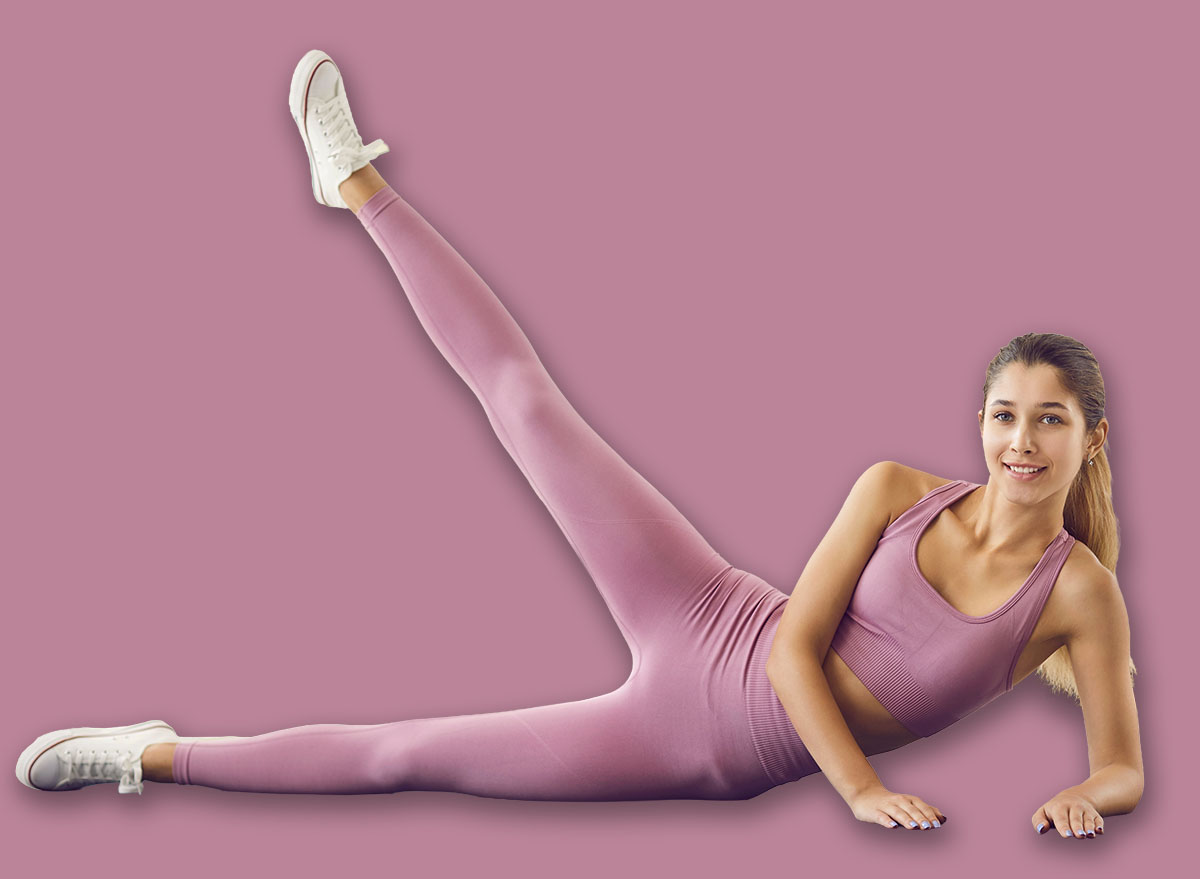
Side-Lying Leg Raises
Side-lying leg raises target the hip abductors, which are responsible for stabilizing the pelvis during walking and standing. Weak abductors have been linked to poor balance and instability. “Side-lying leg raises strengthen the hip abductors, which are essential for balance, walking stability, and reducing fall risk as we age,” says Brady.
How to do it:
- Lie on one side with your legs stacked on top of each other.
- Rest your head comfortably on your lower arm or a pillow.
- Keep your top leg straight and your hips stacked vertically.
- Brace your core to stabilize your body.
- Slowly lift your top leg upward (avoid rolling your hips backward).
- Raise your leg as high as comfortable with control.
- Lower your leg back down slowly.
- Perform two to three sets of 12 to 15 reps per leg, resting for 45 to 60 seconds between sets.
Clamshells
“Clamshells are highly effective for activating the smaller stabilizing muscles around the hips,” says Brady. These muscles are essential for maintaining proper hip alignment during movement.
How to do it:
- Lie on your side with your knees bent and your feet together.
- Stack your hips and your shoulders vertically.
- Rest your head comfortably on your arm or a pillow.
- Keep your feet touching throughout the movement.
- Slowly lift your top knee upward like opening a clamshell (avoid rotating your hips backward).
- Pause for one to two seconds at the top of the movement.
- Lower your knee back down slowly with control.
- Complete two to three sets of 10 to 15 reps per side. Rest for 45 to 60 seconds between sets.
Straight Leg Raises
“Straight leg raises help improve hip flexor and quad strength, both of which are important for walking, climbing stairs, and maintaining mobility,” explains Brady. These muscles are heavily involved in walking, stair climbing, and standing movements.
How to do it:
- Lie flat on your back on the bed.
- Bend one knee while keeping your other leg straight.
- Engage your core and keep your lower back stable.
- Slowly raise your straight leg upward.
- Lift your leg until it reaches the height of your opposite knee.
- Pause for one to two seconds at the top of the movement.
- Lower your leg back down slowly with control.
- Keep the movement smooth and steady throughout.
- Perform two to three sets of 10 to 12 reps per leg, resting for 45 to 60 seconds between sets.
Hip Marches
The alternating movement pattern involved with this exercise mimics walking mechanics while strengthening your hips and core. “Hip marches are a simple but effective exercise for restoring hip mobility and strength,” says Brady.
How to do it:
- Lie on your back with your knees bent and your feet flat on the bed.
- Position your feet hip-width apart.
- Engage your core gently before beginning.
- Slowly lift one knee toward your chest.
- Keep your pelvis stable throughout the movement.
- Lower the foot back down with control.
- Repeat with the opposite leg.
- Continue alternating sides in a smooth rhythm.
- Perform two to three sets of 15 to 20 reps per leg. Rest for 45 to 60 seconds between sets.