5 Simple Moves That Trim Waist Fat Faster Than Hour-Long Workouts After 60

If you’ve reached your 60s and noticed that your midsection seems to have a mind of its own, you aren’t alone. For many of us, the weight that used to respond to a few extra laps on the track or an hour in the gym now feels stubbornly “locked in.” You might find yourself working out harder and longer than ever, only to see the scale stay still—or worse, feel more exhausted and stiffer than when you started.
Here is the truth: After 60, your body doesn’t need more movement, it needs smarter movement.
The traditional “hour-long slog” often backfires at this age by spiking cortisol—the stress hormone that actually signals your body to store fat around your internal organs. To trim the waist, we need to stop fighting against our biology and start working with it. By focusing on “consistency of degree”—small, high-impact movements performed with precision—you can spark your metabolism and firm your core in less time than it takes to brew a pot of coffee.
Why Losing Waist Fat is Different After 60
Losing abdominal fat becomes more complex as we cross the 60-year mark due to a “perfect storm” of biological shifts:
- Hormonal Redistribution: As estrogen and testosterone levels continue to decline, the body naturally shifts its fat-storage preference from the hips and limbs to the visceral area (around the internal organs).
- The Cortisol Trap: People over 60 are often more sensitive to the stress hormone cortisol. High-stress, high-intensity workouts can actually spike cortisol, signaling the body to protect and store belly fat as a survival mechanism.
- Declining Insulin Sensitivity: Our cells become less efficient at processing glucose as we age. This often leads to more “sugar” being stored as fat in the midsection rather than being used for energy.
Why “Short and Simple” Beats the Gym

You might think an hour of cardio is the gold standard, but for the over-60 demographic, short, focused movements are often superior for three reasons:
- Lower Cortisol Response: A 10-minute session provides a metabolic “spark” without the massive stress spike of an hour-long slog.
- Higher Consistency: It is easier to maintain a “consistency of degree” with 10 minutes a day than 60 minutes twice a week.
- The “Afterburn” Effect: Functional moves engage multiple muscle groups simultaneously, keeping your metabolic rate elevated long after you’ve finished.
The 5 Simple Moves to Trim Your Waist
While we cannot “spot-reduce” fat (the body loses fat systemically), these moves build the underlying muscle structure that cinches the waist and improves posture, making the midsection appear leaner.
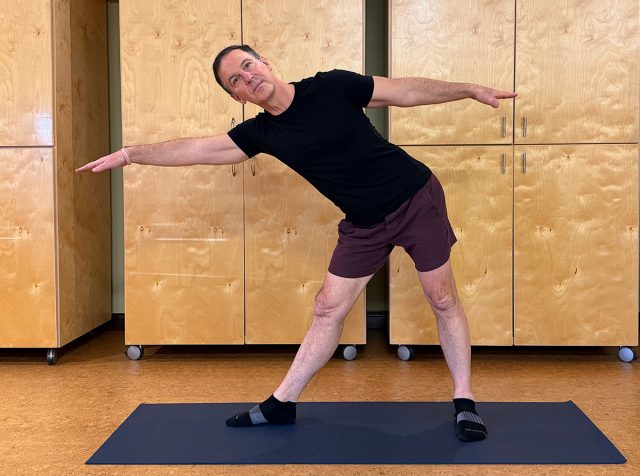
The Standing Windmill
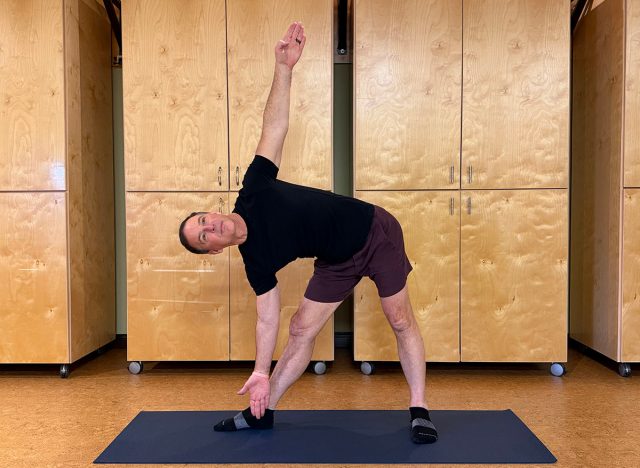
Why it targets waist fat: This move targets the obliques (your side-waist muscles) and the transverse abdominis, the deepest layer of abdominal muscle that wraps around your waist. By hinging and reaching, you’re forcing your core to stabilize your spine against gravity, creating a natural “cinching” effect.
- Step-by-Step: Stand with feet wider than shoulder-width. Point your right toes out (90 degrees). Extend arms out like a “T.” Hinge your hips toward the left as you lower your right hand toward your right shin. Reach your left arm straight up toward the ceiling. Squeeze your core to pull back to center.
- Common Mistakes: Rounding your back or rotating toward the leg. Imagine standing between two narrow panes of glass; you can only move side-to-side.
- Easier Modifications: Keep the opposite foot pointed forward, or both feet forward. Only reach down as far as your mid-thigh. Use a chair in front of you for balance.
Standing Cross-Body Knee-to-Elbow
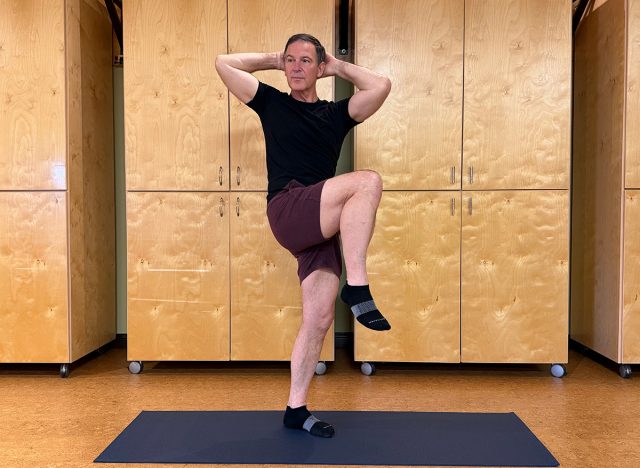
Why it targets waist fat: This is a “functional crunch.” It engages the deep abdominal wall and the “six-pack” muscles through rotation, burning more energy than a traditional floor crunch.
- Step-by-Step: Stand with feet hip-width apart, fingertips behind your ears. Lift your right knee toward your chest while rotating your torso so your left elbow moves toward that knee. Exhale as you “crunch,” then return to tall standing.
- Common Mistakes: Yanking on your neck. The movement should come from your ribcage rotating, not your arms pulling your head.
- Easier Modification: Perform this while seated on the edge of a firm chair.
The Standing Woodchopper
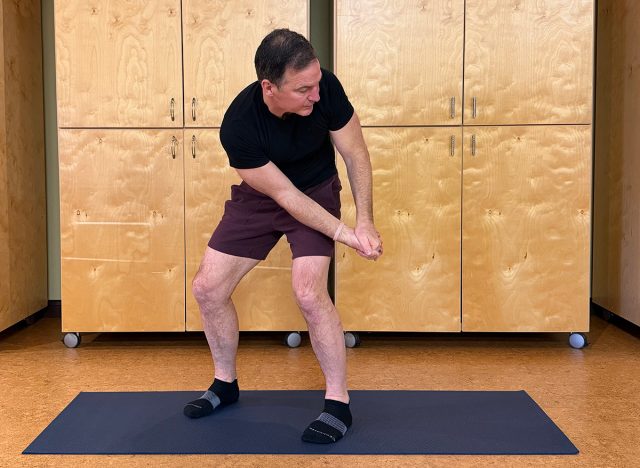
Why it targets waist fat: This mimics real-life actions like gardening. It uses a diagonal “slashing” motion that forces the entire waist to rotate and stabilize, targeting the “love handle” area.
- Step-by-Step: Clasp your hands together. Reach up and over your left shoulder. In one controlled “chopping” motion, bring your hands diagonally down across your body toward your right hip, bending your knees slightly.
- Common Mistakes: Moving only the arms. Ensure your torso and belly button turn along with your hands.
- Easier Modification: Keep the “chop” smaller, moving only from chest height to waist height.
Wall-Supported Side Lean
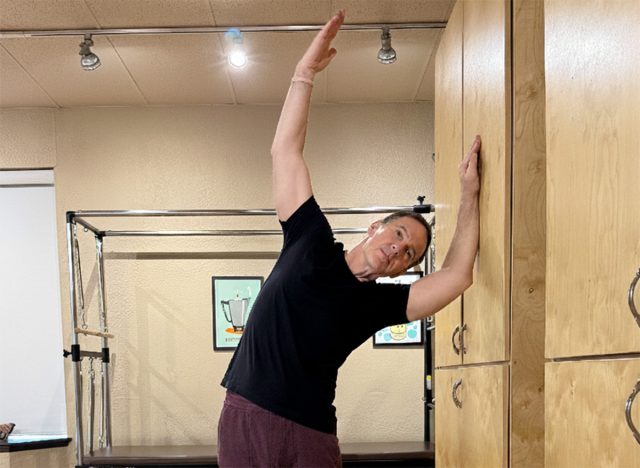
Why it targets waist fat: This isolates the obliques better than almost any other standing move, helping to firm the “side-seams” of your torso.
- Step-by-Step: Stand sideways 12 inches from a wall. Place the forearm closest to the wall against it for support. Reach your outside arm up and over your head toward the wall, creating a “C” curve. Use your waist muscles to “pull” yourself back to upright.
- Common Mistakes: Leaning forward toward the floor. Keep your shoulders stacked directly over your hips.
- Easier Modification: Stand closer to the wall or keep your top hand on your hip.
The “Boxer” Reach
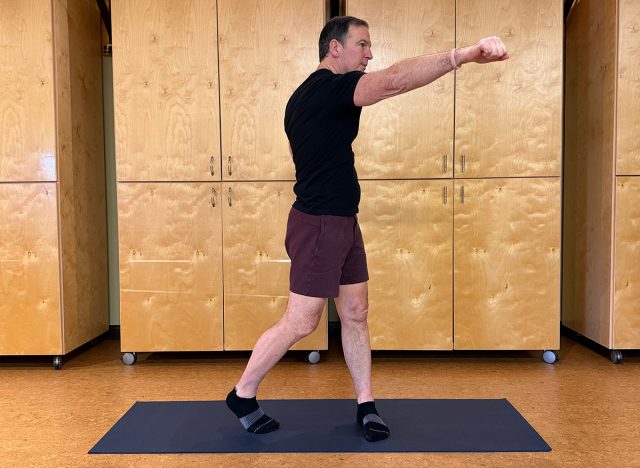
Why it targets waist fat: This creates “tension under rotation,” engaging the muscles along your ribs and obliques. It’s a low-impact way to keep the heart rate up.
- Step-by-Step: Stand with feet shoulder-width apart and knees soft. Reach your right hand across your body as if reaching for a high shelf to your left. Pivot on your right foot and exhale, squeezing your abs tight.
- Common Mistakes: “Floppy” arms. Each reach should be crisp and intentional.
- Easier Modification: Perform seated in a chair, focusing on the torso rotation.
RELATED: The 6-Minute Chair Routine That Rebuilds Core Strength Better Than Planks After 60
Safety & Scheduling

Should you check with a doctor? Yes. Before starting any new routine after 60, a quick check-in with your physician is recommended, especially if you have a history of back issues or osteoporosis.
Warning Signs to Watch For:
Stop immediately if you experience pain in the spine, sudden dizziness, or chest pressure.
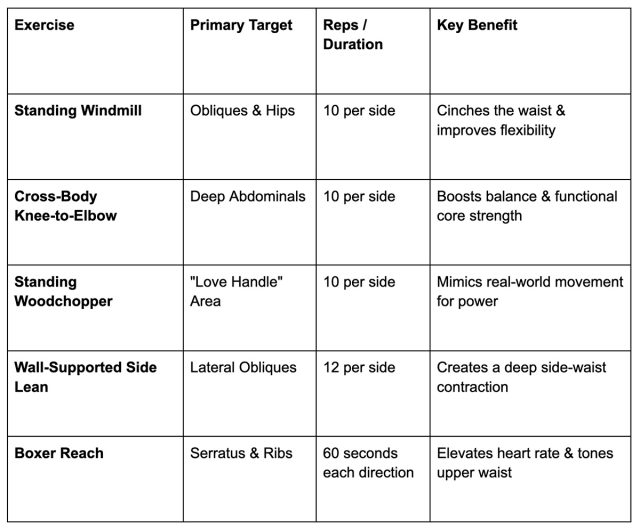
The “Waist-Trimmer” Quick Reference Table
The 8-Week “Consistency of Degree” Schedule
- Weeks 1–2: 3 days per week. Focus on form. Perform 1 round of all five moves.
- Weeks 3–4: 4 days per week. Increase range of motion. Perform 2 rounds of all five moves.
- Weeks 5–8: 5 days per week. The routine is now a habit. Perform 2–3 rounds of all five moves.
Realistic Results in 6–8 Weeks

Consistent effort over two months typically yields:
- Improved “Tightness”: Your waist may feel “firmer” as the underlying muscle tone improves.
- Better Posture: Standing taller instantly makes the stomach look flatter.
- Clothing Fit: Many find their waistbands feel less restrictive as visceral fat begins to mobilize.
Eat This: 3 Power Foods That Fight Cortisol and Bloat

To support your results, add these three items to your plate to help lower stress hormones and flatten the midsection.
- Pumpkin Seeds: High in Magnesium, which acts as a natural “chill pill” for your nervous system to regulate cortisol.
- Avocado: High in Potassium, which helps your body flush out the excess sodium that causes “puffiness” and bloating.
- Wild-Caught Salmon: High in Omega-3s and lean protein to fight inflammation and prevent age-related muscle loss.
Conclusion: Consistency Over Intensity

It is a common misconception that reclaiming your health after 60 requires a total identity shift. In reality, the most transformative results come from the smallest, most consistent degrees of effort. By dedicating just 10 to 15 minutes to these functional moves, you are teaching your body to remain stable, capable, and lean.
While you can’t “spot-reduce” fat, these moves build the structural corset of muscle that keeps your waist tight. Don’t wait for a “perfect” time to start. Commit to just one of these moves tomorrow morning. Within 8 weeks, you won’t just see a difference in how your clothes fit—you’ll feel a difference in how you move through the world.
References & Sources
On Cortisol & Abdominal Fat: Epel, E. S., et al. (2000). “Stress and Body Shape: The Role of Cortisol in Abdominal Fat Deposition.” Psychosomatic Medicine. (Supports the “short workout” vs. “high stress” hour-long workout theory).
On Sarcopenia & Metabolism: Volpi, E., et al. (2004). “Muscle tissue changes with aging.” Current Opinion in Clinical Nutrition & Metabolic Care. (Supports the need for functional muscle maintenance over 60).
On Visceral Fat Redistribution: Lovejoy, J. C., et al. (2008). “Influence of age, race and body composition on 24-hour cortisol secretion.” The Journal of Clinical Endocrinology & Metabolism. (Supports the hormonal shift discussion).