5 Morning Exercises That Restore Bone Strength Faster Than Gym Machines After 60
Bone strength responds well to movement that makes your body work against gravity. Your bones adapt when muscles pull on them, when your feet meet the floor, and when your body has to support a load through real positions. After 60, that kind of training matters because stronger bones help support balance, posture, walking confidence, and everyday strength.
Gym machines can build muscle, but many of them keep you seated or supported. Morning exercises give you a chance to load your legs, hips, arms, shoulders, spine, and core in a more natural way. Weight-bearing movement, light impact, loaded carries, squats, and step-ups all send a useful signal to your bones while also training the muscles that protect your joints.
A lot of people think bone-focused training has to feel intimidating. I’d coach it the opposite way. Start with movements you can repeat well, use a range that feels strong, and gradually add load, reps, or time as your body adapts. A few focused minutes in the morning can help you build consistency, and consistency is a huge part of keeping bones and muscles strong.
This routine blends lower-body strength, gentle impact, loaded walking, and upper-body support work. Each exercise helps build the kind of strength that carries into stairs, walking, standing, reaching, carrying, and staying active with more confidence.
Low Box Step-Ups
Low box step-ups train your quads, glutes, calves, hips, and core while giving your bones a weight-bearing strength signal. Each rep asks one leg to drive your body upward, which loads the hips, knees, ankles, and feet in a practical way. Step-ups work well in the morning because they wake up your legs without needing a complicated setup. Use a low step at first and make every rep smooth.
Muscles Trained: Quadriceps, glutes, hamstrings, calves, core.
How to Do It:
- Stand facing a low box, step, or sturdy stair.
- Place your whole foot on the step.
- Brace your core and keep your chest lifted.
- Press through your lead foot to stand tall.
- Step back down with control.
- Complete all reps, then switch sides.
Recommended Sets and Reps: Perform 3 sets of 8 to 10 reps per leg. Rest for 45 seconds between each set.
Best Variations: Assisted step-ups, slower step-downs, slightly higher step-ups.
Form Tip: Drive through your whole foot and keep your knee tracking with your toes.
Goblet Squats
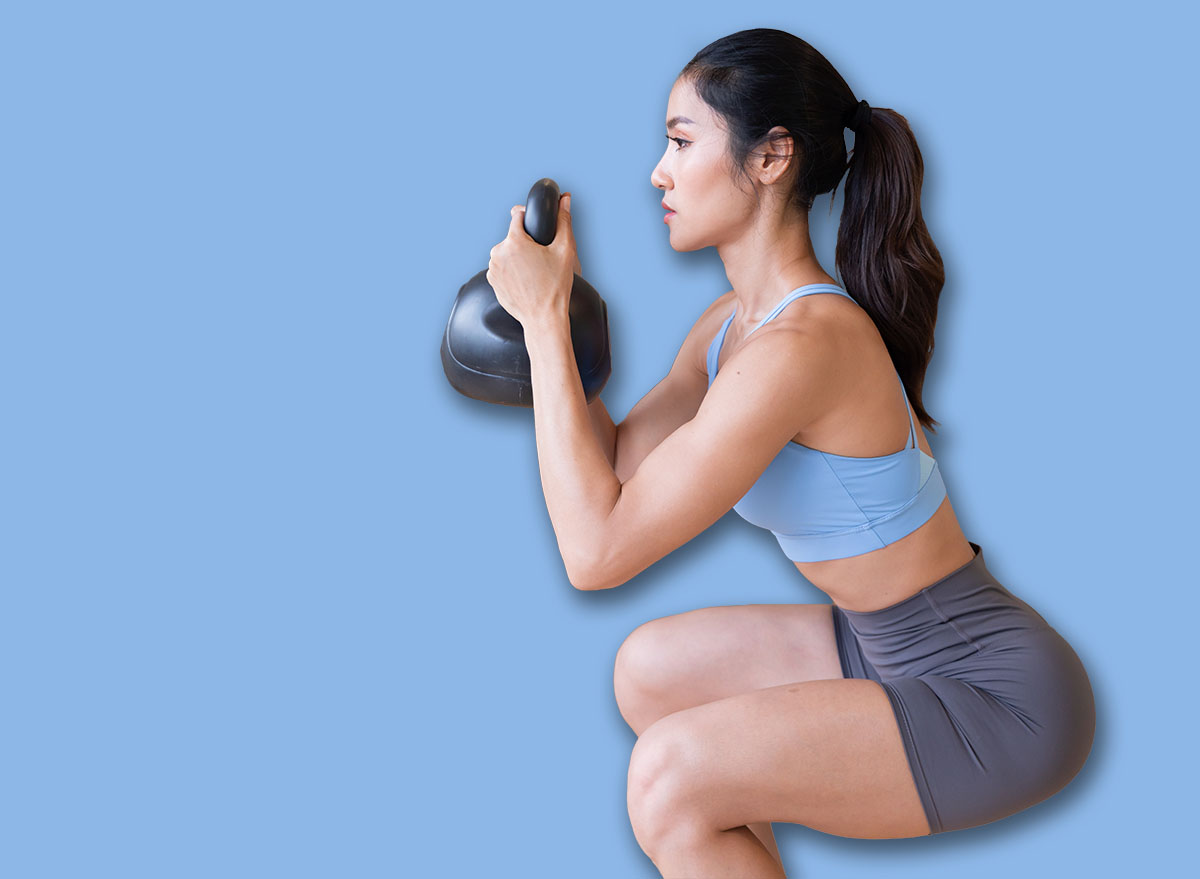
Goblet squats train your legs, hips, core, and upper back while loading your body from a standing position. Holding a dumbbell or kettlebell at your chest adds resistance through your spine, hips, and legs, which makes the movement more effective for bone strength than a seated machine. The squat pattern also supports daily movements like getting out of a chair, climbing stairs, and picking things up. Keep the weight manageable and focus on clean depth.
Muscles Trained: Quadriceps, glutes, hamstrings, core, upper back.
How to Do It:
- Stand with your feet about shoulder-width apart.
- Hold a dumbbell or kettlebell at your chest.
- Brace your core and keep your chest lifted.
- Lower into a squat by bending your hips and knees.
- Drive through your feet to return to standing.
- Squeeze your glutes at the top.
Recommended Sets and Reps: Perform 3 sets of 8 to 12 reps. Rest for 60 seconds between each set.
Best Variations: Bodyweight squats, box goblet squats, pause goblet squats.
Form Tip: Keep the weight close to your chest and press through your whole foot.
Farmer Carry
Farmer carries train your grip, shoulders, upper back, core, hips, and legs while loading your body in a way that feels incredibly practical. Holding weights while walking challenges your posture and gives your bones a steady weight-bearing stimulus. The core has to brace, your feet and ankles have to stay active, and your upper body has to hold a strong position. This makes carrying one of the simplest ways to train strength that feels useful outside the gym.
Muscles Trained: Core, grip, shoulders, upper back, glutes, legs.
How to Do It:
- Hold a dumbbell or kettlebell in each hand.
- Stand tall with your shoulders down and back.
- Brace your core before you start walking.
- Walk forward with controlled steps.
- Keep your chest lifted and your posture strong.
- Set the weights down with control when the carry ends.
Recommended Sets and Reps: Perform 3 carries of 30 to 45 seconds. Rest for 60 seconds between each carry.
Best Variations: Lighter farmer carries, heavier farmer carries, suitcase carries.
Form Tip: Walk tall and keep your ribs stacked over your hips.
Heel Drops to Calf Raise
Heel drops to calf raises train your calves, ankles, feet, and lower legs while adding a small, controlled impact element. A gentle impact can help bones adapt when it fits your body and feels comfortable. The calf raise builds strength through the lower leg, while the controlled heel drop gives your feet, ankles, and bones a little extra loading. Start light, use a wall or chair for support, and keep the rhythm steady.
Muscles Trained: Calves, ankles, foot stabilizers, core.
How to Do It:
- Stand tall near a wall, counter, or sturdy chair.
- Place your hands lightly on the support.
- Rise onto the balls of your feet.
- Pause briefly at the top.
- Lower your heels with control.
- Add a gentle heel drop if the movement feels comfortable.
Recommended Sets and Reps: Perform 3 sets of 10 to 15 reps. Rest for 30 to 45 seconds between each set.
Best Variations: Seated heel raises, standing calf raises, paused calf raises.
Form Tip: Lift through your big toes and keep your ankles steady.
Incline Push-Ups
Incline push-ups train your chest, shoulders, triceps, and core while loading your upper body through your hands and arms. Bone strength is often discussed in terms of the hips and legs, but your wrists, arms, shoulders, and upper body need attention too. The incline makes the push-up more approachable while still giving your upper body a solid strength signal. Use a counter, bench, or sturdy surface and focus on smooth reps.
Muscles Trained: Chest, shoulders, triceps, core.
How to Do It:
- Place your hands on a counter, bench, or sturdy elevated surface.
- Step your feet back until your body forms a straight line.
- Brace your core and keep your hips level.
- Lower your chest toward the surface with control.
- Press through your hands to return to the starting position.
- Repeat with steady, clean reps.
Recommended Sets and Reps: Perform 3 sets of 8 to 12 reps. Rest for 45 to 60 seconds between each set.
Best Variations: Wall push-ups, counter push-ups, lower incline push-ups.
Form Tip: Keep your elbows angled slightly back and press through your whole hand.
How Morning Exercise Supports Bone Strength After 60
Bone-strength training works best when your body gets regular, repeatable loading. You want exercises that make your muscles pull, your legs support your body, your core brace, and your posture stay strong. Morning sessions are useful because they create an easy routine you can build into the day before distractions take over.
- Prioritize weight-bearing moves: Step-ups, squats, carries, and calf raises train your body against gravity. This type of loading gives your bones and muscles a useful reason to stay strong.
- Add resistance gradually: Dumbbells, kettlebells, or a heavier carry can increase the challenge over time. Small progressions help your body adapt while keeping the routine approachable.
- Train the upper and lower body: Bone strength matters through the hips, legs, spine, arms, and shoulders. Pairing carries and push-ups with lower-body work gives the routine a more complete effect.
- Use controlled impact when appropriate: Heel drops can add a gentle loading signal through the feet, ankles, and lower legs. Keep the movement light, smooth, and comfortable.
- Repeat the routine consistently: A few short morning sessions each week can build momentum. Stronger bones and muscles respond best to steady practice over time.
Strong bones need regular reminders to stay strong. Start the morning with loaded movement, controlled reps, and a routine you can repeat, and you’ll give your body a stronger foundation for walking, lifting, balancing, and moving well after 60.
References
- Benedetti MG, Furlini G, Zati A, Letizia Mauro G. The Effectiveness of Physical Exercise on Bone Density in Osteoporotic Patients. Biomed Res Int. 2018 Dec 23;2018:4840531. doi: 10.1155/2018/4840531. PMID: 30671455; PMCID: PMC6323511.
- Carter MI, Hinton PS. Physical activity and bone health. Mo Med. 2014 Jan-Feb;111(1):59-64. PMID: 24645301; PMCID: PMC6179512.